 Add to Chrome
 Add to Firefox
 Add to Edge
What Is Missing in Surgical Risk Stratification and Outcome Prediction: A Scoping Review of End-to-End Machine Learning Approaches
Jul 31, 2026
Postoperative adverse events, including mortality and morbidity, remain a major global burden, many of which are preventable through early identification of high-risk patients and targeted perioperative care. Accurate risk stratification is therefore essential. With the growing availability of large-scale electronic health records (EHRs), machine learning (ML) provides a data-driven approach to model complex clinical patterns. However, existing studies vary widely in design, and methodological practices remain fragmented. This scoping review characterizes ML pipelines for surgical risk stratification and outcome prediction using EHR data. We reviewed 190 studies covering the ML workflow, including data preprocessing, algorithm selection, model evaluation, and explainability. Most studies relied on single-center private datasets with limited data modalities, while the scarcity of open-access surgical datasets constrained reproducibility and generalizability. Reporting of key preprocessing steps, including missing data handling, feature selection, and class imbalance, was often incomplete. Conventional ML models and simple neural networks predominated, whereas deep learning and multimodal approaches remained uncommon. Benchmark datasets and standardized evaluation protocols were largely absent, hindering cross-study comparisons. Only about one-third of studies incorporated explainability methods. This review identifies methodological gaps limiting clinically robust postoperative ML tools and provides a structured reference to support more rigorous, reproducible, and clinically meaningful ML development for perioperative care.

Language Modeling on Tabular Data: A Survey of Foundations, Techniques and Evolution
Aug 20, 2024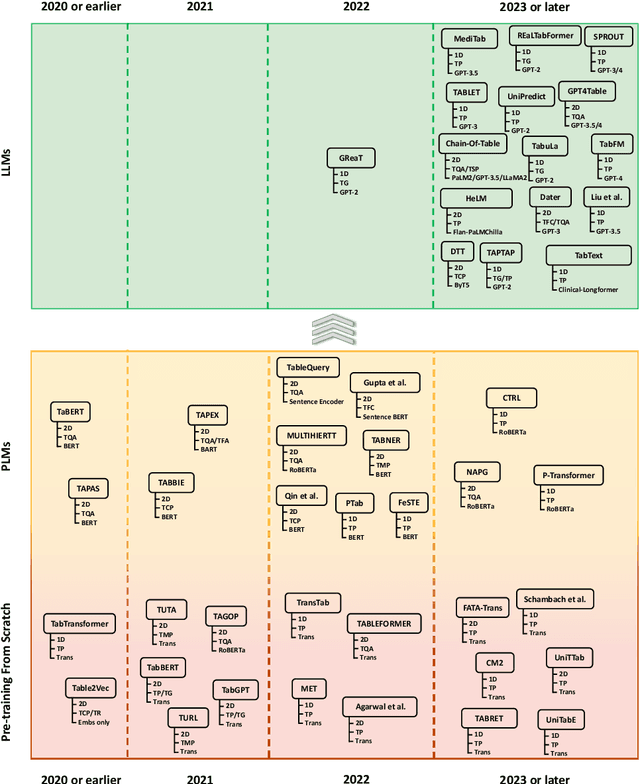
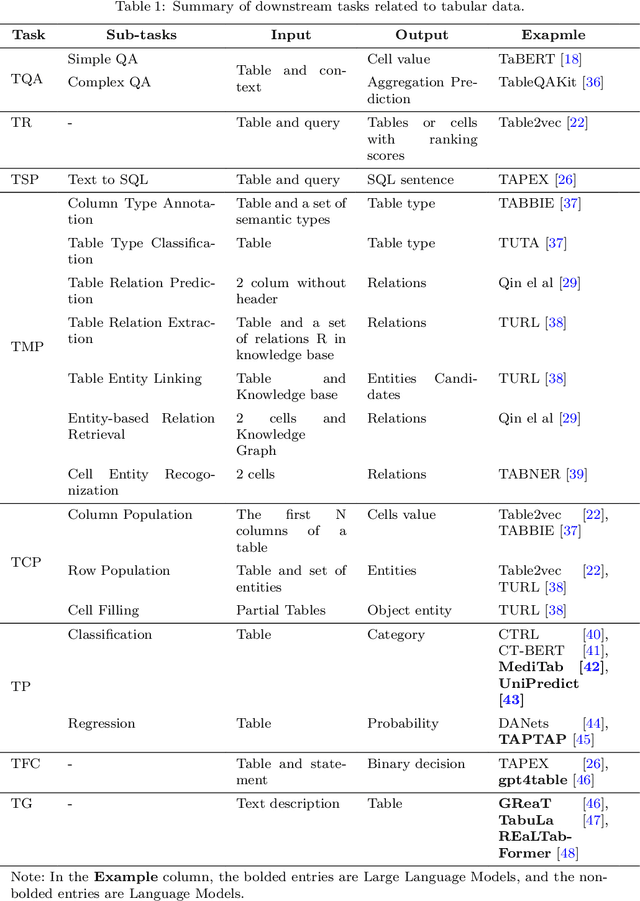
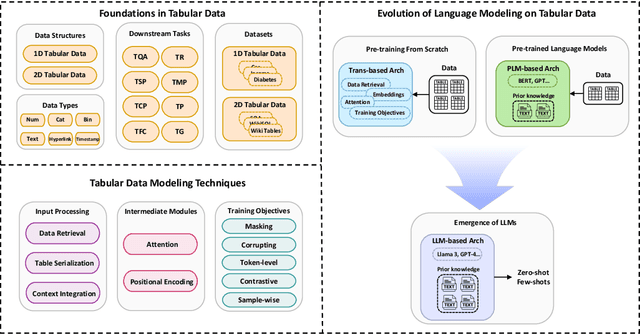
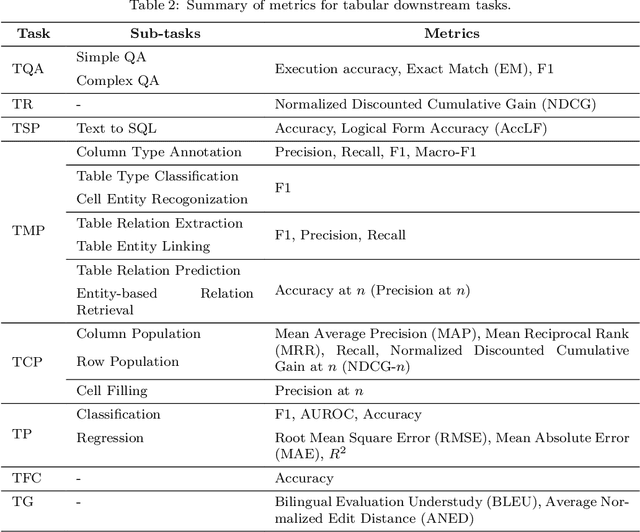
Tabular data, a prevalent data type across various domains, presents unique challenges due to its heterogeneous nature and complex structural relationships. Achieving high predictive performance and robustness in tabular data analysis holds significant promise for numerous applications. Influenced by recent advancements in natural language processing, particularly transformer architectures, new methods for tabular data modeling have emerged. Early techniques concentrated on pre-training transformers from scratch, often encountering scalability issues. Subsequently, methods leveraging pre-trained language models like BERT have been developed, which require less data and yield enhanced performance. The recent advent of large language models, such as GPT and LLaMA, has further revolutionized the field, facilitating more advanced and diverse applications with minimal fine-tuning. Despite the growing interest, a comprehensive survey of language modeling techniques for tabular data remains absent. This paper fills this gap by providing a systematic review of the development of language modeling for tabular data, encompassing: (1) a categorization of different tabular data structures and data types; (2) a review of key datasets used in model training and tasks used for evaluation; (3) a summary of modeling techniques including widely-adopted data processing methods, popular architectures, and training objectives; (4) the evolution from adapting traditional Pre-training/Pre-trained language models to the utilization of large language models; (5) an identification of persistent challenges and potential future research directions in language modeling for tabular data analysis. GitHub page associated with this survey is available at: https://github.com/lanxiang1017/Language-Modeling-on-Tabular-Data-Survey.git.