 Add to Chrome
 Add to Firefox
 Add to Edge
Follow the Latent Roadmap: Navigating Revocable Decoding for Diffusion LLMs with Anchor Tokens
Jun 15, 2026
Diffusion Large Language Models (dLLMs) offer a promising avenue for parallel generation but face a trade-off between decoding speed and quality. While revocable decoding strategies attempt to mitigate errors by verifying and remasking tokens, they typically operate within a mixed-quality context. This leads to two critical failures: \textit{Error Propagation}, where new tokens absorb toxic information from erroneous context, and \textit{Local Error Reinforcement}, where errors mutually reinforce each other to evade detection. To alleviate these challenges, we propose ASRD (Anchor Supervised Revocable Decoding), a training-free framework that operates within the embedding space. ASRD explicitly decouples the decoding context into trusted \textit{Anchor Tokens}, which are identified via temporal consistency, and uncertain candidates. Leveraging a dynamic Anchor Tokens Cache, we introduce two complementary mechanisms: (1) Anchor-Guided Generation, which injects entropy-weighted anchor signals into masked positions to implicitly rectify attention toward the reliable global skeleton; and (2) Anchor-Perturbed Verification, which applies orthogonal perturbations to uncertain candidate tokens, destabilizing and remasking errors driven by fragile local consensus. Extensive experiments on math and coding benchmarks demonstrate that ASRD outperforms recent remasking baselines, achieving accuracy improvements of up to 6.4\% while accelerating inference throughput by up to 7.2$\times$.

Stop the Flip-Flop: Context-Preserving Verification for Fast Revocable Diffusion Decoding
Feb 05, 2026Parallel diffusion decoding can accelerate diffusion language model inference by unmasking multiple tokens per step, but aggressive parallelism often harms quality. Revocable decoding mitigates this by rechecking earlier tokens, yet we observe that existing verification schemes frequently trigger flip-flop oscillations, where tokens are remasked and later restored unchanged. This behaviour slows inference in two ways: remasking verified positions weakens the conditioning context for parallel drafting, and repeated remask cycles consume the revision budget with little net progress. We propose COVER (Cache Override Verification for Efficient Revision), which performs leave-one-out verification and stable drafting within a single forward pass. COVER constructs two attention views via KV cache override: selected seeds are masked for verification, while their cached key value states are injected for all other queries to preserve contextual information, with a closed form diagonal correction preventing self leakage at the seed positions. COVER further prioritises seeds using a stability aware score that balances uncertainty, downstream influence, and cache drift, and it adapts the number of verified seeds per step. Across benchmarks, COVER markedly reduces unnecessary revisions and yields faster decoding while preserving output quality.
AdaSkip: Adaptive Sublayer Skipping for Accelerating Long-Context LLM Inference
Jan 04, 2025


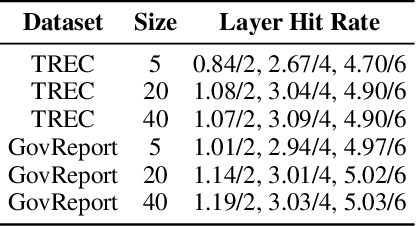
Long-context large language models (LLMs) inference is increasingly critical, motivating a number of studies devoted to alleviating the substantial storage and computational costs in such scenarios. Layer-wise skipping methods are promising optimizations but rarely explored in long-context inference. We observe that existing layer-wise skipping strategies have several limitations when applied in long-context inference, including the inability to adapt to model and context variability, disregard for sublayer significance, and inapplicability for the prefilling phase. This paper proposes \sysname, an adaptive sublayer skipping method specifically designed for long-context inference. \sysname adaptively identifies less important layers by leveraging on-the-fly similarity information, enables sublayer-wise skipping, and accelerates both the prefilling and decoding phases. The effectiveness of \sysname is demonstrated through extensive experiments on various long-context benchmarks and models, showcasing its superior inference performance over existing baselines.