 Add to Chrome
 Add to Firefox
 Add to Edge
CausalNav: Reliability-Certified Causal World Models for Control under Physical-Parameter Shift
Aug 07, 2026
A world model is only useful for physical AI if it changes what the agent does, and only safe if it declines to do so when it is wrong. We study both halves of that requirement with CausalNav, a controller built around a signed, action-conditioned transition graph over identified state coordinates. At deployment CausalNav simulates a small library of intervention sequences, converts their objective error into policy-logit advice, and admits that advice only when a scale-free predictive-reliability certificate, a policy-margin gate, and an argmax-agreement gate all pass; otherwise it falls back exactly to its own model-based base controller. We evaluate against nine controlled baselines (transformer, recurrent, split-latent, graph, causal-induction, and three recent model-based reasoning modules) on CartPole-v1 and discretized Pendulum-v1 with physical-parameter shifts, under one shared PPO trainer, one interaction budget, and ten held-out seeds (200 runs). CausalNav attains the best average rank (1.25 of ten). The diagnostic result is more informative than the ranking: the learned graph recovers structure well above chance (CartPole F1 = 0.59 +/- 0.09), yet per-seed structural fidelity is uncorrelated with per-seed control benefit (r = -0.15, p = 0.67), and the certificate abstains on 10/10 Pendulum seeds, where forcing the planner on costs return. Model fidelity did not predict downstream control utility in our setting; certified abstention, not better prediction, is what made the world model safe to deploy.

When the Judge Should Not Decide: Evidence-Locked, Non-Compensatory Selection Bounds LLM-Judge Failure in Reasoning Pipelines
Aug 07, 2026An LLM judge deployed inside a reasoning pipeline does not merely measure quality, it decides which answer ships. We show that the cost of that decision depends less on judge accuracy than on the decision rule the judge is embedded in. On frozen candidate pools from four GRPO policies, an unconstrained scalar DeepSeek-R1-7B judge buys almost nothing over answer-level majority vote (+1.0 pp on 500 GSM8K questions, +0.34 EM on 300 HotpotQA questions), and on a frozen-rule 30-question confirmation split it is 10 points worse than majority, a judge that destroys accuracy while scoring candidates confidently. We then subordinate the same judge to Evidence-Locked Derive-Gate-Repair (EL-DGR), a task-adaptive non-compensatory rule under which a judge preference may override evidence-supported consensus only with an extractive evidence certificate, and a repair only when neither alternative is certified and the repair is. With no change to the judge, the candidates, or the budget, EL-DGR reaches 58.2% on GSM8K (vs. 56.8% judge, 55.8% majority, 55.4% first candidate) and 17.33 EM / 25.46 F1 on HotpotQA (vs. 15.67/23.49, 15.33/23.19, 15.33/22.97), improving on first-candidate GRPO by +2.8 pp (exact McNemar p=0.0026) and +2.00 EM (p=0.070, borderline). A decision audit shows why: EL-DGR overturns consensus on only 8 of 30 pilot questions and never converts a correct consensus into an incorrect answer. We also report what did not work: the same seven-channel decomposition used as a step-level gated training reward is null, and corrected channel-drop ablations show no channel is individually necessary (p=1.0 throughout). The practitioner-facing finding is negative about judges and positive about admissibility, bound the judge's blast radius rather than trying to make it accurate.
Learning $\mathsf{AC}^0$ under Locally Sampleable Graphical Models
Jul 09, 2026The problem of learning constant-depth circuits holds profound implications for computational learning theory. In a seminal result, by introducing the low-degree algorithm, Linial, Mansour, and Nisan (J. ACM 1993) presented a quasipolynomial-time learner for $\mathsf{AC}^0$ under the uniform distribution. However, obtaining comparable learning guarantees for broader classes of correlated distributions has remained a longstanding challenge. Recently, Chandrasekaran, Gaitonde, Moitra, and Vasilyan (arXiv 2026) extended these guarantees to Gibbs distributions on bounded-degree graphical models with both strong spatial mixing and polynomial growth. In this paper, we give a quasipolynomial-time learner for $\mathsf{AC}^0$ under graphical models that admit efficient local samplers, circumventing the polynomial-growth requirement in prior work. The key ingredient is a new low-degree approximation for Gibbs distributions, established by simulating and suitably truncating the classical Glauber dynamics. As applications, this framework yields learners for two-spin systems, including the hard-core model and Ising model, on arbitrary bounded-degree graphs, in regimes approaching their respective sampling thresholds.
Explainable Autonomous Cyber Defense using Adversarial Multi-Agent Reinforcement Learning
Apr 06, 2026Autonomous agents are increasingly deployed in both offensive and defensive cyber operations, creating high-speed, closed-loop interactions in critical infrastructure environments. Advanced Persistent Threat (APT) actors exploit "Living off the Land" techniques and targeted telemetry perturbations to induce ambiguity in monitoring systems, causing automated defenses to overreact or misclassify benign behavior as malicious activity. Existing monolithic and multi-agent defense pipelines largely operate on correlation-based signals, lack structural constraints on response actions, and are vulnerable to reasoning drift under ambiguous or adversarial inputs. We present the Causal Multi-Agent Decision Framework (C-MADF), a structurally constrained architecture for autonomous cyber defense that integrates causal modeling with adversarial dual-policy control. C-MADF first learns a Structural Causal Model (SCM) from historical telemetry and compiles it into an investigation-level Directed Acyclic Graph (DAG) that defines admissible response transitions. This roadmap is formalized as a Markov Decision Process (MDP) whose action space is explicitly restricted to causally consistent transitions. Decision-making within this constrained space is performed by a dual-agent reinforcement learning system in which a threat-optimizing Blue-Team policy is counterbalanced by a conservatively shaped Red-Team policy. Inter-policy disagreement is quantified through a Policy Divergence Score and exposed via a human-in-the-loop interface equipped with an Explainability-Transparency Score that serves as an escalation signal under uncertainty. On the real-world CICIoT2023 dataset, C-MADF reduces the false-positive rate from 11.2%, 9.7%, and 8.4% in three cutting-edge literature baselines to 1.8%, while achieving 0.997 precision, 0.961 recall, and 0.979 F1-score.
Breaking the Limitations with Sparse Inputs by Variational Frameworks (BLIss) in Terahertz Super-Resolution 3D Reconstruction
Mar 27, 2024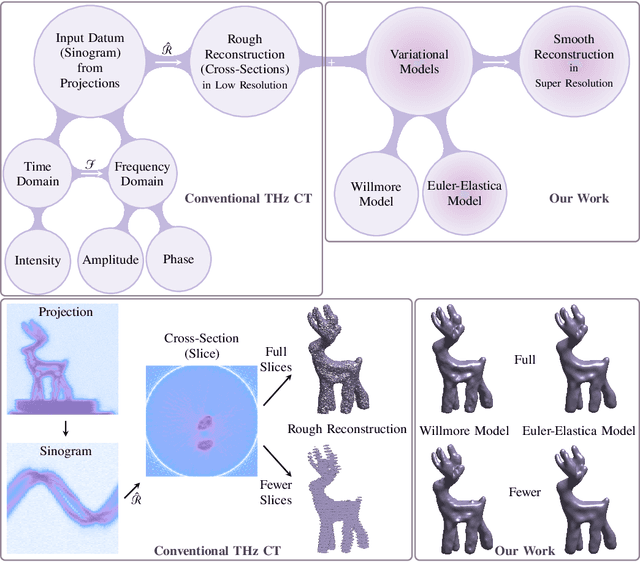
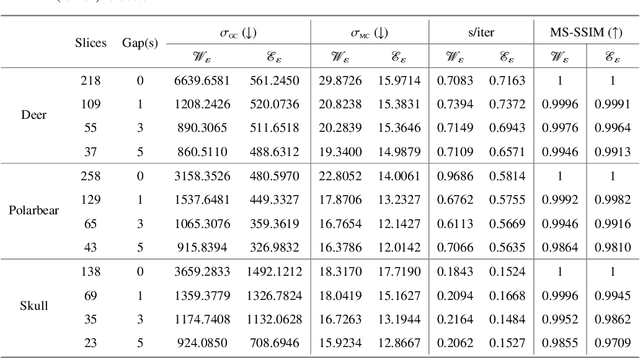
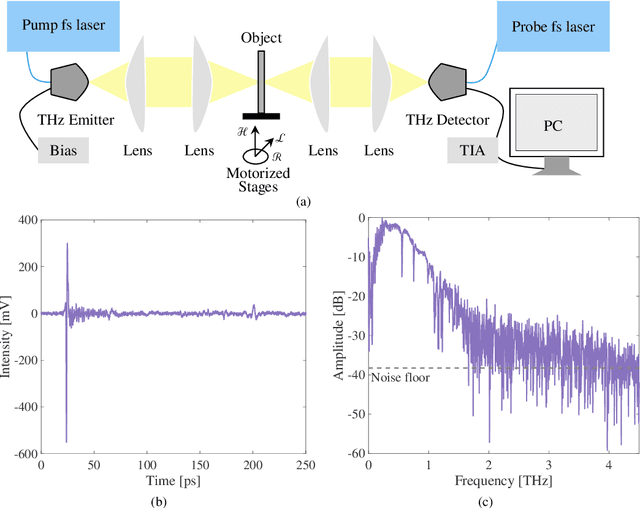
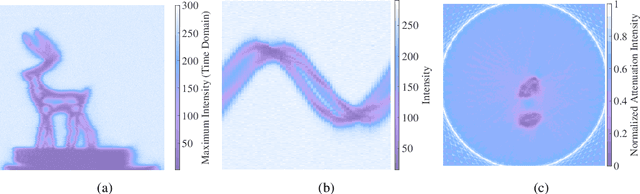
Data acquisition, image processing, and image quality are the long-lasting issues for terahertz (THz) 3D reconstructed imaging. Existing methods are primarily designed for 2D scenarios, given the challenges associated with obtaining super-resolution (SR) data and the absence of an efficient SR 3D reconstruction framework in conventional computed tomography (CT). Here, we demonstrate BLIss, a new approach for THz SR 3D reconstruction with sparse 2D data input. BLIss seamlessly integrates conventional CT techniques and variational framework with the core of the adapted Euler-Elastica-based model. The quantitative 3D image evaluation metrics, including the standard deviation of Gaussian, mean curvatures, and the multi-scale structural similarity index measure (MS-SSIM), validate the superior smoothness and fidelity achieved with our variational framework approach compared with conventional THz CT modal. Beyond its contributions to advancing THz SR 3D reconstruction, BLIss demonstrates potential applicability in other imaging modalities, such as X-ray and MRI. This suggests extensive impacts on the broader field of imaging applications.
* 15 pages, 7 figures. Supplemental Document: https://doi.org/10.6084/m9.figshare.24455206
Super-Resolution Surface Reconstruction from Few Low-Resolution Slices
Sep 12, 2023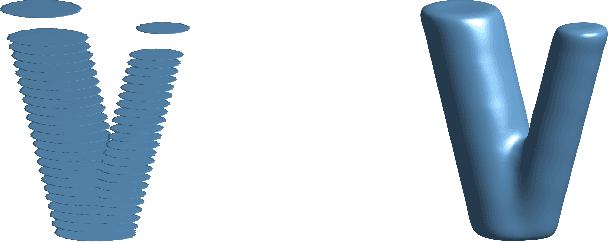
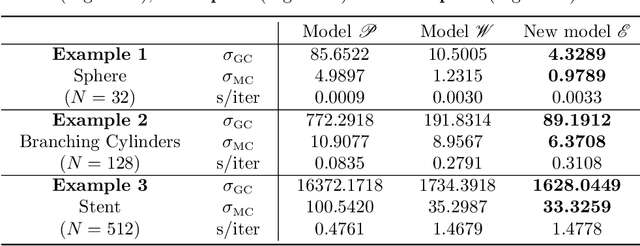
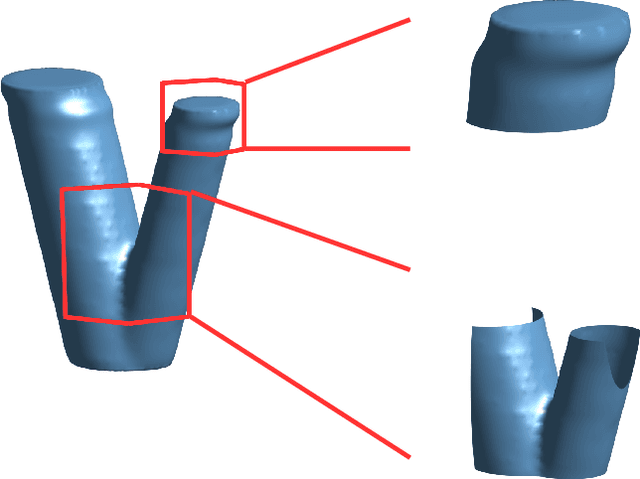
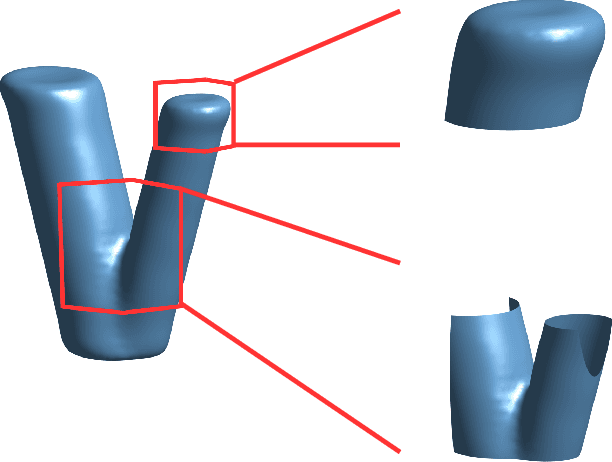
In many imaging applications where segmented features (e.g. blood vessels) are further used for other numerical simulations (e.g. finite element analysis), the obtained surfaces do not have fine resolutions suitable for the task. Increasing the resolution of such surfaces becomes crucial. This paper proposes a new variational model for solving this problem, based on an Euler-Elastica-based regulariser. Further, we propose and implement two numerical algorithms for solving the model, a projected gradient descent method and the alternating direction method of multipliers. Numerical experiments using real-life examples (including two from outputs of another variational model) have been illustrated for effectiveness. The advantages of the new model are shown through quantitative comparisons by the standard deviation of Gaussian curvatures and mean curvatures from the viewpoint of discrete geometry.
* 33 pages, 25 figures