 Add to Chrome
 Add to Firefox
 Add to Edge
Geometry-Guided Modeling of Foundation Features Enables Generalizable Object Shape Deformation Learning
May 28, 2026
Monocular 3D shape recovery is fundamental to geometric understanding, yet achieving robust generalization across arbitrary viewpoints and unseen object categories remains a significant challenge. In this paper, we present a generalizable deformation learning framework that reconstructs 3D objects by explicitly deforming a category-level shape template to match the target observation. To address complex shape variations between the template and the target, we introduce a geometry-guided feature modeling mechanism. This process first enriches foundation features with template topology to yield a geometry-aware representation, which is then explicitly correlated with the target observation to guide precise deformation. Furthermore, to bridge the disparity between the fixed template and arbitrary target views, we propose a view-adaptive feature aggregation module. This module leverages multi-view template features and their corresponding camera poses to enrich the canonical template representation, ensuring robust feature alignment regardless of the target's perspective. Extensive experiments demonstrate that our approach significantly outperforms state-of-the-art methods in handling large shape variations and diverse viewpoints, exhibiting strong generalization to novel categories and effectively supporting downstream real-world dexterous robotic manipulation tasks. Project homepage: https://GODeform.github.io/

Real-time Monocular 2D and 3D Perception of Endoluminal Scenes for Controlling Flexible Robotic Endoscopic Instruments
Feb 16, 2026Endoluminal surgery offers a minimally invasive option for early-stage gastrointestinal and urinary tract cancers but is limited by surgical tools and a steep learning curve. Robotic systems, particularly continuum robots, provide flexible instruments that enable precise tissue resection, potentially improving outcomes. This paper presents a visual perception platform for a continuum robotic system in endoluminal surgery. Our goal is to utilize monocular endoscopic image-based perception algorithms to identify position and orientation of flexible instruments and measure their distances from tissues. We introduce 2D and 3D learning-based perception algorithms and develop a physically-realistic simulator that models flexible instruments dynamics. This simulator generates realistic endoluminal scenes, enabling control of flexible robots and substantial data collection. Using a continuum robot prototype, we conducted module and system-level evaluations. Results show that our algorithms improve control of flexible instruments, reducing manipulation time by over 70% for trajectory-following tasks and enhancing understanding of surgical scenarios, leading to robust endoluminal surgeries.
Enhanced Scale-aware Depth Estimation for Monocular Endoscopic Scenes with Geometric Modeling
Aug 14, 2024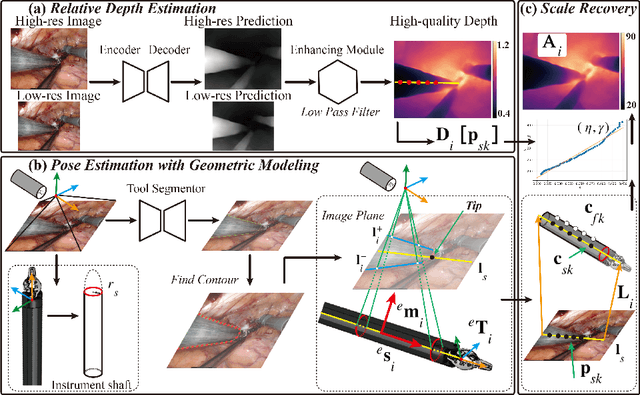
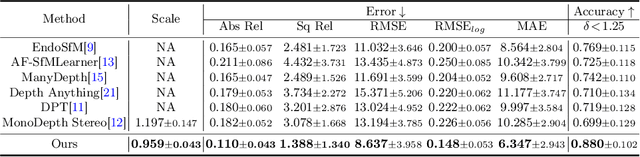
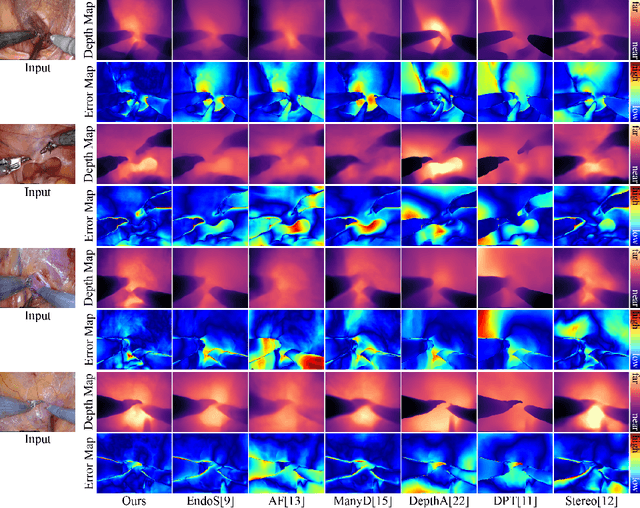
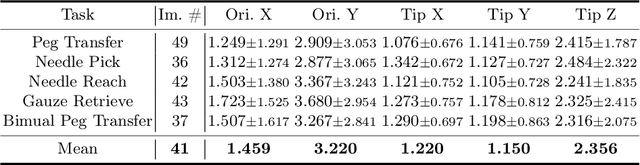
Scale-aware monocular depth estimation poses a significant challenge in computer-aided endoscopic navigation. However, existing depth estimation methods that do not consider the geometric priors struggle to learn the absolute scale from training with monocular endoscopic sequences. Additionally, conventional methods face difficulties in accurately estimating details on tissue and instruments boundaries. In this paper, we tackle these problems by proposing a novel enhanced scale-aware framework that only uses monocular images with geometric modeling for depth estimation. Specifically, we first propose a multi-resolution depth fusion strategy to enhance the quality of monocular depth estimation. To recover the precise scale between relative depth and real-world values, we further calculate the 3D poses of instruments in the endoscopic scenes by algebraic geometry based on the image-only geometric primitives (i.e., boundaries and tip of instruments). Afterwards, the 3D poses of surgical instruments enable the scale recovery of relative depth maps. By coupling scale factors and relative depth estimation, the scale-aware depth of the monocular endoscopic scenes can be estimated. We evaluate the pipeline on in-house endoscopic surgery videos and simulated data. The results demonstrate that our method can learn the absolute scale with geometric modeling and accurately estimate scale-aware depth for monocular scenes.