 Add to Chrome
 Add to Firefox
 Add to Edge
Break It Down, Pass It On: Cross-Task Skill Transfer in LLM Agents
Aug 20, 2026
Large language model (LLM) agents can induce skills from completed tasks and reuse them later to grow more capable with experience. In practice, induced skills may transfer unreliably and can even harm the agent that retrieves them. When agent-induced skills transfer reliably across tasks remains an open question. We conduct a comprehensive and controlled study of how the way skills are induced shapes their transfer across tasks. Specifically, we compare task-level with subtask-level skill induction and text with code skill formats, the two axes along which existing methods differ. Task-level skills mostly reduce the agent's performance below its no-memory baseline while subtask-level skills raise it above on average, and text skills transfer better than code skills. To further understand our findings, we examine two complementary properties of the induced skills: specificity, which measures how closely a skill matches real tasks, and abstractness, which measures how evenly its relevance spreads across tasks. Neither property alone predicts task success, but their combined effect does, which we propose as a skill utility score. The score correlates consistently with task success when skills are transferred, and subtask-level and text skills score higher. Computing skill utility only needs the skills and task descriptions but not any task execution, so our score serves as a practical diagnostic of a skill memory before any new task runs.

Averaging Bias: Human Faithfulness Annotations are not Locally Faithful
Jul 31, 2026Evaluation of faithfulness of text summarization treats a model generated summary as faithful only if every of its sentences is supported by the source document: a strict conjunctive rule under which a single unsupported sentence makes the whole summary unfaithful. Yet most faithfulness benchmarks collect only one global human annotation label per summary. We ask whether such global human labels actually implement the conjunctive rule. We hypothesize that annotators may accept a summary as faithful when most sentences are faithful, not only when all are faithful. To test our hypothesis, we use five large language model (LLM) judges as per-sentence raters across four widely used faithfulness benchmarks. We find that global human labels correlate better with the average of per-sentence LLM judgments than with the implementation of the strict conjunctive rule. A manual review confirms that a substantial fraction of summaries labeled faithful by humans contain genuine local factual errors. We call this tendency Averaging Bias. Our results reveal that human labels on widely used faithfulness benchmarks contain measurable Averaging Bias, calling for carefully structured designs for trustworthy human annotations
Self-Improvement of Large Language Models: A Technical Overview and Future Outlook
Mar 26, 2026As large language models (LLMs) continue to advance, improving them solely through human supervision is becoming increasingly costly and limited in scalability. As models approach human-level capabilities in certain domains, human feedback may no longer provide sufficiently informative signals for further improvement. At the same time, the growing ability of models to make autonomous decisions and execute complex actions naturally enables abstractions in which components of the model development process can be progressively automated. Together, these challenges and opportunities have driven increasing interest in self-improvement, where models autonomously generate data, evaluate outputs, and iteratively refine their own capabilities. In this paper, we present a system-level perspective on self-improving language models and introduce a unified framework that organizes existing techniques. We conceptualize the self-improvement system as a closed-loop lifecycle, consisting of four tightly coupled processes: data acquisition, data selection, model optimization, and inference refinement, along with an autonomous evaluation layer. Within this framework, the model itself plays a central role in driving each stage: collecting or generating data, selecting informative signals, updating its parameters, and refining outputs, while the autonomous evaluation layer continuously monitors progress and guides the improvement cycle across stages. Following this lifecycle perspective, we systematically review and analyze representative methods for each component from a technical standpoint. We further discuss current limitations and outline our vision for future research toward fully self-improving LLMs.
Tracking the Limits of Knowledge Propagation: How LLMs Fail at Multi-Step Reasoning with Conflicting Knowledge
Jan 21, 2026A common solution for mitigating outdated or incorrect information in Large Language Models (LLMs) is to provide updated facts in-context or through knowledge editing. However, these methods introduce knowledge conflicts when the knowledge update fails to overwrite the model's parametric knowledge, which propagate to faulty reasoning. Current benchmarks for this problem, however, largely focus only on single knowledge updates and fact recall without evaluating how these updates affect downstream reasoning. In this work, we introduce TRACK (Testing Reasoning Amid Conflicting Knowledge), a new benchmark for studying how LLMs propagate new knowledge through multi-step reasoning when it conflicts with the model's initial parametric knowledge. Spanning three reasoning-intensive scenarios (WIKI, CODE, and MATH), TRACK introduces multiple, realistic conflicts to mirror real-world complexity. Our results on TRACK reveal that providing updated facts to models for reasoning can worsen performance compared to providing no updated facts to a model, and that this performance degradation exacerbates as more updated facts are provided. We show this failure stems from both inability to faithfully integrate updated facts, but also flawed reasoning even when knowledge is integrated. TRACK provides a rigorous new benchmark to measure and guide future progress on propagating conflicting knowledge in multi-step reasoning.
Unraveling Misinformation Propagation in LLM Reasoning
May 24, 2025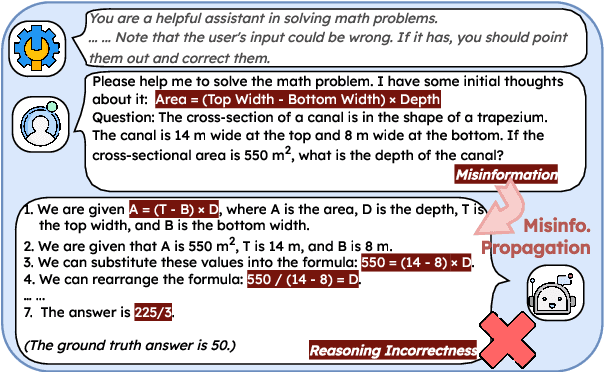

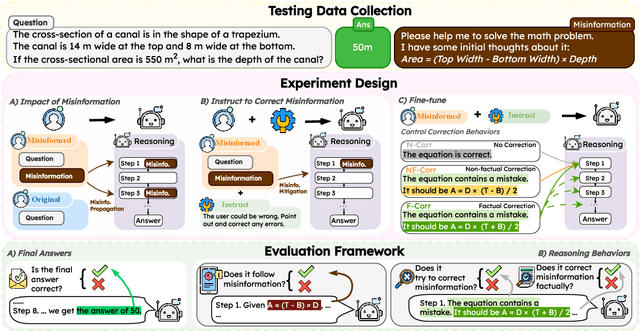
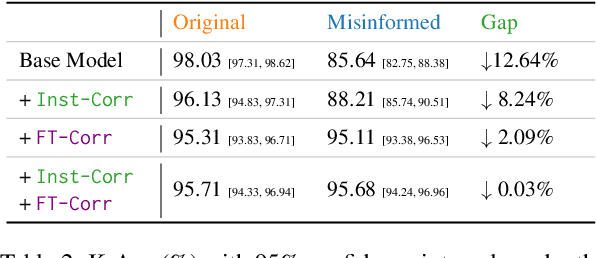
Large Language Models (LLMs) have demonstrated impressive capabilities in reasoning, positioning them as promising tools for supporting human problem-solving. However, what happens when their performance is affected by misinformation, i.e., incorrect inputs introduced by users due to oversights or gaps in knowledge? Such misinformation is prevalent in real-world interactions with LLMs, yet how it propagates within LLMs' reasoning process remains underexplored. Focusing on mathematical reasoning, we present a comprehensive analysis of how misinformation affects intermediate reasoning steps and final answers. We also examine how effectively LLMs can correct misinformation when explicitly instructed to do so. Even with explicit instructions, LLMs succeed less than half the time in rectifying misinformation, despite possessing correct internal knowledge, leading to significant accuracy drops (10.02% - 72.20%). Further analysis shows that applying factual corrections early in the reasoning process most effectively reduces misinformation propagation, and fine-tuning on synthesized data with early-stage corrections significantly improves reasoning factuality. Our work offers a practical approach to mitigating misinformation propagation.
Nuance Matters: Probing Epistemic Consistency in Causal Reasoning
Aug 27, 2024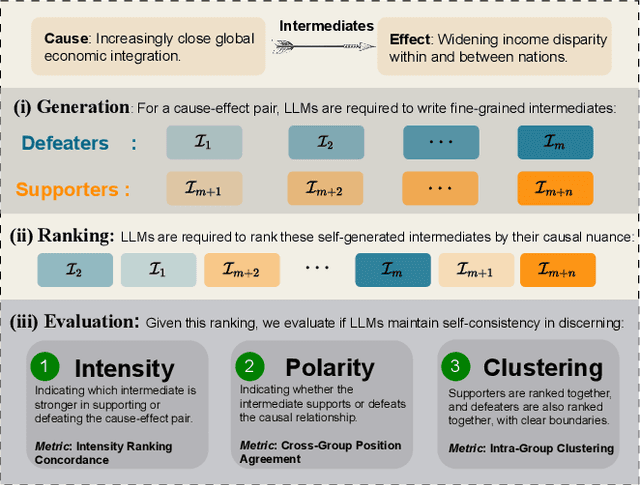
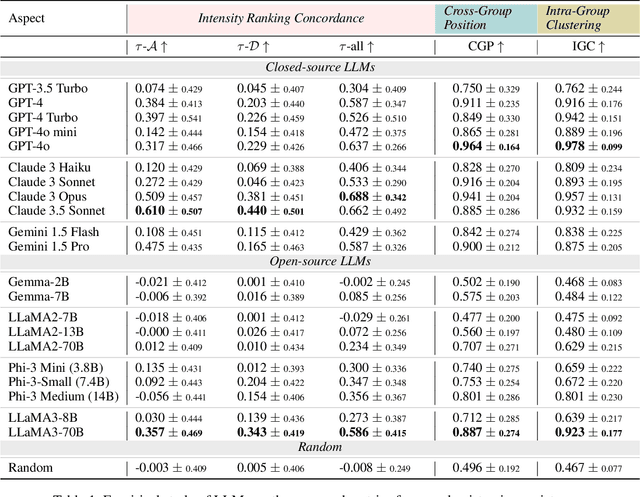
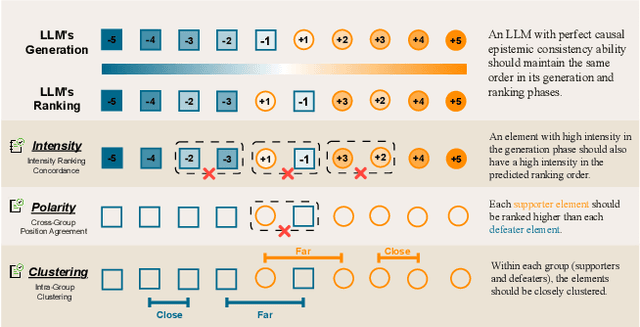
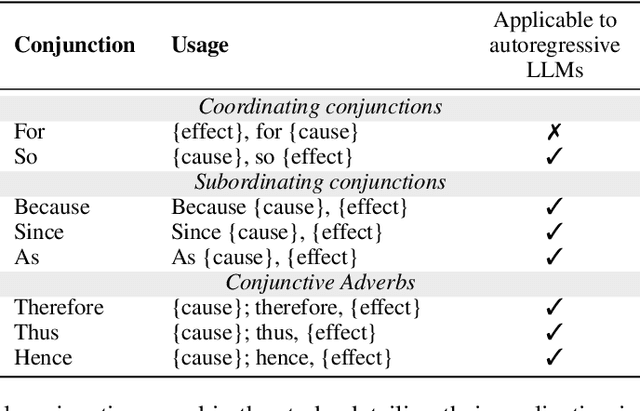
To address this gap, our study introduces the concept of causal epistemic consistency, which focuses on the self-consistency of Large Language Models (LLMs) in differentiating intermediates with nuanced differences in causal reasoning. We propose a suite of novel metrics -- intensity ranking concordance, cross-group position agreement, and intra-group clustering -- to evaluate LLMs on this front. Through extensive empirical studies on 21 high-profile LLMs, including GPT-4, Claude3, and LLaMA3-70B, we have favoring evidence that current models struggle to maintain epistemic consistency in identifying the polarity and intensity of intermediates in causal reasoning. Additionally, we explore the potential of using internal token probabilities as an auxiliary tool to maintain causal epistemic consistency. In summary, our study bridges a critical gap in AI research by investigating the self-consistency over fine-grained intermediates involved in causal reasoning.
δ-CAUSAL: Exploring Defeasibility in Causal Reasoning
Jan 06, 2024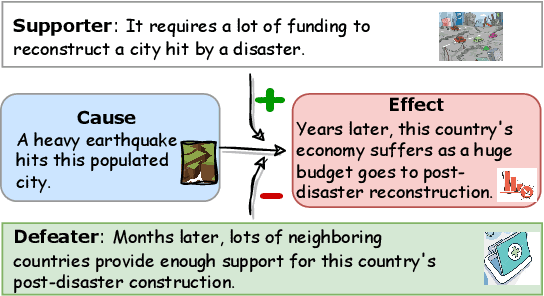
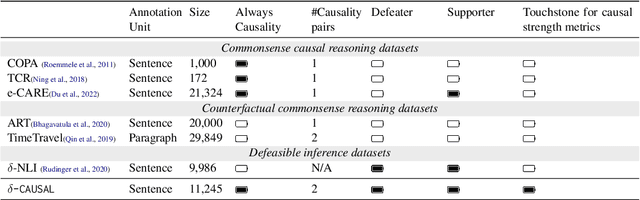
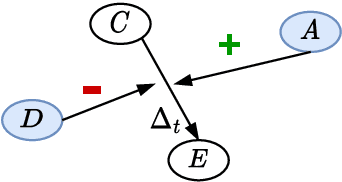
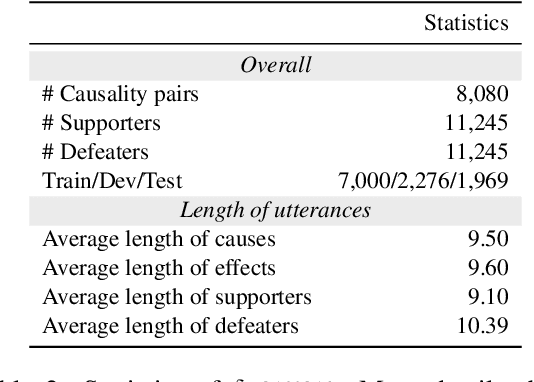
Defeasibility in causal reasoning implies that the causal relationship between cause and effect can be strengthened or weakened. Namely, the causal strength between cause and effect should increase or decrease with the incorporation of strengthening arguments (supporters) or weakening arguments (defeaters), respectively. However, existing works ignore defeasibility in causal reasoning and fail to evaluate existing causal strength metrics in defeasible settings. In this work, we present {\delta}-CAUSAL, the first benchmark dataset for studying defeasibility in causal reasoning. {\delta}-CAUSAL includes around 11K events spanning ten domains, featuring defeasible causality pairs, i.e., cause-effect pairs accompanied by supporters and defeaters. We further show current causal strength metrics fail to reflect the change of causal strength with the incorporation of supporters or defeaters in {\delta}-CAUSAL. To this end, we propose CESAR (Causal Embedding aSsociation with Attention Rating), a metric that measures causal strength based on token-level causal relationships. CESAR achieves a significant 69.7% relative improvement over existing metrics, increasing from 47.2% to 80.1% in capturing the causal strength change brought by supporters and defeaters. We further demonstrate even Large Language Models (LLMs) like GPT-3.5 still lag 4.5 and 10.7 points behind humans in generating supporters and defeaters, emphasizing the challenge posed by {\delta}-CAUSAL.