 Add to Chrome
 Add to Firefox
 Add to Edge
VLD: Visual Language Goal Distance for Reinforcement Learning Navigation
Dec 08, 2025
Training end-to-end policies from image data to directly predict navigation actions for robotic systems has proven inherently difficult. Existing approaches often suffer from either the sim-to-real gap during policy transfer or a limited amount of training data with action labels. To address this problem, we introduce Vision-Language Distance (VLD) learning, a scalable framework for goal-conditioned navigation that decouples perception learning from policy learning. Instead of relying on raw sensory inputs during policy training, we first train a self-supervised distance-to-goal predictor on internet-scale video data. This predictor generalizes across both image- and text-based goals, providing a distance signal that can be minimized by a reinforcement learning (RL) policy. The RL policy can be trained entirely in simulation using privileged geometric distance signals, with injected noise to mimic the uncertainty of the trained distance predictor. At deployment, the policy consumes VLD predictions, inheriting semantic goal information-"where to go"-from large-scale visual training while retaining the robust low-level navigation behaviors learned in simulation. We propose using ordinal consistency to assess distance functions directly and demonstrate that VLD outperforms prior temporal distance approaches, such as ViNT and VIP. Experiments show that our decoupled design achieves competitive navigation performance in simulation while supporting flexible goal modalities, providing an alternative and, most importantly, scalable path toward reliable, multimodal navigation policies.

δ-CAUSAL: Exploring Defeasibility in Causal Reasoning
Jan 06, 2024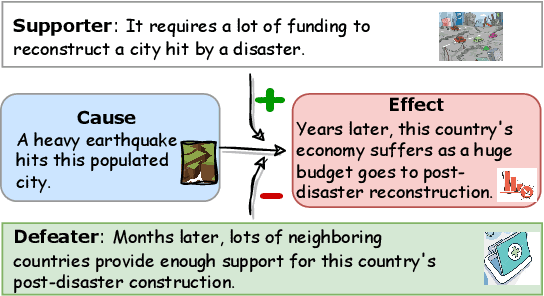
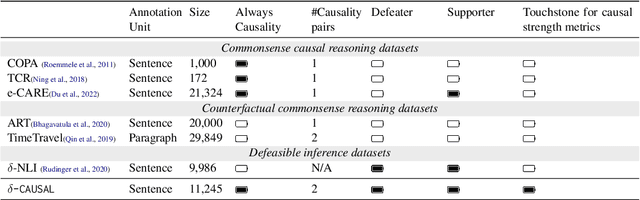
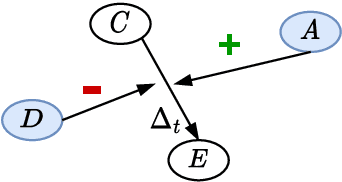
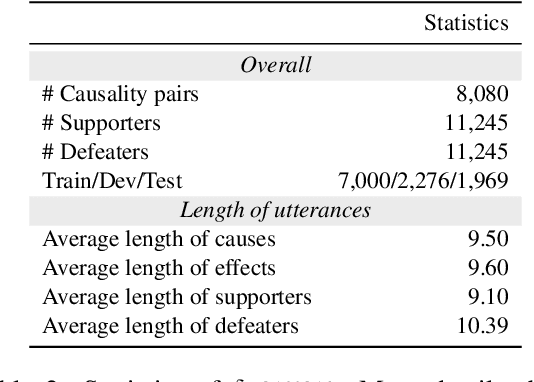
Defeasibility in causal reasoning implies that the causal relationship between cause and effect can be strengthened or weakened. Namely, the causal strength between cause and effect should increase or decrease with the incorporation of strengthening arguments (supporters) or weakening arguments (defeaters), respectively. However, existing works ignore defeasibility in causal reasoning and fail to evaluate existing causal strength metrics in defeasible settings. In this work, we present {\delta}-CAUSAL, the first benchmark dataset for studying defeasibility in causal reasoning. {\delta}-CAUSAL includes around 11K events spanning ten domains, featuring defeasible causality pairs, i.e., cause-effect pairs accompanied by supporters and defeaters. We further show current causal strength metrics fail to reflect the change of causal strength with the incorporation of supporters or defeaters in {\delta}-CAUSAL. To this end, we propose CESAR (Causal Embedding aSsociation with Attention Rating), a metric that measures causal strength based on token-level causal relationships. CESAR achieves a significant 69.7% relative improvement over existing metrics, increasing from 47.2% to 80.1% in capturing the causal strength change brought by supporters and defeaters. We further demonstrate even Large Language Models (LLMs) like GPT-3.5 still lag 4.5 and 10.7 points behind humans in generating supporters and defeaters, emphasizing the challenge posed by {\delta}-CAUSAL.