 Add to Chrome
 Add to Firefox
 Add to Edge
Self-DACE++: Robust Low-Light Enhancement via Efficient Adaptive Curve Estimation
Apr 28, 2026
In this paper, we present Self-DACE++, an improved unsupervised and lightweight framework for Low-Light Image Enhancement (LLIE), building upon our previous Self-Reference Deep Adaptive Curve Estimation (Self-DACE). To better address the trade-off between computational efficiency and restoration quality, Self-DACE++ introduces enhanced Adaptive Adjustment Curves (AACs). These curves, governed by minimal trainable parameters, flexibly adjust the dynamic range while preserving the color fidelity, structural integrity, and naturalness of the enhanced images. To achieve an extremely lightweight architecture without sacrificing performance, we propose a randomized order training strategy coupled with a network fusion mechanism, which compresses the model into an efficient iterative inference structure. Furthermore, we formulate a physics-grounded objective function based on Retinex theory and incorporate a dedicated denoising module to effectively estimate and suppress latent noise in dark regions. Extensive qualitative and quantitative evaluations on multiple real-world benchmark datasets demonstrate that Self-DACE++ outperforms existing state-of-the-art methods, delivering superior enhancement quality with real-time inference capability. The code is available at https://github.com/John-Wendell/Self-DACE.

Self-Reference Deep Adaptive Curve Estimation for Low-Light Image Enhancement
Sep 07, 2023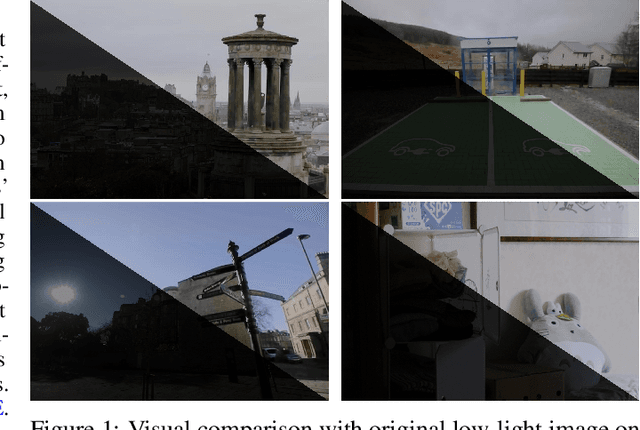
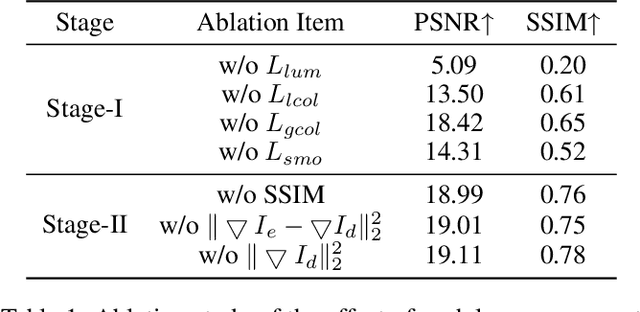
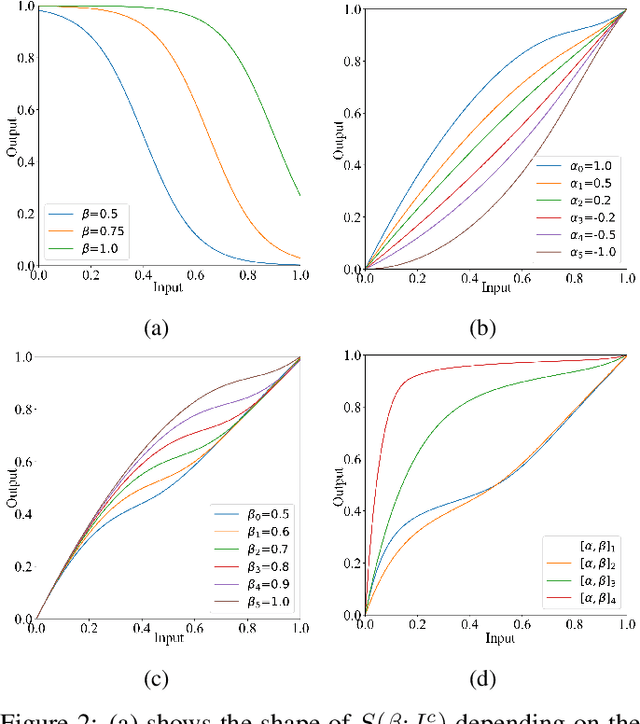
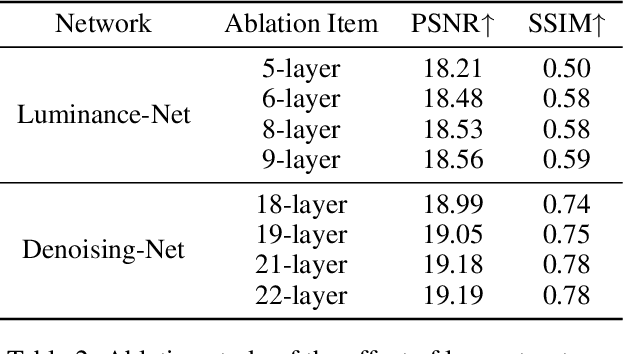
In this paper, we propose a 2-stage low-light image enhancement method called Self-Reference Deep Adaptive Curve Estimation (Self-DACE). In the first stage, we present an intuitive, lightweight, fast, and unsupervised luminance enhancement algorithm. The algorithm is based on a novel low-light enhancement curve that can be used to locally boost image brightness. We also propose a new loss function with a simplified physical model designed to preserve natural images' color, structure, and fidelity. We use a vanilla CNN to map each pixel through deep Adaptive Adjustment Curves (AAC) while preserving the local image structure. Secondly, we introduce the corresponding denoising scheme to remove the latent noise in the darkness. We approximately model the noise in the dark and deploy a Denoising-Net to estimate and remove the noise after the first stage. Exhaustive qualitative and quantitative analysis shows that our method outperforms existing state-of-the-art algorithms on multiple real-world datasets.
Encoding feature supervised UNet++: Redesigning Supervision for liver and tumor segmentation
Nov 15, 2022Liver tumor segmentation in CT images is a critical step in the diagnosis, surgical planning and postoperative evaluation of liver disease. An automatic liver and tumor segmentation method can greatly relieve physicians of the heavy workload of examining CT images and better improve the accuracy of diagnosis. In the last few decades, many modifications based on U-Net model have been proposed in the literature. However, there are relatively few improvements for the advanced UNet++ model. In our paper, we propose an encoding feature supervised UNet++(ES-UNet++) and apply it to the liver and tumor segmentation. ES-UNet++ consists of an encoding UNet++ and a segmentation UNet++. The well-trained encoding UNet++ can extract the encoding features of label map which are used to additionally supervise the segmentation UNet++. By adding supervision to the each encoder of segmentation UNet++, U-Nets of different depths that constitute UNet++ outperform the original version by average 5.7% in dice score and the overall dice score is thus improved by 2.1%. ES-UNet++ is evaluated with dataset LiTS, achieving 95.6% for liver segmentation and 67.4% for tumor segmentation in dice score. In this paper, we also concluded some valuable properties of ES-UNet++ by conducting comparative anaylsis between ES-UNet++ and UNet++:(1) encoding feature supervision can accelerate the convergence of the model.(2) encoding feature supervision enhances the effect of model pruning by achieving huge speedup while providing pruned models with fairly good performance.