 Add to Chrome
 Add to Firefox
 Add to Edge
Self-DACE++: Robust Low-Light Enhancement via Efficient Adaptive Curve Estimation
Apr 28, 2026
In this paper, we present Self-DACE++, an improved unsupervised and lightweight framework for Low-Light Image Enhancement (LLIE), building upon our previous Self-Reference Deep Adaptive Curve Estimation (Self-DACE). To better address the trade-off between computational efficiency and restoration quality, Self-DACE++ introduces enhanced Adaptive Adjustment Curves (AACs). These curves, governed by minimal trainable parameters, flexibly adjust the dynamic range while preserving the color fidelity, structural integrity, and naturalness of the enhanced images. To achieve an extremely lightweight architecture without sacrificing performance, we propose a randomized order training strategy coupled with a network fusion mechanism, which compresses the model into an efficient iterative inference structure. Furthermore, we formulate a physics-grounded objective function based on Retinex theory and incorporate a dedicated denoising module to effectively estimate and suppress latent noise in dark regions. Extensive qualitative and quantitative evaluations on multiple real-world benchmark datasets demonstrate that Self-DACE++ outperforms existing state-of-the-art methods, delivering superior enhancement quality with real-time inference capability. The code is available at https://github.com/John-Wendell/Self-DACE.

Fisheye Stereo Vision: Depth and Range Error
Feb 03, 2026This study derives analytical expressions for the depth and range error of fisheye stereo vision systems as a function of object distance, specifically accounting for accuracy at large angles.
High-Definition 5MP Stereo Vision Sensing for Robotics
Jan 30, 2026High-resolution (5MP+) stereo vision systems are essential for advancing robotic capabilities, enabling operation over longer ranges and generating significantly denser and accurate 3D point clouds. However, realizing the full potential of high-angular-resolution sensors requires a commensurately higher level of calibration accuracy and faster processing -- requirements often unmet by conventional methods. This study addresses that critical gap by processing 5MP camera imagery using a novel, advanced frame-to-frame calibration and stereo matching methodology designed to achieve both high accuracy and speed. Furthermore, we introduce a new approach to evaluate real-time performance by comparing real-time disparity maps with ground-truth disparity maps derived from more computationally intensive stereo matching algorithms. Crucially, the research demonstrates that high-pixel-count cameras yield high-quality point clouds only through the implementation of high-accuracy calibration.
Self-Reference Deep Adaptive Curve Estimation for Low-Light Image Enhancement
Sep 07, 2023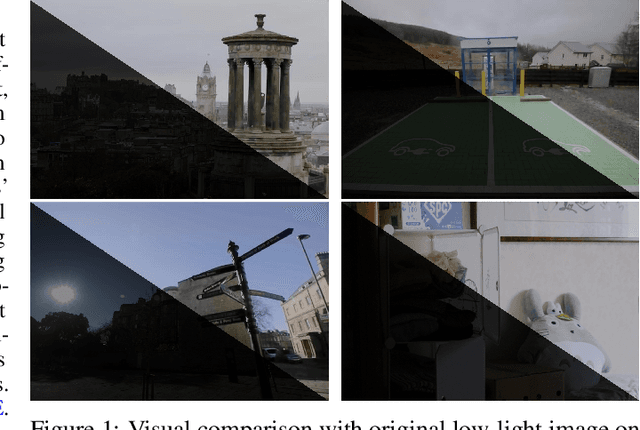
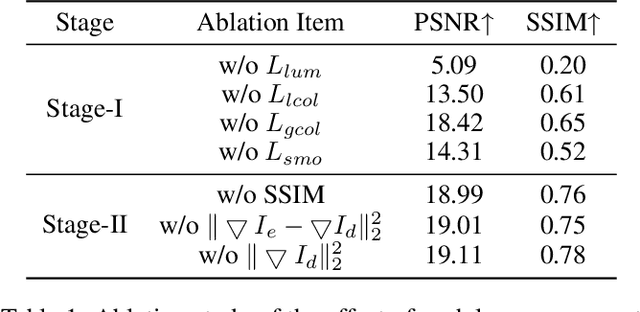
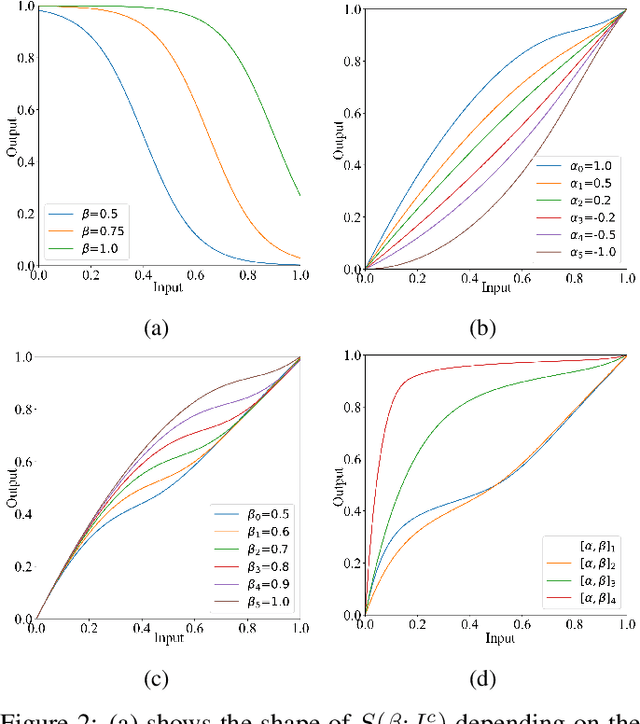
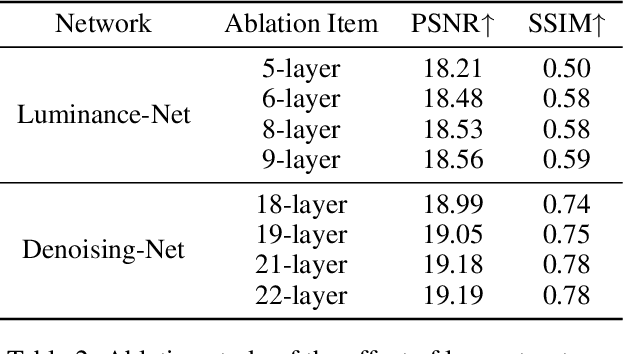
In this paper, we propose a 2-stage low-light image enhancement method called Self-Reference Deep Adaptive Curve Estimation (Self-DACE). In the first stage, we present an intuitive, lightweight, fast, and unsupervised luminance enhancement algorithm. The algorithm is based on a novel low-light enhancement curve that can be used to locally boost image brightness. We also propose a new loss function with a simplified physical model designed to preserve natural images' color, structure, and fidelity. We use a vanilla CNN to map each pixel through deep Adaptive Adjustment Curves (AAC) while preserving the local image structure. Secondly, we introduce the corresponding denoising scheme to remove the latent noise in the darkness. We approximately model the noise in the dark and deploy a Denoising-Net to estimate and remove the noise after the first stage. Exhaustive qualitative and quantitative analysis shows that our method outperforms existing state-of-the-art algorithms on multiple real-world datasets.