 Add to Chrome
 Add to Firefox
 Add to Edge
Cross-Modal Coreference Alignment: Enabling Reliable Information Transfer in Omni-LLMs
Apr 07, 2026
Omni Large Language Models (Omni-LLMs) have demonstrated impressive capabilities in holistic multi-modal perception, yet they consistently falter in complex scenarios requiring synergistic omni-modal reasoning. Beyond understanding global multimodal context, effective reasoning also hinges on fine-grained cross-modal alignment, especially identifying shared referents across modalities, yet this aspect has been largely overlooked. To bridge this gap, we formalize the challenge as a cross-modal coreference problem, where a model must localize a referent in a source modality and re-identify it in a target modality. Building on this paradigm, we introduce CrossOmni, a dataset comprising nine tasks equipped with human-designed reasoning rationales to evaluate and enhance this capability. Experiments on 13 Omni-LLMs reveal systematic weaknesses in cross-modal coreference, which we attribute to the absence of coreference-aware thinking patterns. To address this, we enhance cross-modal alignment via two strategies: a training-free In-Context Learning method and a training-based SFT+GRPO framework designed to induce such thinking patterns. Both approaches yield substantial performance gains and generalize effectively to collaborative reasoning tasks. Overall, our findings highlight cross-modal coreference as a crucial missing piece for advancing robust omni-modal reasoning.

Decoding Linguistic Representations of Human Brain
Jul 30, 2024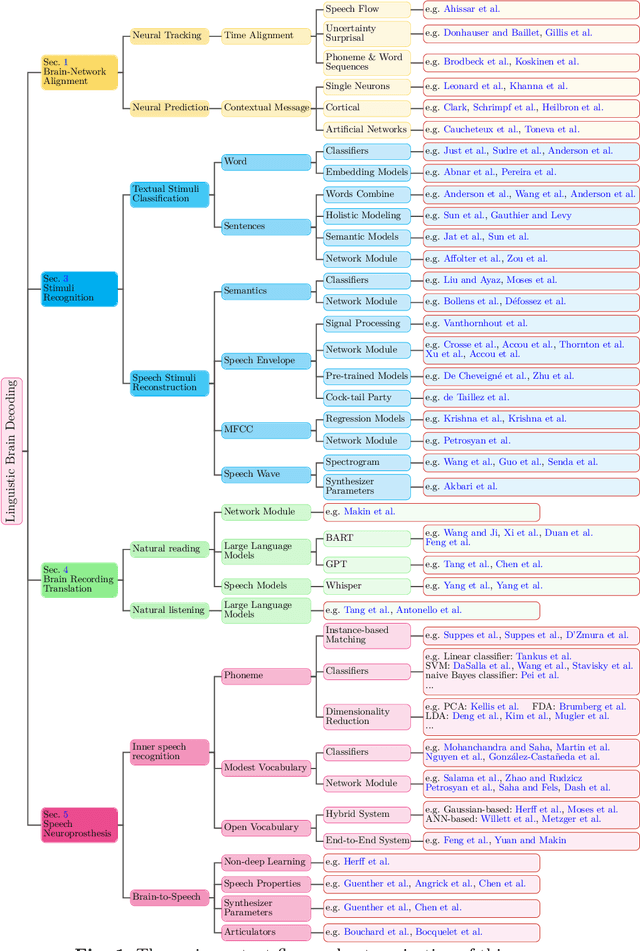
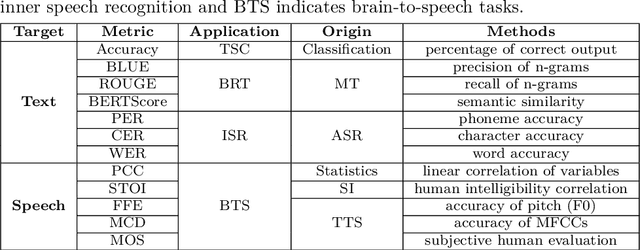
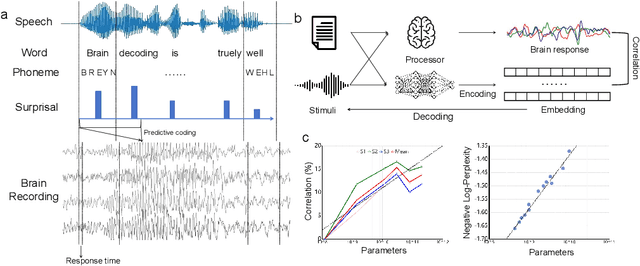
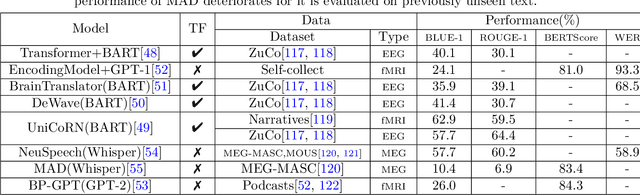
Language, as an information medium created by advanced organisms, has always been a concern of neuroscience regarding how it is represented in the brain. Decoding linguistic representations in the evoked brain has shown groundbreaking achievements, thanks to the rapid improvement of neuroimaging, medical technology, life sciences and artificial intelligence. In this work, we present a taxonomy of brain-to-language decoding of both textual and speech formats. This work integrates two types of research: neuroscience focusing on language understanding and deep learning-based brain decoding. Generating discernible language information from brain activity could not only help those with limited articulation, especially amyotrophic lateral sclerosis (ALS) patients but also open up a new way for the next generation's brain-computer interface (BCI). This article will help brain scientists and deep-learning researchers to gain a bird's eye view of fine-grained language perception, and thus facilitate their further investigation and research of neural process and language decoding.