 Add to Chrome
 Add to Firefox
 Add to Edge
Still Manual? Automated Linter Configuration via DSL-Based LLM Compilation of Coding Standards
Feb 08, 2026
Coding standards are essential for maintaining consistent and high-quality code across teams and projects. Linters help developers enforce these standards by detecting code violations. However, manual linter configuration is complex and expertise-intensive, and the diversity and evolution of programming languages, coding standards, and linters lead to repetitive and maintenance-intensive configuration work. To reduce manual effort, we propose LintCFG, a domain-specific language (DSL)-driven, LLM-based compilation approach to automate linter configuration generation for coding standards, independent of programming languages, coding standards, and linters. Inspired by compiler design, we first design a DSL to express coding rules in a tool-agnostic, structured, readable, and precise manner. Then, we build linter configurations into DSL configuration instructions. For a given natural language coding standard, the compilation process parses it into DSL coding standards, matches them with the DSL configuration instructions to set configuration names, option names and values, verifies consistency between the standards and configurations, and finally generates linter-specific configurations. Experiments with Checkstyle for Java coding standard show that our approach achieves over 90% precision and recall in DSL representation, with accuracy, precision, recall, and F1-scores close to 70% (with some exceeding 70%) in fine-grained linter configuration generation. Notably, our approach outperforms baselines by over 100% in precision. A user study further shows that our approach improves developers' efficiency in configuring linters for coding standards. Finally, we demonstrate the generality of the approach by generating ESLint configurations for JavaScript coding standards, showcasing its broad applicability across other programming languages, coding standards, and linters.

Segmentation of Levator Hiatus Using Multi-Scale Local Region Active contours and Boundary Shape Similarity Constraint
Jan 11, 2019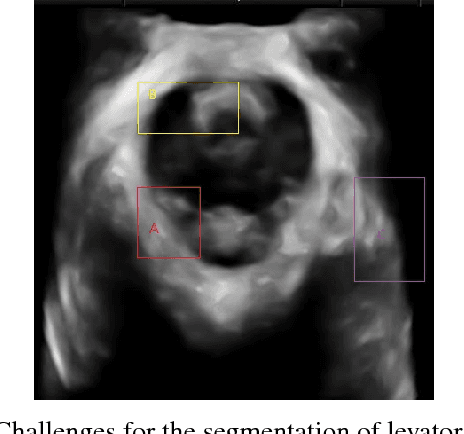
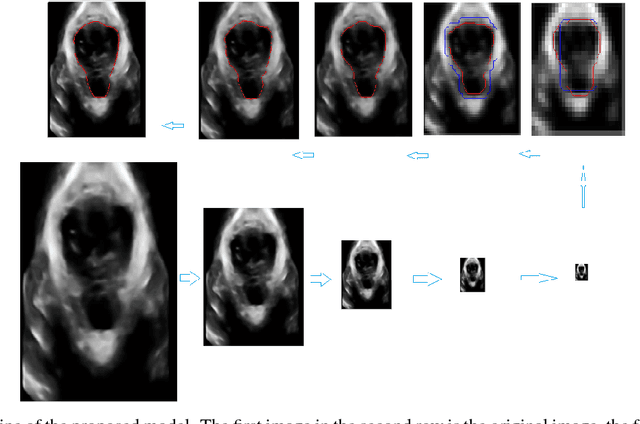
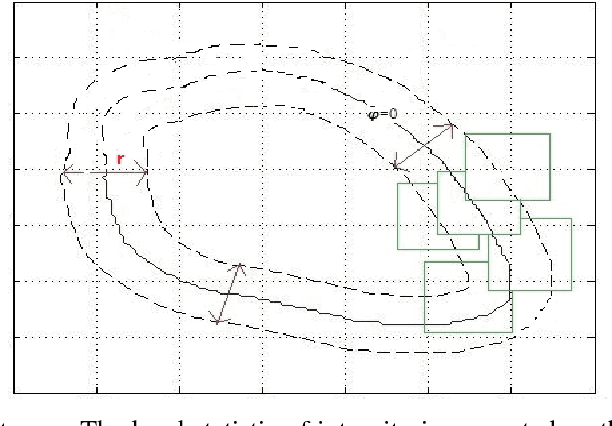
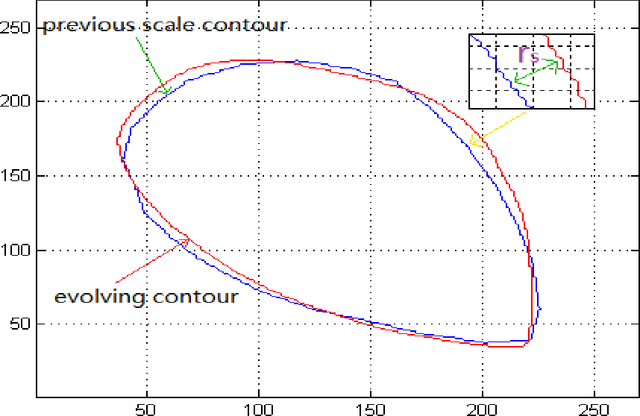
In this paper, a multi-scale framework with local region based active contour and boundary shape similarity constraint is proposed for the segmentation of levator hiatus in ultrasound images. In this paper, we proposed a multiscale active contour framework to segment levator hiatus ultrasound images by combining the local region information and boundary shape similarity constraint. In order to get more precisely initializations and reduce the computational cost, Gaussian pyramid method is used to decompose the image into coarse-to-fine scales. A localized region active contour model is firstly performed on the coarsest scale image to get a rough contour of the levator hiatus, then the segmentation result on the coarse scale is interpolated into the finer scale image as the initialization. The boundary shape similarity between different scales is incorporate into the local region based active contour model so that the result from coarse scale can guide the contour evolution at finer scale. By incorporating the multi-scale and boundary shape similarity, the proposed method can precisely locate the levator hiatus boundaries despite various ultrasound image artifacts. With a data set of 90 levator hiatus ultrasound images, the efficiency and accuracy of the proposed method are validated by quantitative and qualitative evaluations (TP, FP, Js) and comparison with other two state-of-art active contour segmentation methods (C-V model, DRLSE model).