 Add to Chrome
 Add to Firefox
 Add to Edge
Next-Scale Prediction: A Self-Supervised Approach for Real-World Image Denoising
Dec 24, 2025
Self-supervised real-world image denoising remains a fundamental challenge, arising from the antagonistic trade-off between decorrelating spatially structured noise and preserving high-frequency details. Existing blind-spot network (BSN) methods rely on pixel-shuffle downsampling (PD) to decorrelate noise, but aggressive downsampling fragments fine structures, while milder downsampling fails to remove correlated noise. To address this, we introduce Next-Scale Prediction (NSP), a novel self-supervised paradigm that decouples noise decorrelation from detail preservation. NSP constructs cross-scale training pairs, where BSN takes low-resolution, fully decorrelated sub-images as input to predict high-resolution targets that retain fine details. As a by-product, NSP naturally supports super-resolution of noisy images without retraining or modification. Extensive experiments demonstrate that NSP achieves state-of-the-art self-supervised denoising performance on real-world benchmarks, significantly alleviating the long-standing conflict between noise decorrelation and detail preservation.

LaverNet: Lightweight All-in-one Video Restoration via Selective Propagation
Dec 18, 2025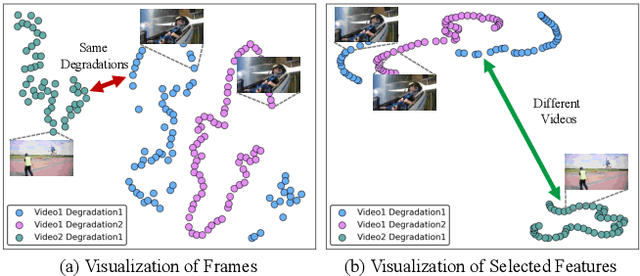
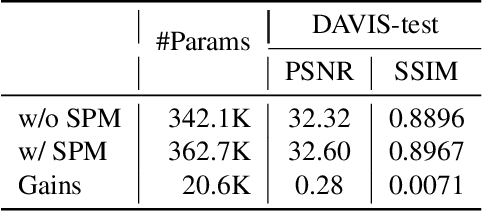
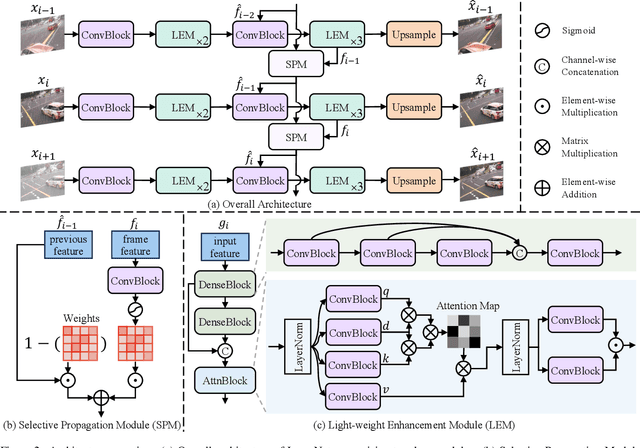
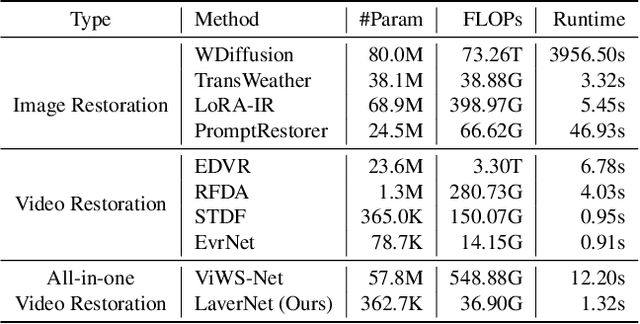
Recent studies have explored all-in-one video restoration, which handles multiple degradations with a unified model. However, these approaches still face two challenges when dealing with time-varying degradations. First, the degradation can dominate temporal modeling, confusing the model to focus on artifacts rather than the video content. Second, current methods typically rely on large models to handle all-in-one restoration, concealing those underlying difficulties. To address these challenges, we propose a lightweight all-in-one video restoration network, LaverNet, with only 362K parameters. To mitigate the impact of degradations on temporal modeling, we introduce a novel propagation mechanism that selectively transmits only degradation-agnostic features across frames. Through LaverNet, we demonstrate that strong all-in-one restoration can be achieved with a compact network. Despite its small size, less than 1\% of the parameters of existing models, LaverNet achieves comparable, even superior performance across benchmarks.
A Novel Truncated Norm Regularization Method for Multi-channel Color Image Denoising
Jul 16, 2023
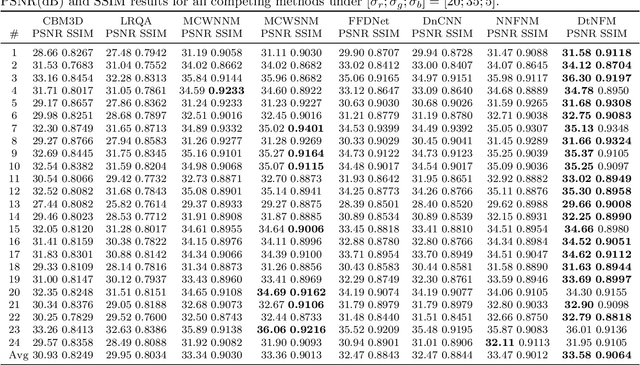
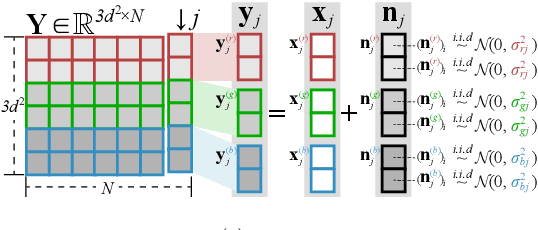
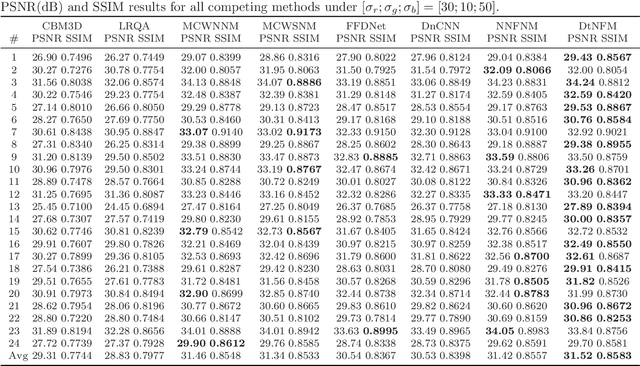
Due to the high flexibility and remarkable performance, low-rank approximation methods has been widely studied for color image denoising. However, those methods mostly ignore either the cross-channel difference or the spatial variation of noise, which limits their capacity in real world color image denoising. To overcome those drawbacks, this paper is proposed to denoise color images with a double-weighted truncated nuclear norm minus truncated Frobenius norm minimization (DtNFM) method. Through exploiting the nonlocal self-similarity of the noisy image, the similar structures are gathered and a series of similar patch matrices are constructed. For each group, the DtNFM model is conducted for estimating its denoised version. The denoised image would be obtained by concatenating all the denoised patch matrices. The proposed DtNFM model has two merits. First, it models and utilizes both the cross-channel difference and the spatial variation of noise. This provides sufficient flexibility for handling the complex distribution of noise in real world images. Second, the proposed DtNFM model provides a close approximation to the underlying clean matrix since it can treat different rank components flexibly. To solve the problem resulted from DtNFM model, an accurate and effective algorithm is proposed by exploiting the framework of the alternating direction method of multipliers (ADMM). The generated subproblems are discussed in detail. And their global optima can be easily obtained in closed-form. Rigorous mathematical derivation proves that the solution sequences generated by the algorithm converge to a single critical point. Extensive experiments on synthetic and real noise datasets demonstrate that the proposed method outperforms many state-of-the-art color image denoising methods.
Multi-channel Nuclear Norm Minus Frobenius Norm Minimization for Color Image Denoising
Sep 16, 2022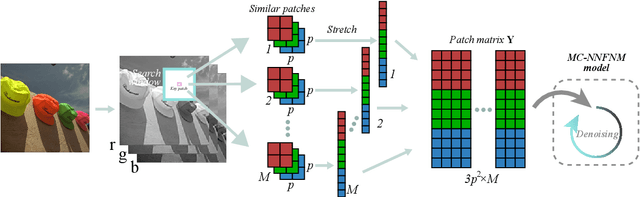
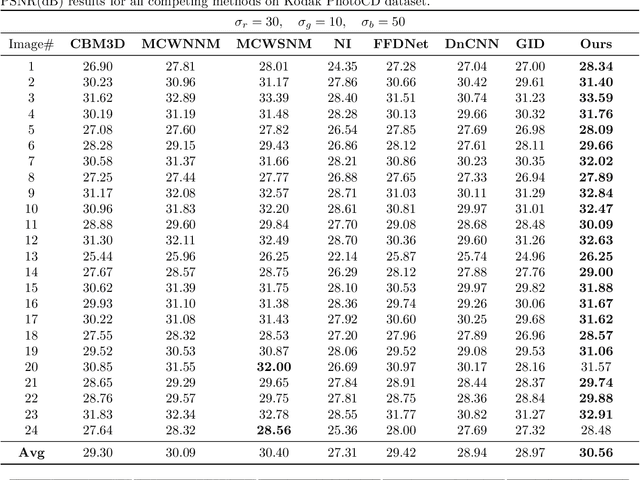
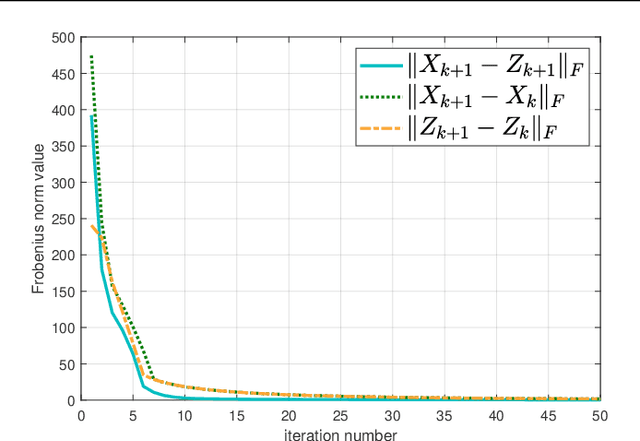
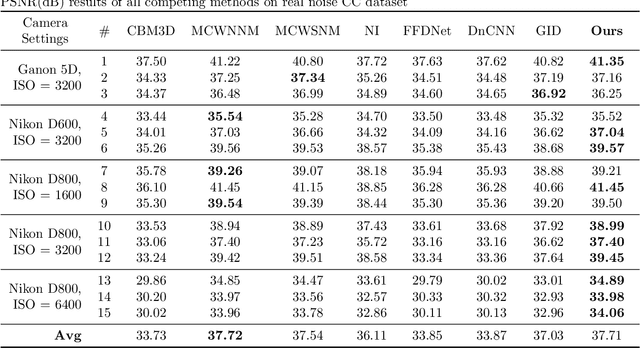
Color image denoising is frequently encountered in various image processing and computer vision tasks. One traditional strategy is to convert the RGB image to a less correlated color space and denoise each channel of the new space separately. However, such a strategy can not fully exploit the correlated information between channels and is inadequate to obtain satisfactory results. To address this issue, this paper proposes a new multi-channel optimization model for color image denoising under the nuclear norm minus Frobenius norm minimization framework. Specifically, based on the block-matching, the color image is decomposed into overlapping RGB patches. For each patch, we stack its similar neighbors to form the corresponding patch matrix. The proposed model is performed on the patch matrix to recover its noise-free version. During the recovery process, a) a weight matrix is introduced to fully utilize the noise difference between channels; b) the singular values are shrunk adaptively without additionally assigning weights. With them, the proposed model can achieve promising results while keeping simplicity. To solve the proposed model, an accurate and effective algorithm is built based on the alternating direction method of multipliers framework. The solution of each updating step can be analytically expressed in closed-from. Rigorous theoretical analysis proves the solution sequences generated by the proposed algorithm converge to their respective stationary points. Experimental results on both synthetic and real noise datasets demonstrate the proposed model outperforms state-of-the-art models.