 Add to Chrome
 Add to Firefox
 Add to Edge
No Universal Signal Predicts Sample-Level LLM Regression under Version Updates
Aug 11, 2026
Frontier LLMs are updated frequently and typically outperform their predecessors in aggregate. But aggregate gains say little about individual samples: an update can still cause sample-level regression, where a response correct under the old model becomes incorrect under the new one. This paper studies how to predict such regressions from signals available at inference time. We compare single-model signals (confidence, logit margin, attention entropy) against cross-version signals (output KL divergence, likelihood drift, token-level KL, representation drift) under a unified added-value test that isolates each signal's gain over a confidence baseline. Across six benchmarks in three task families (multiple-choice question answering, or MCQ; math reasoning; code generation) and six model update pairs, we find that (1) signal effectiveness is task-dependent: confidence is strongest on MCQ and simpler math, while likelihood/KL signals give the most frequent gains on harder math and code; (2) no signal is universally best across model updates either; and (3) some cross-version signals stay informative even when confidence fails, including without labels, which supports a proof-of-concept selective fallback that routes high-risk samples back to the old model. Practitioners can use these task-level patterns to choose which regression signal to trust for a given update. Code is available at https://github.com/jiashengsally/llm-regression-signals.

Sequential Data Poisoning in LLM Post-Training
Jun 03, 2026LLM post-training proceeds through multiple stages, e.g., supervised fine-tuning (SFT) followed by reinforcement learning from human feedback (RLHF) or direct preference optimization (DPO), where each stage draws data from different, potentially untrusted sources. Existing literature assumes data poisoning attacks may occur at each training stage, but neglects the possibility of multiple attackers. To study the trustworthiness of the entire post-training pipeline, we propose the threat model of sequential data poisoning, where multiple adversaries separately poison the SFT and preference datasets. Under this threat model, we identify the single-attacker illusion: each adversary, evaluated in isolation, appears to pose a negligible threat. Yet when adversaries collaborate across stages, the true vulnerability is revealed. In the SFT $\to$ DPO pipeline, their contributions are additive: splitting a fixed poison budget across stages outperforms concentrating it in either stage alone. In the SFT $\to$ PPO pipeline, their contributions are complementary: neither SFT nor reward model poisoning succeeds individually, yet their combination does. These findings show that security analyses of individual post-training stages systematically underestimate compound vulnerabilities that emerge only from their interaction. Code is available at https://github.com/jcksanderson/sequential-poisoning.
MVGD-Net: A Novel Motion-aware Video Glass Surface Detection Network
Jan 20, 2026Glass surface ubiquitous in both daily life and professional environments presents a potential threat to vision-based systems, such as robot and drone navigation. To solve this challenge, most recent studies have shown significant interest in Video Glass Surface Detection (VGSD). We observe that objects in the reflection (or transmission) layer appear farther from the glass surfaces. Consequently, in video motion scenarios, the notable reflected (or transmitted) objects on the glass surface move slower than objects in non-glass regions within the same spatial plane, and this motion inconsistency can effectively reveal the presence of glass surfaces. Based on this observation, we propose a novel network, named MVGD-Net, for detecting glass surfaces in videos by leveraging motion inconsistency cues. Our MVGD-Net features three novel modules: the Cross-scale Multimodal Fusion Module (CMFM) that integrates extracted spatial features and estimated optical flow maps, the History Guided Attention Module (HGAM) and Temporal Cross Attention Module (TCAM), both of which further enhances temporal features. A Temporal-Spatial Decoder (TSD) is also introduced to fuse the spatial and temporal features for generating the glass region mask. Furthermore, for learning our network, we also propose a large-scale dataset, which comprises 312 diverse glass scenarios with a total of 19,268 frames. Extensive experiments demonstrate that our MVGD-Net outperforms relevant state-of-the-art methods.
Not All Samples Are Equal: Quantifying Instance-level Difficulty in Targeted Data Poisoning
Sep 08, 2025Targeted data poisoning attacks pose an increasingly serious threat due to their ease of deployment and high success rates. These attacks aim to manipulate the prediction for a single test sample in classification models. Unlike indiscriminate attacks that aim to decrease overall test performance, targeted attacks present a unique threat to individual test instances. This threat model raises a fundamental question: what factors make certain test samples more susceptible to successful poisoning than others? We investigate how attack difficulty varies across different test instances and identify key characteristics that influence vulnerability. This paper introduces three predictive criteria for targeted data poisoning difficulty: ergodic prediction accuracy (analyzed through clean training dynamics), poison distance, and poison budget. Our experimental results demonstrate that these metrics effectively predict the varying difficulty of real-world targeted poisoning attacks across diverse scenarios, offering practitioners valuable insights for vulnerability assessment and understanding data poisoning attacks.
Cross-Border Legal Adaptation of Autonomous Vehicle Design based on Logic and Non-monotonic Reasoning
Jul 30, 2025This paper focuses on the legal compliance challenges of autonomous vehicles in a transnational context. We choose the perspective of designers and try to provide supporting legal reasoning in the design process. Based on argumentation theory, we introduce a logic to represent the basic properties of argument-based practical (normative) reasoning, combined with partial order sets of natural numbers to express priority. Finally, through case analysis of legal texts, we show how the reasoning system we provide can help designers to adapt their design solutions more flexibly in the cross-border application of autonomous vehicles and to more easily understand the legal implications of their decisions.
BridgePure: Revealing the Fragility of Black-box Data Protection
Dec 30, 2024Availability attacks, or unlearnable examples, are defensive techniques that allow data owners to modify their datasets in ways that prevent unauthorized machine learning models from learning effectively while maintaining the data's intended functionality. It has led to the release of popular black-box tools for users to upload personal data and receive protected counterparts. In this work, we show such black-box protections can be substantially bypassed if a small set of unprotected in-distribution data is available. Specifically, an adversary can (1) easily acquire (unprotected, protected) pairs by querying the black-box protections with the unprotected dataset; and (2) train a diffusion bridge model to build a mapping. This mapping, termed BridgePure, can effectively remove the protection from any previously unseen data within the same distribution. Under this threat model, our method demonstrates superior purification performance on classification and style mimicry tasks, exposing critical vulnerabilities in black-box data protection.
Explaining Non-monotonic Normative Reasoning using Argumentation Theory with Deontic Logic
Sep 18, 2024In our previous research, we provided a reasoning system (called LeSAC) based on argumentation theory to provide legal support to designers during the design process. Building on this, this paper explores how to provide designers with effective explanations for their legally relevant design decisions. We extend the previous system for providing explanations by specifying norms and the key legal or ethical principles for justifying actions in normative contexts. Considering that first-order logic has strong expressive power, in the current paper we adopt a first-order deontic logic system with deontic operators and preferences. We illustrate the advantages and necessity of introducing deontic logic and designing explanations under LeSAC by modelling two cases in the context of autonomous driving. In particular, this paper also discusses the requirements of the updated LeSAC to guarantee rationality, and proves that a well-defined LeSAC can satisfy the rationality postulate for rule-based argumentation frameworks. This ensures the system's ability to provide coherent, legally valid explanations for complex design decisions.
Machine Unlearning Fails to Remove Data Poisoning Attacks
Jun 25, 2024We revisit the efficacy of several practical methods for approximate machine unlearning developed for large-scale deep learning. In addition to complying with data deletion requests, one often-cited potential application for unlearning methods is to remove the effects of training on poisoned data. We experimentally demonstrate that, while existing unlearning methods have been demonstrated to be effective in a number of evaluation settings (e.g., alleviating membership inference attacks), they fail to remove the effects of data poisoning, across a variety of types of poisoning attacks (indiscriminate, targeted, and a newly-introduced Gaussian poisoning attack) and models (image classifiers and LLMs); even when granted a relatively large compute budget. In order to precisely characterize unlearning efficacy, we introduce new evaluation metrics for unlearning based on data poisoning. Our results suggest that a broader perspective, including a wider variety of evaluations, is required to avoid a false sense of confidence in machine unlearning procedures for deep learning without provable guarantees. Moreover, while unlearning methods show some signs of being useful to efficiently remove poisoned datapoints without having to retrain, our work suggests that these methods are not yet "ready for prime time", and currently provide limited benefit over retraining.
Alignment Calibration: Machine Unlearning for Contrastive Learning under Auditing
Jun 05, 2024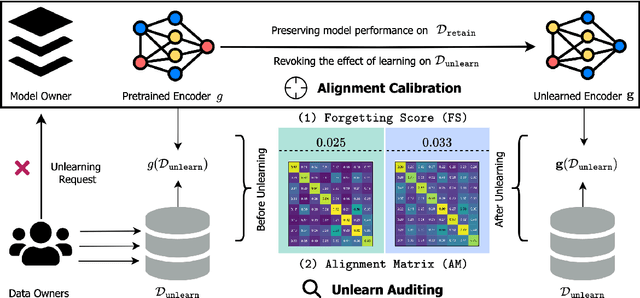
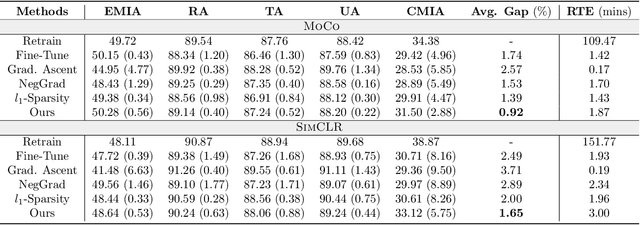
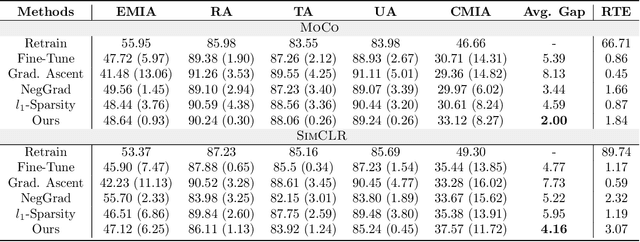
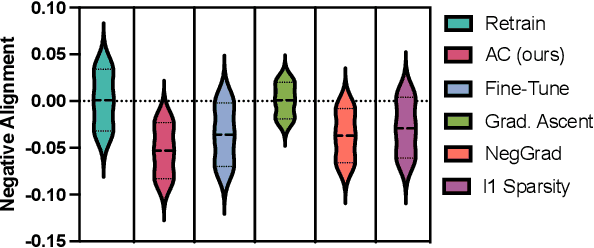
Machine unlearning provides viable solutions to revoke the effect of certain training data on pre-trained model parameters. Existing approaches provide unlearning recipes for classification and generative models. However, a category of important machine learning models, i.e., contrastive learning (CL) methods, is overlooked. In this paper, we fill this gap by first proposing the framework of Machine Unlearning for Contrastive learning (MUC) and adapting existing methods. Furthermore, we observe that several methods are mediocre unlearners and existing auditing tools may not be sufficient for data owners to validate the unlearning effects in contrastive learning. We thus propose a novel method called Alignment Calibration (AC) by explicitly considering the properties of contrastive learning and optimizing towards novel auditing metrics to easily verify unlearning. We empirically compare AC with baseline methods on SimCLR, MoCo and CLIP. We observe that AC addresses drawbacks of existing methods: (1) achieving state-of-the-art performance and approximating exact unlearning (retraining); (2) allowing data owners to clearly visualize the effect caused by unlearning through black-box auditing.
Disguised Copyright Infringement of Latent Diffusion Models
Apr 11, 2024Copyright infringement may occur when a generative model produces samples substantially similar to some copyrighted data that it had access to during the training phase. The notion of access usually refers to including copyrighted samples directly in the training dataset, which one may inspect to identify an infringement. We argue that such visual auditing largely overlooks a concealed copyright infringement, where one constructs a disguise that looks drastically different from the copyrighted sample yet still induces the effect of training Latent Diffusion Models on it. Such disguises only require indirect access to the copyrighted material and cannot be visually distinguished, thus easily circumventing the current auditing tools. In this paper, we provide a better understanding of such disguised copyright infringement by uncovering the disguises generation algorithm, the revelation of the disguises, and importantly, how to detect them to augment the existing toolbox. Additionally, we introduce a broader notion of acknowledgment for comprehending such indirect access.