 Add to Chrome
 Add to Firefox
 Add to Edge
Multi-Agent Systems are Mixtures of Experts: Who Becomes an Influencer?
May 25, 2026
The effectiveness of multi-agent LLM deliberation depends not only on the agents' individual predictions, but also on how they communicate and collaborate. We study this mechanism through the lens of Friedkin-Johnsen (FJ) opinion dynamics, a tractable model for analyzing stubbornness, influence, and opinion change in multi-agent systems that captures empirically observed deliberation patterns. We show that the FJ parameters are input-dependent, turning multi-agent deliberation into a mixture of experts. This perspective implies that multi-agent systems can outperform single agents and static ensembles when routing reflects agent competence. Since competence is latent in practice, we analyze how influence is established through observable proxies: agents' self-assessed confidence, their perceived confidence, and initial alignment with other agents' views.

Don't Trust Stubborn Neighbors: A Security Framework for Agentic Networks
Mar 16, 2026Large Language Model (LLM)-based Multi-Agent Systems (MASs) are increasingly deployed for agentic tasks, such as web automation, itinerary planning, and collaborative problem solving. Yet, their interactive nature introduces new security risks: malicious or compromised agents can exploit communication channels to propagate misinformation and manipulate collective outcomes. In this paper, we study how such manipulation can arise and spread by borrowing the Friedkin-Johnsen opinion formation model from social sciences to propose a general theoretical framework to study LLM-MAS. Remarkably, this model closely captures LLM-MAS behavior, as we verify in extensive experiments across different network topologies and attack and defense scenarios. Theoretically and empirically, we find that a single highly stubborn and persuasive agent can take over MAS dynamics, underscoring the systems' high susceptibility to attacks by triggering a persuasion cascade that reshapes collective opinion. Our theoretical analysis reveals three mechanisms to increase system security: a) increasing the number of benign agents, b) increasing the innate stubbornness or peer-resistance of agents, or c) reducing trust in potential adversaries. Because scaling is computationally expensive and high stubbornness degrades the network's ability to reach consensus, we propose a new mechanism to mitigate threats by a trust-adaptive defense that dynamically adjusts inter-agent trust to limit adversarial influence while maintaining cooperative performance. Extensive experiments confirm that this mechanism effectively defends against manipulation.
Easy Data Unlearning Bench
Feb 18, 2026Evaluating machine unlearning methods remains technically challenging, with recent benchmarks requiring complex setups and significant engineering overhead. We introduce a unified and extensible benchmarking suite that simplifies the evaluation of unlearning algorithms using the KLoM (KL divergence of Margins) metric. Our framework provides precomputed model ensembles, oracle outputs, and streamlined infrastructure for running evaluations out of the box. By standardizing setup and metrics, it enables reproducible, scalable, and fair comparison across unlearning methods. We aim for this benchmark to serve as a practical foundation for accelerating research and promoting best practices in machine unlearning. Our code and data are publicly available.
Generalizing Trust: Weak-to-Strong Trustworthiness in Language Models
Dec 31, 2024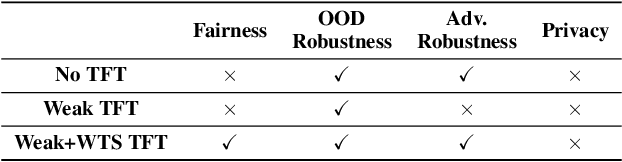
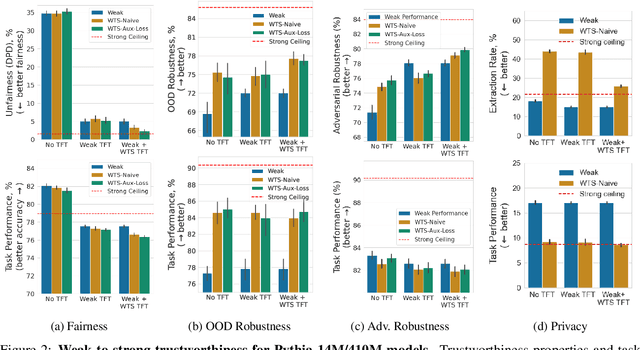
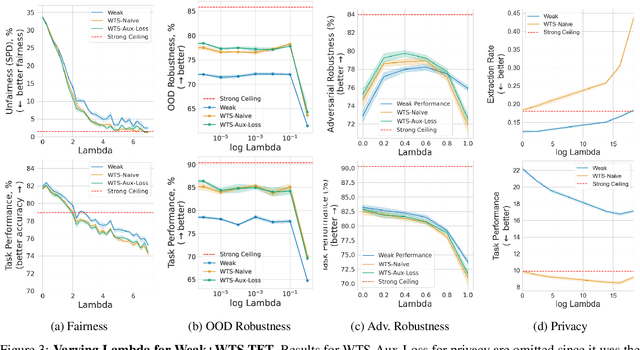

The rapid proliferation of generative AI, especially large language models, has led to their integration into a variety of applications. A key phenomenon known as weak-to-strong generalization - where a strong model trained on a weak model's outputs surpasses the weak model in task performance - has gained significant attention. Yet, whether critical trustworthiness properties such as robustness, fairness, and privacy can generalize similarly remains an open question. In this work, we study this question by examining if a stronger model can inherit trustworthiness properties when fine-tuned on a weaker model's outputs, a process we term weak-to-strong trustworthiness generalization. To address this, we introduce two foundational training strategies: 1) Weak Trustworthiness Finetuning (Weak TFT), which leverages trustworthiness regularization during the fine-tuning of the weak model, and 2) Weak and Weak-to-Strong Trustworthiness Finetuning (Weak+WTS TFT), which extends regularization to both weak and strong models. Our experimental evaluation on real-world datasets reveals that while some trustworthiness properties, such as fairness, adversarial, and OOD robustness, show significant improvement in transfer when both models were regularized, others like privacy do not exhibit signs of weak-to-strong trustworthiness. As the first study to explore trustworthiness generalization via weak-to-strong generalization, our work provides valuable insights into the potential and limitations of weak-to-strong generalization.
Explaining the Model, Protecting Your Data: Revealing and Mitigating the Data Privacy Risks of Post-Hoc Model Explanations via Membership Inference
Jul 24, 2024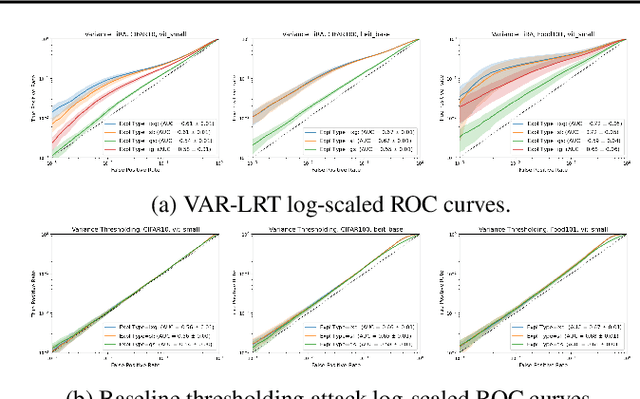


Predictive machine learning models are becoming increasingly deployed in high-stakes contexts involving sensitive personal data; in these contexts, there is a trade-off between model explainability and data privacy. In this work, we push the boundaries of this trade-off: with a focus on foundation models for image classification fine-tuning, we reveal unforeseen privacy risks of post-hoc model explanations and subsequently offer mitigation strategies for such risks. First, we construct VAR-LRT and L1/L2-LRT, two new membership inference attacks based on feature attribution explanations that are significantly more successful than existing explanation-leveraging attacks, particularly in the low false-positive rate regime that allows an adversary to identify specific training set members with confidence. Second, we find empirically that optimized differentially private fine-tuning substantially diminishes the success of the aforementioned attacks, while maintaining high model accuracy. We carry out a systematic empirical investigation of our 2 new attacks with 5 vision transformer architectures, 5 benchmark datasets, 4 state-of-the-art post-hoc explanation methods, and 4 privacy strength settings.
Machine Unlearning Fails to Remove Data Poisoning Attacks
Jun 25, 2024We revisit the efficacy of several practical methods for approximate machine unlearning developed for large-scale deep learning. In addition to complying with data deletion requests, one often-cited potential application for unlearning methods is to remove the effects of training on poisoned data. We experimentally demonstrate that, while existing unlearning methods have been demonstrated to be effective in a number of evaluation settings (e.g., alleviating membership inference attacks), they fail to remove the effects of data poisoning, across a variety of types of poisoning attacks (indiscriminate, targeted, and a newly-introduced Gaussian poisoning attack) and models (image classifiers and LLMs); even when granted a relatively large compute budget. In order to precisely characterize unlearning efficacy, we introduce new evaluation metrics for unlearning based on data poisoning. Our results suggest that a broader perspective, including a wider variety of evaluations, is required to avoid a false sense of confidence in machine unlearning procedures for deep learning without provable guarantees. Moreover, while unlearning methods show some signs of being useful to efficiently remove poisoned datapoints without having to retrain, our work suggests that these methods are not yet "ready for prime time", and currently provide limited benefit over retraining.
Towards Non-Adversarial Algorithmic Recourse
Mar 15, 2024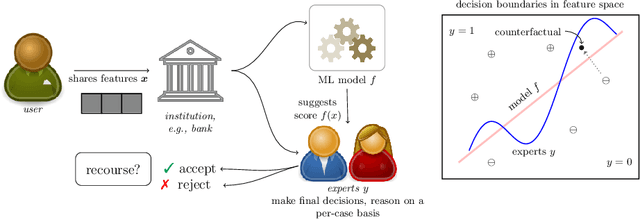
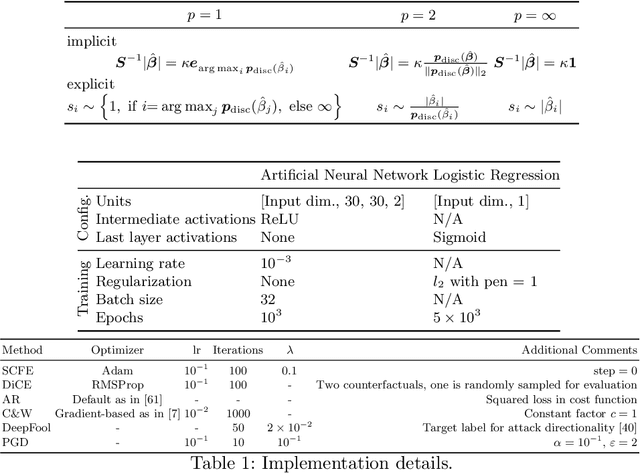
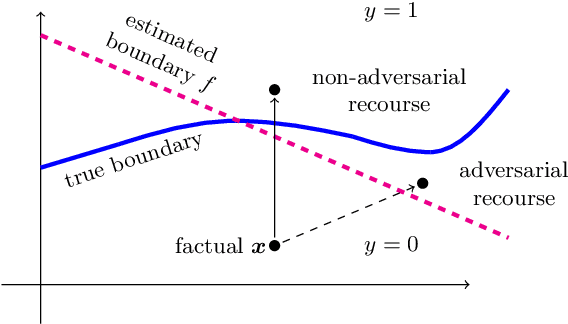
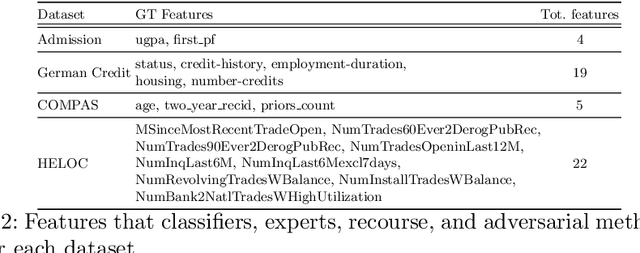
The streams of research on adversarial examples and counterfactual explanations have largely been growing independently. This has led to several recent works trying to elucidate their similarities and differences. Most prominently, it has been argued that adversarial examples, as opposed to counterfactual explanations, have a unique characteristic in that they lead to a misclassification compared to the ground truth. However, the computational goals and methodologies employed in existing counterfactual explanation and adversarial example generation methods often lack alignment with this requirement. Using formal definitions of adversarial examples and counterfactual explanations, we introduce non-adversarial algorithmic recourse and outline why in high-stakes situations, it is imperative to obtain counterfactual explanations that do not exhibit adversarial characteristics. We subsequently investigate how different components in the objective functions, e.g., the machine learning model or cost function used to measure distance, determine whether the outcome can be considered an adversarial example or not. Our experiments on common datasets highlight that these design choices are often more critical in deciding whether recourse is non-adversarial than whether recourse or attack algorithms are used. Furthermore, we show that choosing a robust and accurate machine learning model results in less adversarial recourse desired in practice.
In-Context Unlearning: Language Models as Few Shot Unlearners
Oct 12, 2023Machine unlearning, the study of efficiently removing the impact of specific training points on the trained model, has garnered increased attention of late, driven by the need to comply with privacy regulations like the Right to be Forgotten. Although unlearning is particularly relevant for LLMs in light of the copyright issues they raise, achieving precise unlearning is computationally infeasible for very large models. To this end, recent work has proposed several algorithms which approximate the removal of training data without retraining the model. These algorithms crucially rely on access to the model parameters in order to update them, an assumption that may not hold in practice due to computational constraints or when the LLM is accessed via API. In this work, we propose a new class of unlearning methods for LLMs we call ''In-Context Unlearning'', providing inputs in context and without having to update model parameters. To unlearn a particular training instance, we provide the instance alongside a flipped label and additional correctly labelled instances which are prepended as inputs to the LLM at inference time. Our experimental results demonstrate that these contexts effectively remove specific information from the training set while maintaining performance levels that are competitive with (or in some cases exceed) state-of-the-art unlearning methods that require access to the LLM parameters.
Gaussian Membership Inference Privacy
Jun 12, 2023We propose a new privacy notion called $f$-Membership Inference Privacy ($f$-MIP), which explicitly considers the capabilities of realistic adversaries under the membership inference attack threat model. By doing so $f$-MIP offers interpretable privacy guarantees and improved utility (e.g., better classification accuracy). Our novel theoretical analysis of likelihood ratio-based membership inference attacks on noisy stochastic gradient descent (SGD) results in a parametric family of $f$-MIP guarantees that we refer to as $\mu$-Gaussian Membership Inference Privacy ($\mu$-GMIP). Our analysis additionally yields an analytical membership inference attack that offers distinct advantages over previous approaches. First, unlike existing methods, our attack does not require training hundreds of shadow models to approximate the likelihood ratio. Second, our analytical attack enables straightforward auditing of our privacy notion $f$-MIP. Finally, our analysis emphasizes the importance of various factors, such as hyperparameters (e.g., batch size, number of model parameters) and data specific characteristics in controlling an attacker's success in reliably inferring a given point's membership to the training set. We demonstrate the effectiveness of our method on models trained across vision and tabular datasets.
On the Privacy Risks of Algorithmic Recourse
Nov 10, 2022
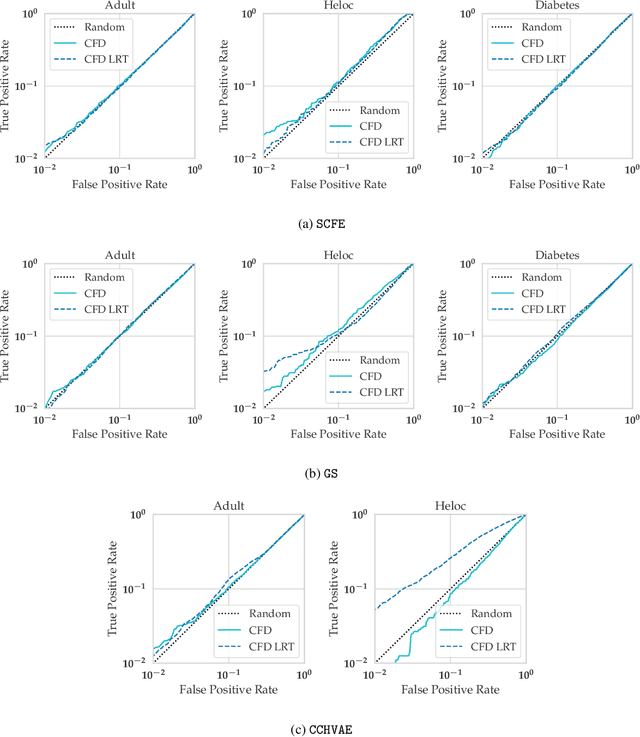
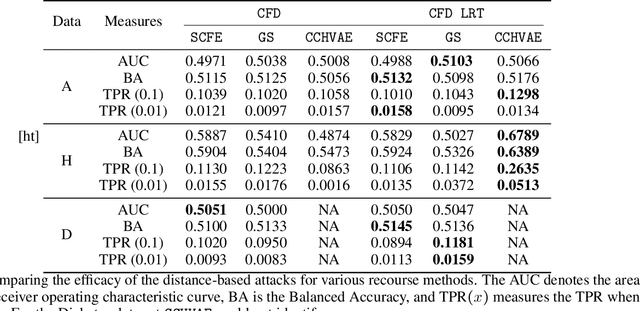

As predictive models are increasingly being employed to make consequential decisions, there is a growing emphasis on developing techniques that can provide algorithmic recourse to affected individuals. While such recourses can be immensely beneficial to affected individuals, potential adversaries could also exploit these recourses to compromise privacy. In this work, we make the first attempt at investigating if and how an adversary can leverage recourses to infer private information about the underlying model's training data. To this end, we propose a series of novel membership inference attacks which leverage algorithmic recourse. More specifically, we extend the prior literature on membership inference attacks to the recourse setting by leveraging the distances between data instances and their corresponding counterfactuals output by state-of-the-art recourse methods. Extensive experimentation with real world and synthetic datasets demonstrates significant privacy leakage through recourses. Our work establishes unintended privacy leakage as an important risk in the widespread adoption of recourse methods.