 Add to Chrome
 Add to Firefox
 Add to Edge
Debating the Unspoken: Role-Anchored Multi-Agent Reasoning for Half-Truth Detection
Apr 21, 2026
Half-truths, claims that are factually correct yet misleading due to omitted context, remain a blind spot for fact verification systems focused on explicit falsehoods. Addressing such omission-based manipulation requires reasoning not only about what is said, but also about what is left unsaid. We propose RADAR, a role-anchored multi-agent debate framework for omission-aware fact verification under realistic, noisy retrieval. RADAR assigns complementary roles to a Politician and a Scientist, who reason adversarially over shared retrieved evidence, moderated by a neutral Judge. A dual-threshold early termination controller adaptively decides when sufficient reasoning has been reached to issue a verdict. Experiments show that RADAR consistently outperforms strong single- and multi-agent baselines across datasets and backbones, improving omission detection accuracy while reducing reasoning cost. These results demonstrate that role-anchored, retrieval-grounded debate with adaptive control is an effective and scalable framework for uncovering missing context in fact verification. The code is available at https://github.com/tangyixuan/RADAR.

PROMISE: Prompt-Attentive Hierarchical Contrastive Learning for Robust Cross-Modal Representation with Missing Modalities
Nov 14, 2025Multimodal models integrating natural language and visual information have substantially improved generalization of representation models. However, their effectiveness significantly declines in real-world situations where certain modalities are missing or unavailable. This degradation primarily stems from inconsistent representation learning between complete multimodal data and incomplete modality scenarios. Existing approaches typically address missing modalities through relatively simplistic generation methods, yet these approaches fail to adequately preserve cross-modal consistency, leading to suboptimal performance. To overcome this limitation, we propose a novel multimodal framework named PROMISE, a PROMpting-Attentive HIerarchical ContraStive LEarning approach designed explicitly for robust cross-modal representation under conditions of missing modalities. Specifically, PROMISE innovatively incorporates multimodal prompt learning into a hierarchical contrastive learning framework, equipped with a specially designed prompt-attention mechanism. This mechanism dynamically generates robust and consistent representations for scenarios where particular modalities are absent, thereby effectively bridging the representational gap between complete and incomplete data. Extensive experiments conducted on benchmark datasets, along with comprehensive ablation studies, clearly demonstrate the superior performance of PROMISE compared to current state-of-the-art multimodal methods.
ChatLLM Network: More brains, More intelligence
Apr 24, 2023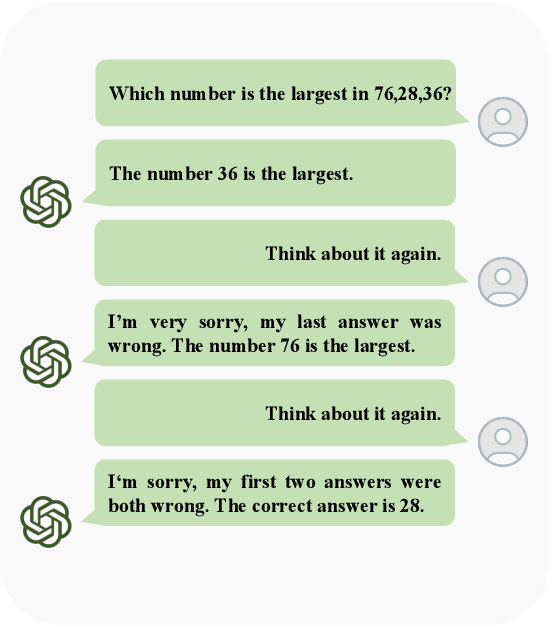
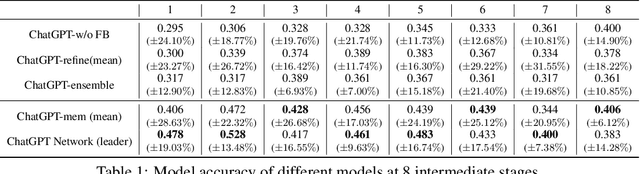
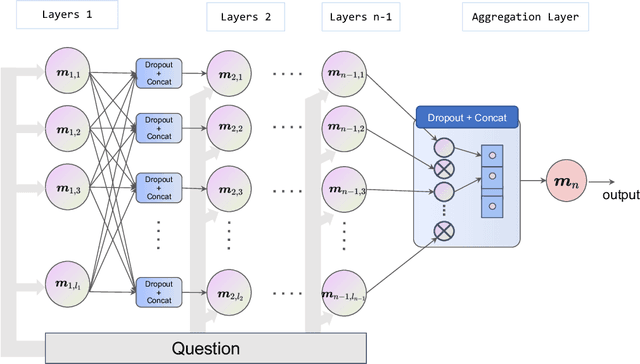
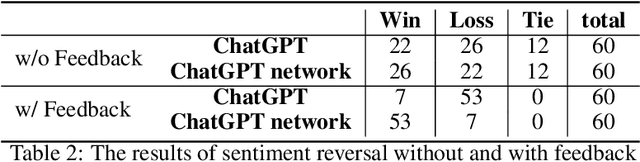
Dialogue-based language models mark a huge milestone in the field of artificial intelligence, by their impressive ability to interact with users, as well as a series of challenging tasks prompted by customized instructions. However, the prevalent large-scale dialogue-based language models like ChatGPT still have room for improvement, such as unstable responses to questions and the inability to think cooperatively like humans. Considering the ability of dialogue-based language models in conversation and their inherent randomness in thinking, we propose ChatLLM network that allows multiple dialogue-based language models to interact, provide feedback, and think together. We design the network of ChatLLMs based on ChatGPT. Specifically, individual instances of ChatGPT may possess distinct perspectives towards the same problem, and by consolidating these diverse viewpoints via a separate ChatGPT, the ChatLLM network system can conduct decision-making more objectively and comprehensively. In addition, a language-based feedback mechanism comparable to backpropagation is devised to update the ChatGPTs within the network. Experiments on two datasets demonstrate that our network attains significant improvements in problem-solving, leading to observable progress amongst each member.