 Add to Chrome
 Add to Firefox
 Add to Edge
Hidden APIs in Language Models: Discovering Reusable Causal Interfaces from Forked Futures
Jul 30, 2026
Identical language-model answers can arise from hidden states that support different future computations, so current-answer probes do not establish a reusable internal interface. We introduce forked futures: future operations are sampled only after a prefix state has formed, and states are compared through the response distributions induced by those operations. This yields an empirical causal quotient over hidden states without requiring researcher-specified latent labels. Shared, Local, Mixture, and Distributed interfaces then compete under prequential causal description length subject to future-signature fidelity and matched capacity constraints. In the two detailed model evaluations, Shared has the lowest held-out description length, with gains of 0.216 nats on Qwen2.5-1.5B and 0.294 nats on Llama-3-8B, while maintaining tightly clustered mean future-signature distortion; a five-backbone sweep preserves the positive direction of Sharedness Gain. The figure-aligned transplantation analysis gives Shared the strongest joint target-correctness, locality, copy-preservation, and composite profile, and API-aligned paths mediate 0.749 of the target effect versus 0.150 for matched null paths. In the blind four-class model-organism test, 14/16 architectures are recovered, with one observed non-Shared to Shared error among 12 non-Shared organisms. These results support an economical reusable causal interface within the tested operation banks, while keeping the claim explicitly conditional on the candidate architectures, interventions, and held-out futures.

FairDD: Enhancing Fairness with domain-incremental learning in dermatological disease diagnosis
Dec 21, 2024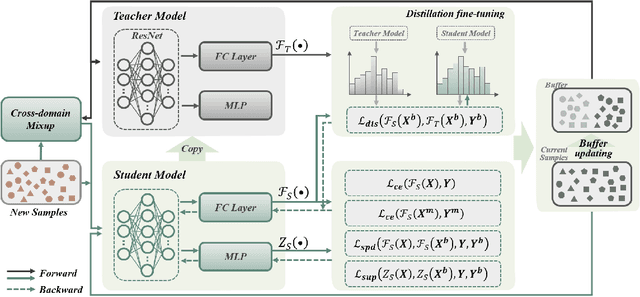
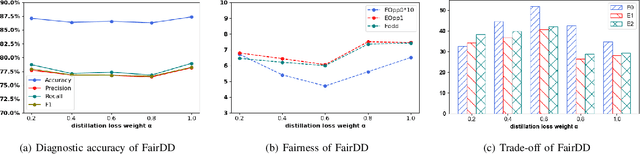
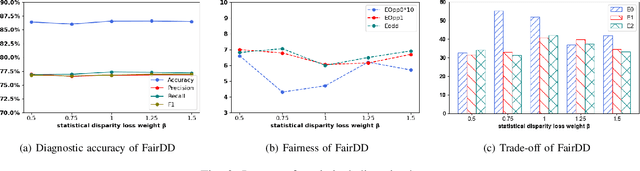
With the rapid advancement of deep learning technologies, artificial intelligence has become increasingly prevalent in the research and application of dermatological disease diagnosis. However, this data-driven approach often faces issues related to decision bias. Existing fairness enhancement techniques typically come at a substantial cost to accuracy. This study aims to achieve a better trade-off between accuracy and fairness in dermatological diagnostic models. To this end, we propose a novel fair dermatological diagnosis network, named FairDD, which leverages domain incremental learning to balance the learning of different groups by being sensitive to changes in data distribution. Additionally, we incorporate the mixup data augmentation technique and supervised contrastive learning to enhance the network's robustness and generalization. Experimental validation on two dermatological datasets demonstrates that our proposed method excels in both fairness criteria and the trade-off between fairness and performance.