 Add to Chrome
 Add to Firefox
 Add to Edge
LEGO: Leveled Language Gaussian Splatting
Aug 10, 2026
We introduce LEGO for advanced open-vocabulary scene understanding. Beyond basic concept recognition, its core innovation lies in capturing the intrinsic semantic hierarchies within the scene, such as the "flowerpot -> bouquet -> bud -> petal" lineage. While foundation models like SAM can identify multi-granular structures in 2D, their partitions are strictly perspective-bound and lack cross-view consensus. LEGO self-adaptively re-grades volatile multi-view SAM granularities into a unified, 3D-consistent hierarchy. This provides precise supervision for the structurally coherent, multi-level segmentation of 3D scenes. By grounding these segments with CLIP embeddings, LEGO recovers open-vocabulary semantic logic across hierarchical levels. Furthermore, by incorporating spatial relationships, we elevate these segments into level-wise language scene graphs, effectively empowering Large Language Models to perform complex, context-aware spatial reasoning and precise visual grounding. Experimental results demonstrate that LEGO establishes new state-of-the-art performance across both promptable and open-vocabulary 3D segmentation benchmarks, exhibiting advanced hierarchical scene decomposition and context-aware spatial reasoning.

Exploiting Motion Prior for Accurate Pose Estimation of Dashboard Cameras
Sep 27, 2024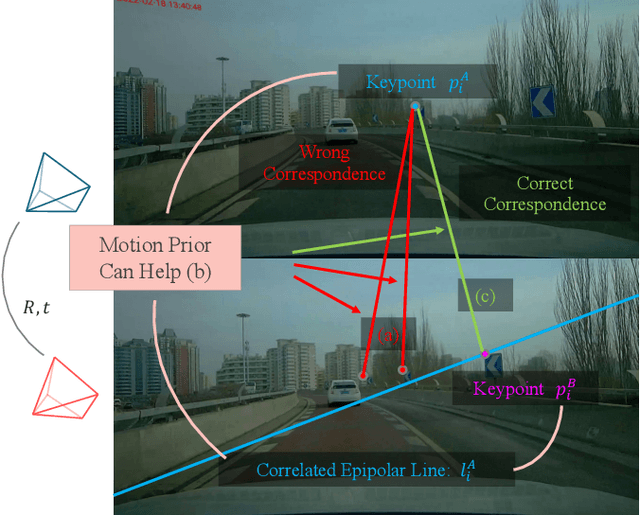

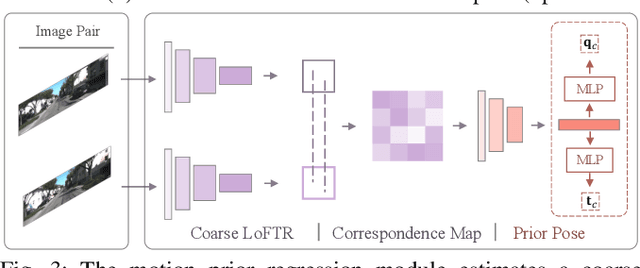
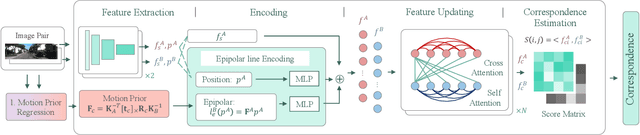
Dashboard cameras (dashcams) record millions of driving videos daily, offering a valuable potential data source for various applications, including driving map production and updates. A necessary step for utilizing these dashcam data involves the estimation of camera poses. However, the low-quality images captured by dashcams, characterized by motion blurs and dynamic objects, pose challenges for existing image-matching methods in accurately estimating camera poses. In this study, we propose a precise pose estimation method for dashcam images, leveraging the inherent camera motion prior. Typically, image sequences captured by dash cameras exhibit pronounced motion prior, such as forward movement or lateral turns, which serve as essential cues for correspondence estimation. Building upon this observation, we devise a pose regression module aimed at learning camera motion prior, subsequently integrating these prior into both correspondences and pose estimation processes. The experiment shows that, in real dashcams dataset, our method is 22% better than the baseline for pose estimation in AUC5\textdegree, and it can estimate poses for 19% more images with less reprojection error in Structure from Motion (SfM).