 Add to Chrome
 Add to Firefox
 Add to Edge
Learning from Own Solutions: Self-Conditioned Credit Assignment for Reinforcement Learning with Verifiable Rewards
Jun 17, 2026
Reinforcement learning with verifiable rewards (RLVR) has driven substantial progress in training LLMs for reasoning tasks, but representative methods such as GRPO assign uniform credit across all tokens, wasting gradient on routine tokens while under-crediting pivotal reasoning steps. Existing token-level credit assignment methods require resources beyond the model's own rollouts. GRPO variants rely on process reward models or ground-truth answers. Knowledge distillation assigns credit through per-token divergence but requires external teachers (On-Policy Distillation) or privileged information (On-Policy Self Distillation). However, these dependencies limit applicability in the pure RLVR setting. We observe that conditioning the model on its own verified trajectories induces a measurable per-token KL divergence between the original and conditioned distributions, and prove that distilling from a self-teacher constructed by verified trajectories leads to infeasible weighted-average solutions when multiple verified trajectories exist. We propose SC-GRPO (Self-Conditioned GRPO), which uses KL divergence mentioned before as a multiplicative weight on GRPO gradients. Across five benchmarks spanning math, code, and agentic tasks, SC-GRPO consistently outperforms 8.1% over GRPO and 5.9% over DAPO with stronger OOD performance. Moreover, SC-GRPO achieves higher performance than OPD.

PEC-Home: Interpretation of Progressively Elliptical Commands in Smart Homes
Jun 17, 2026Recent advancements in Large Language Models (LLMs) have empowered home assistants with natural language interaction capabilities. However, current assistants overlook the progressive omission that occurs in human dialogue as shared context accumulates, leading to more elliptical expressions for efficient communication. Thus, current assistants still struggle to interpret such elliptical expressions accurately, which limits their effectiveness in real-world applications. In practical smart home scenarios, assistants face two major challenges caused by elliptical commands: (1) referential ambiguity caused by different environmental expectations among multiple users; and (2) intention ambiguity resulting from user preferences that evolve over time or change with the environment. To address these challenges, we introduce PEC-Home, the first simulated home dataset specifically designed for interpreting progressively elliptical commands in smart homes. Extensive experiments on various LLMs, including GPT-4o, show that existing home assistants struggle to execute user-intended operations based solely on elliptical commands. Even when equipped with tools for storing and retrieving user dialogue history, execution accuracy remains below that achieved with complete commands.}.
Mem$^2$Evolve: Towards Self-Evolving Agents via Co-Evolutionary Capability Expansion and Experience Distillation
Apr 13, 2026While large language model--powered agents can self-evolve by accumulating experience or by dynamically creating new assets (i.e., tools or expert agents), existing frameworks typically treat these two evolutionary processes in isolation. This separation overlooks their intrinsic interdependence: the former is inherently bounded by a manually predefined static toolset, while the latter generates new assets from scratch without experiential guidance, leading to limited capability growth and unstable evolution. To address this limitation, we introduce a novel paradigm of co-evolutionary Capability Expansion and Experience Distillation. Guided by this paradigm, we propose the \textbf{Mem$^{\textbf{2}}$Evolve}, which integrates two core components: \textbf{Experience Memory} and \textbf{Asset Memory}. Specifically, Mem$^{2}$Evolve leverages accumulated experience to guide the dynamic creation of assets, thereby expanding the agent's capability space while simultaneously acquiring new experience to achieve co-evolution. Extensive experiments across 6 task categories and 8 benchmarks demonstrate that Mem$^{2}$Evolve achieves improvement of 18.53\% over standard LLMs, 11.80\% over agents evolving solely through experience, and 6.46\% over those evolving solely through asset creation, establishing it as a substantially more effective and stable self-evolving agent framework. Code is available at: https://buaa-irip-llm.github.io/Mem2Evolve.
FAME: Towards Factual Multi-Task Model Editing
Oct 07, 2024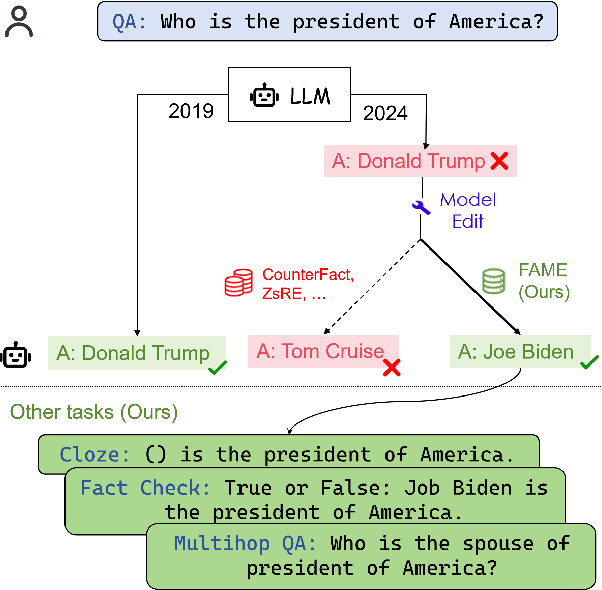
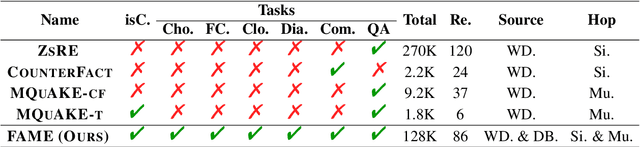
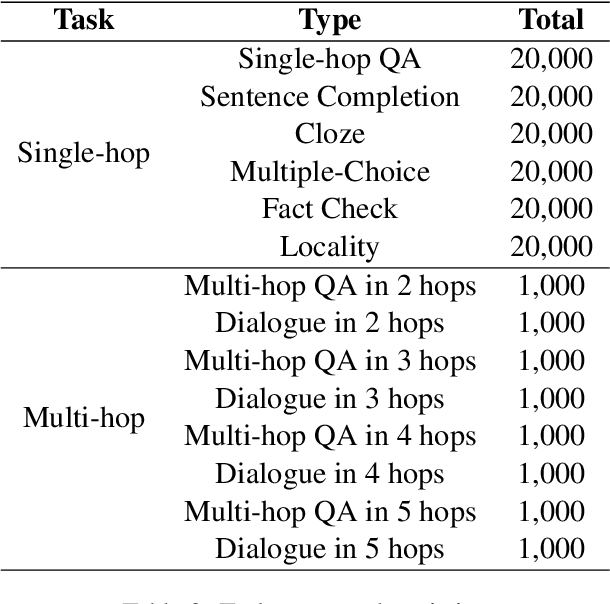
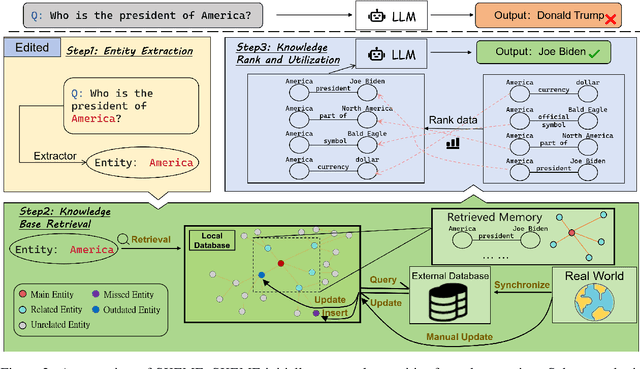
Large language models (LLMs) embed extensive knowledge and utilize it to perform exceptionally well across various tasks. Nevertheless, outdated knowledge or factual errors within LLMs can lead to misleading or incorrect responses, causing significant issues in practical applications. To rectify the fatal flaw without the necessity for costly model retraining, various model editing approaches have been proposed to correct inaccurate knowledge within LLMs in a cost-efficient way. To evaluate these model editing methods, previous work introduced a series of datasets. However, most of the previous datasets only contain fabricated data in a single format, which diverges from real-world model editing scenarios, raising doubts about their usability in practice. To facilitate the application of model editing in real-world scenarios, we propose the challenge of practicality. To resolve such challenges and effectively enhance the capabilities of LLMs, we present FAME, an factual, comprehensive, and multi-task dataset, which is designed to enhance the practicality of model editing. We then propose SKEME, a model editing method that uses a novel caching mechanism to ensure synchronization with the real world. The experiments demonstrate that SKEME performs excellently across various tasks and scenarios, confirming its practicality.