 Add to Chrome
 Add to Firefox
 Add to Edge
PhaseLoRA: Control-Regime-Conditioned Low-Rank Adaptation for Continuous-Action Vision-Language-Action Policies
Aug 15, 2026
Parameter-efficient fine-tuning (PEFT) is a natural way to adapt pretrained vision-language-action (VLA) policies, but most adapter designs apply temporally static updates throughout a control rollout, overlooking the phase-dependent nature of continuous-action manipulation. Such policies traverse distinct regimes, including approach, contact transition, grasping, transport, and placement, each requiring different adaptation behaviors. We propose \textbf{PhaseLoRA}, a lightweight LoRA parameterization that conditions adaptation at each action-chunk prediction step using two weakly supervised descriptors: fine-control tendency and event/boundary intensity. PhaseLoRA modulates the LoRA left factor in the action expert, allowing the effective low-rank update direction to vary over time while keeping the backbone largely frozen. On LIBERO, PhaseLoRA improves average success rate by 12.2 points over a matched-parameter high-rank LoRA baseline and outperforms stronger LoRA variants. Ablations show that random temporal modulation and scalar gating do not reproduce the performance of the full model, while update-direction analyses reveal structured temporal variation associated with the predicted control descriptors. These results establish within-trajectory conditioning as an effective lightweight PEFT axis for continuous-action VLA policies.

CofactVLA: Deconfounding Vision-Language-Action Models via Counterfactual Intervention
Aug 05, 2026Vision-Language-Action (VLA) models have driven significant progress in robotic manipulation, yet they fundamentally struggle with the vision-override phenomenon. Driven by the severe modality imbalance between dense visual streams and sparse linguistic instructions, VLAs frequently fall prey to causal confusion. Instead of treating language as the primary causal driver, the policy entirely bypasses the original instruction by overfitting to spurious visual confounders, such as prominent objects or familiar layouts. To systematically alleviate this bias, we formalize the process of action generation as a Dual-path Deconfounding Graph (DDG) and propose CofactVLA, a novel causal intervention framework. By dynamically constructing a language-masked counterfactual branch within a single forward pass, CofactVLA isolates and neutralizes visual confounders through two synergistic mechanisms. First, Action-Level Orthogonal Projection Guidance (OPG) geometrically projects the factual velocity field away from the counterfactual visual bias during continuous flow matching, extracting the pure semantic intent. Second, Feature-Level Counterfactual Covariance Reduction (CCR) mathematically deconfounds latent representations by penalizing the positive eigenspace of the covariance difference, explicitly suppressing dominant visual shortcuts while preserving the causal language intent. Extensive experiments demonstrate that CofactVLA establishes a new state-of-the-art across diverse simulation benchmarks. Beyond simulation, real-world robot experiments demonstrate the causal efficacy of our method in bridging the generalization gap, yielding a 52.3\% absolute success rate gain under out-of-distribution scenarios.
QuoVLA: Quotient Space for Vision-Language-Action Models
May 24, 2026Vision-Language-Action (VLA) models commonly adapt pretrained Vision-Language Models (VLMs) to robot control by mapping visual observations and language instructions to continuous actions. Existing approaches typically take an action-insufficiency view, assuming that pretrained VLM latents either lack directly usable action information or should be shielded from action-learning signals. Against this view, our \textit{Quotient Theory for VLA} shows that pretrained VLM latents are not action-insufficient but action-sufficient: they already contain the information needed for control, yet remain overcomplete by distinguishing prompt-level variations that induce the same optimal action behavior. To operationalize this theory, we propose QuoVLA, a quotient-space framework for VLA that compresses pretrained VLM latents into action-sufficient representations. Specifically, QuoVLA instantiates this principle with a quantization module and a dual-branch design with relative temporal-complexity regularization, preserving action-relevant information while removing prompt-level redundancy. Extensive experiments across multiple benchmarks demonstrate that QuoVLA achieves strong performance, with particularly notable improvements in generalization under visual, linguistic, and environmental distribution shifts. Our code will be made publicly available.
Adversarial Counterfactual Environment Model Learning
Jun 10, 2022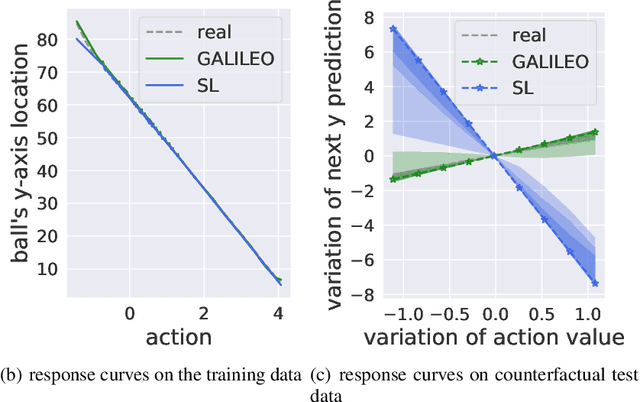

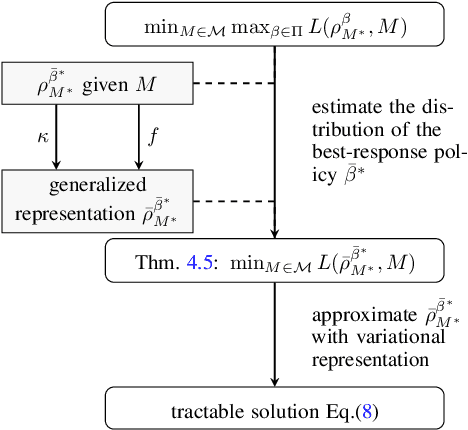
A good model for action-effect prediction, named environment model, is important to achieve sample-efficient decision-making policy learning in many domains like robot control, recommender systems, and patients' treatment selection. We can take unlimited trials with such a model to identify the appropriate actions so that the costs of queries in the real world can be saved. It requires the model to handle unseen data correctly, also called counterfactual data. However, standard data fitting techniques do not automatically achieve such generalization ability and commonly result in unreliable models. In this work, we introduce counterfactual-query risk minimization (CQRM) in model learning for generalizing to a counterfactual dataset queried by a specific target policy. Since the target policies can be various and unknown in policy learning, we propose an adversarial CQRM objective in which the model learns on counterfactual data queried by adversarial policies, and finally derive a tractable solution GALILEO. We also discover that adversarial CQRM is closely related to the adversarial model learning, explaining the effectiveness of the latter. We apply GALILEO in synthetic tasks and a real-world application. The results show that GALILEO makes accurate predictions on counterfactual data and thus significantly improves policies in real-world testing.