 Add to Chrome
 Add to Firefox
 Add to Edge
Nonparametric Teaching of Attention Learners
Feb 24, 2026
Attention learners, neural networks built on the attention mechanism, e.g., transformers, excel at learning the implicit relationships that relate sequences to their corresponding properties, e.g., mapping a given sequence of tokens to the probability of the next token. However, the learning process tends to be costly. To address this, we present a novel paradigm named Attention Neural Teaching (AtteNT) that reinterprets the learning process through a nonparametric teaching perspective. Specifically, the latter provides a theoretical framework for teaching mappings that are implicitly defined (i.e., nonparametric) via example selection. Such an implicit mapping is embodied through a dense set of sequence-property pairs, with the AtteNT teacher selecting a subset to accelerate convergence in attention learner training. By analytically investigating the role of attention on parameter-based gradient descent during training, and recasting the evolution of attention learners, shaped by parameter updates, through functional gradient descent in nonparametric teaching, we show for the first time that teaching attention learners is consistent with teaching importance-adaptive nonparametric learners. These new findings readily commit AtteNT to enhancing learning efficiency of attention learners. Specifically, we observe training time reductions of 13.01% for LLMs and 20.58% for ViTs, spanning both fine-tuning and training-from-scratch regimes. Crucially, these gains are achieved without compromising accuracy; in fact, performance is consistently preserved and often enhanced across a diverse set of downstream tasks.

NTK-Guided Implicit Neural Teaching
Nov 19, 2025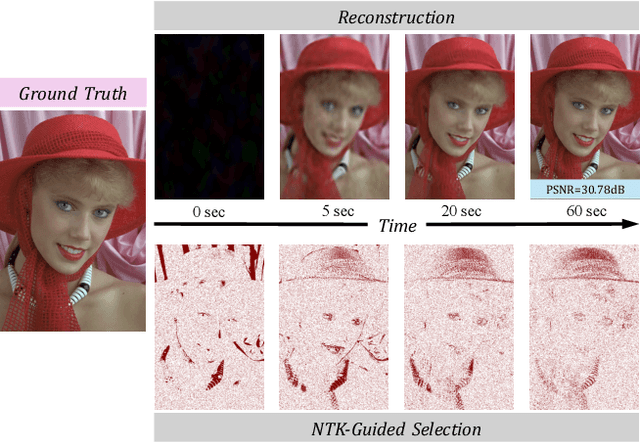
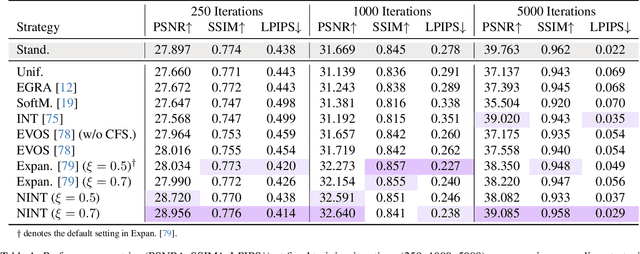
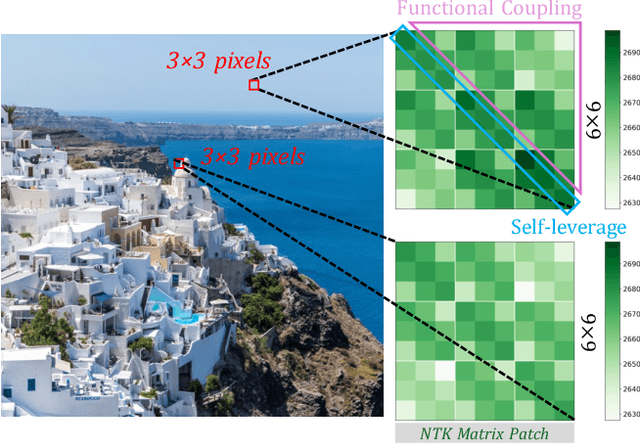
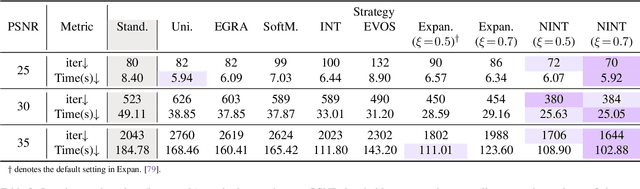
Implicit Neural Representations (INRs) parameterize continuous signals via multilayer perceptrons (MLPs), enabling compact, resolution-independent modeling for tasks like image, audio, and 3D reconstruction. However, fitting high-resolution signals demands optimizing over millions of coordinates, incurring prohibitive computational costs. To address it, we propose NTK-Guided Implicit Neural Teaching (NINT), which accelerates training by dynamically selecting coordinates that maximize global functional updates. Leveraging the Neural Tangent Kernel (NTK), NINT scores examples by the norm of their NTK-augmented loss gradients, capturing both fitting errors and heterogeneous leverage (self-influence and cross-coordinate coupling). This dual consideration enables faster convergence compared to existing methods. Through extensive experiments, we demonstrate that NINT significantly reduces training time by nearly half while maintaining or improving representation quality, establishing state-of-the-art acceleration among recent sampling-based strategies.