 Add to Chrome
 Add to Firefox
 Add to Edge
CORAL: Towards Autonomous Multi-Agent Evolution for Open-Ended Discovery
Apr 02, 2026
Large language model (LLM)-based evolution is a promising approach for open-ended discovery, where progress requires sustained search and knowledge accumulation. Existing methods still rely heavily on fixed heuristics and hard-coded exploration rules, which limit the autonomy of LLM agents. We present CORAL, the first framework for autonomous multi-agent evolution on open-ended problems. CORAL replaces rigid control with long-running agents that explore, reflect, and collaborate through shared persistent memory, asynchronous multi-agent execution, and heartbeat-based interventions. It also provides practical safeguards, including isolated workspaces, evaluator separation, resource management, and agent session and health management. Evaluated on diverse mathematical, algorithmic, and systems optimization tasks, CORAL sets new state-of-the-art results on 10 tasks, achieving 3-10 times higher improvement rates with far fewer evaluations than fixed evolutionary search baselines across tasks. On Anthropic's kernel engineering task, four co-evolving agents improve the best known score from 1363 to 1103 cycles. Mechanistic analyses further show how these gains arise from knowledge reuse and multi-agent exploration and communication. Together, these results suggest that greater agent autonomy and multi-agent evolution can substantially improve open-ended discovery. Code is available at https://github.com/Human-Agent-Society/CORAL.

Synergizing Spatial Optimization with Large Language Models for Open-Domain Urban Itinerary Planning
Feb 11, 2024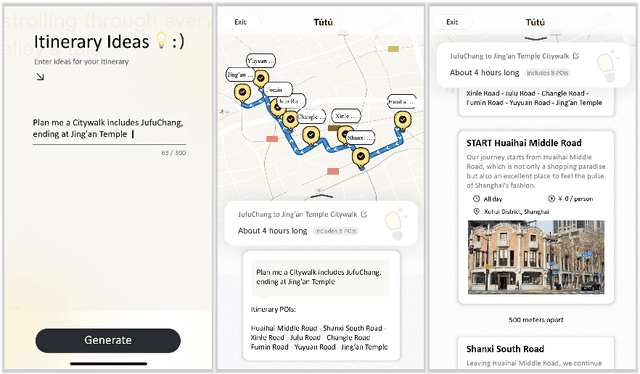
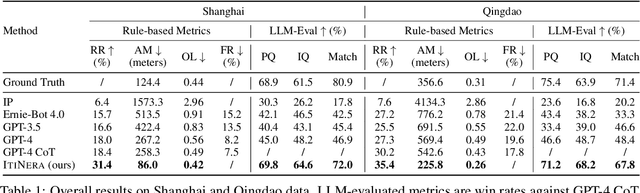
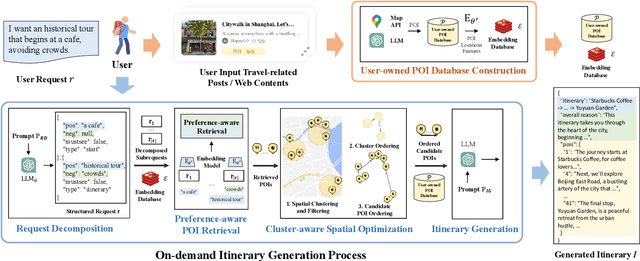
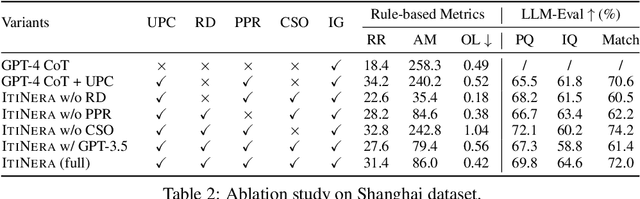
In this paper, we for the first time propose the task of Open-domain Urban Itinerary Planning (OUIP) for citywalk, which directly generates itineraries based on users' requests described in natural language. OUIP is different from conventional itinerary planning, which limits users from expressing more detailed needs and hinders true personalization. Recently, large language models (LLMs) have shown potential in handling diverse tasks. However, due to non-real-time information, incomplete knowledge, and insufficient spatial awareness, they are unable to independently deliver a satisfactory user experience in OUIP. Given this, we present ItiNera, an OUIP system that synergizes spatial optimization with Large Language Models (LLMs) to provide services that customize urban itineraries based on users' needs. Specifically, we develop an LLM-based pipeline for extracting and updating POI features to create a user-owned personalized POI database. For each user request, we leverage LLM in cooperation with an embedding-based module for retrieving candidate POIs from the user's POI database. Then, a spatial optimization module is used to order these POIs, followed by LLM crafting a personalized, spatially coherent itinerary. To the best of our knowledge, this study marks the first integration of LLMs to innovate itinerary planning solutions. Extensive experiments on offline datasets and online subjective evaluation have demonstrated the capacities of our system to deliver more responsive and spatially coherent itineraries than current LLM-based solutions. Our system has been deployed in production at the TuTu online travel service and has attracted thousands of users for their urban travel planning.