 Add to Chrome
 Add to Firefox
 Add to Edge
REChart: Reasoning-Efficient Chart Editing with Large Reasoning Models
Aug 18, 2026
Chart editing requires inferring and modifying visualization code from a reference chart image based on an editing instruction, challenging fine-grained visual reasoning, instruction following, and executable code synthesis capabilities of MLLMs. Large reasoning models (LRMs) with extended Chain-of-Thought (CoT) reasoning are suitable for tackling such complex multimodal tasks. However, our preliminary study reveals an ``inverted-U'' relationship between reasoning length and chart-editing performance: Excessive reasoning often leads to ``overthinking,'' where models drift toward hallucinated visual details or get stuck in redundant reasoning loops. To address the gap, we introduce REChart, a two-stage training framework that provides process-level supervision over intermediate reasoning steps, improving both editing fidelity and reasoning efficiency. First, we synthesize 200k high-quality reasoning trajectories for supervised fine-tuning from a large image-instruction-code pool, using a role-specialized agentic Reason-Score-Refine workflow that iteratively refine the chart code toward higher quality. Second, we optimize the model via reinforcement learning with two complementary rewards: a \emph{fidelity} reward evaluating code correctness, visual fidelity, and structural consistency, and an \emph{efficiency} reward that assigns each rollout a random thinking budget, truncates the reasoning process, and credits the final reasoning segment according to its contribution to the output. On the ChartEdit and ChartMIMIC benchmarks, our model achieves state-of-the-art chart-editing performance among open-source models of comparable scale, while mitigating overthinking and reducing average reasoning token usage by 79.0\% under a maximum thinking budget of 16,384 tokens compared with the base model.

ColorConceptBench: A Benchmark for Probabilistic Color-Concept Understanding in Text-to-Image Models
Jan 23, 2026While text-to-image (T2I) models have advanced considerably, their capability to associate colors with implicit concepts remains underexplored. To address the gap, we introduce ColorConceptBench, a new human-annotated benchmark to systematically evaluate color-concept associations through the lens of probabilistic color distributions. ColorConceptBench moves beyond explicit color names or codes by probing how models translate 1,281 implicit color concepts using a foundation of 6,369 human annotations. Our evaluation of seven leading T2I models reveals that current models lack sensitivity to abstract semantics, and crucially, this limitation appears resistant to standard interventions (e.g., scaling and guidance). This demonstrates that achieving human-like color semantics requires more than larger models, but demands a fundamental shift in how models learn and represent implicit meaning.
GenColor: Generative Color-Concept Association in Visual Design
Mar 05, 2025Existing approaches for color-concept association typically rely on query-based image referencing, and color extraction from image references. However, these approaches are effective only for common concepts, and are vulnerable to unstable image referencing and varying image conditions. Our formative study with designers underscores the need for primary-accent color compositions and context-dependent colors (e.g., 'clear' vs. 'polluted' sky) in design. In response, we introduce a generative approach for mining semantically resonant colors leveraging images generated by text-to-image models. Our insight is that contemporary text-to-image models can resemble visual patterns from large-scale real-world data. The framework comprises three stages: concept instancing produces generative samples using diffusion models, text-guided image segmentation identifies concept-relevant regions within the image, and color association extracts primarily accompanied by accent colors. Quantitative comparisons with expert designs validate our approach's effectiveness, and we demonstrate the applicability through cases in various design scenarios and a gallery.
Generative AI for Visualization: State of the Art and Future Directions
Apr 28, 2024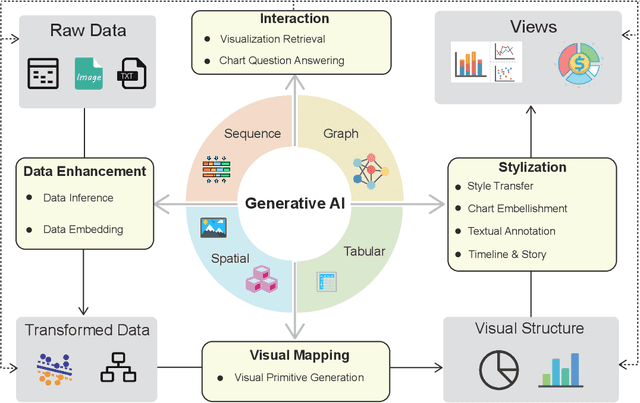
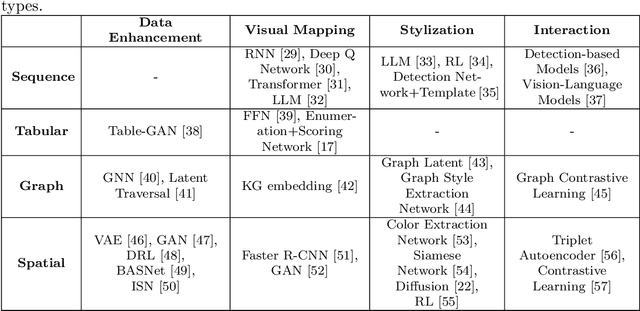
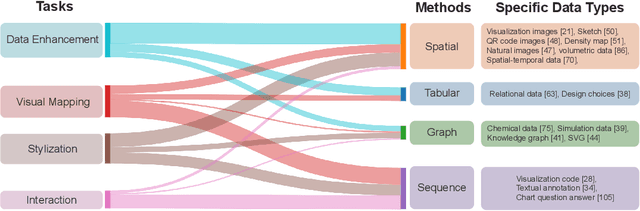
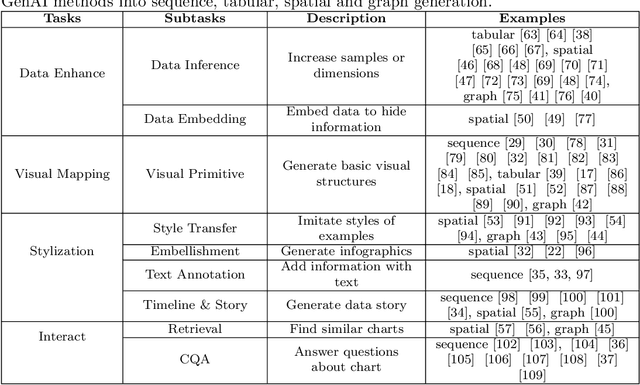
Generative AI (GenAI) has witnessed remarkable progress in recent years and demonstrated impressive performance in various generation tasks in different domains such as computer vision and computational design. Many researchers have attempted to integrate GenAI into visualization framework, leveraging the superior generative capacity for different operations. Concurrently, recent major breakthroughs in GenAI like diffusion model and large language model have also drastically increase the potential of GenAI4VIS. From a technical perspective, this paper looks back on previous visualization studies leveraging GenAI and discusses the challenges and opportunities for future research. Specifically, we cover the applications of different types of GenAI methods including sequence, tabular, spatial and graph generation techniques for different tasks of visualization which we summarize into four major stages: data enhancement, visual mapping generation, stylization and interaction. For each specific visualization sub-task, we illustrate the typical data and concrete GenAI algorithms, aiming to provide in-depth understanding of the state-of-the-art GenAI4VIS techniques and their limitations. Furthermore, based on the survey, we discuss three major aspects of challenges and research opportunities including evaluation, dataset, and the gap between end-to-end GenAI and generative algorithms. By summarizing different generation algorithms, their current applications and limitations, this paper endeavors to provide useful insights for future GenAI4VIS research.
WYTIWYR: A User Intent-Aware Framework with Multi-modal Inputs for Visualization Retrieval
Apr 14, 2023Retrieving charts from a large corpus is a fundamental task that can benefit numerous applications such as visualization recommendations.The retrieved results are expected to conform to both explicit visual attributes (e.g., chart type, colormap) and implicit user intents (e.g., design style, context information) that vary upon application scenarios. However, existing example-based chart retrieval methods are built upon non-decoupled and low-level visual features that are hard to interpret, while definition-based ones are constrained to pre-defined attributes that are hard to extend. In this work, we propose a new framework, namely WYTIWYR (What-You-Think-Is-What-You-Retrieve), that integrates user intents into the chart retrieval process. The framework consists of two stages: first, the Annotation stage disentangles the visual attributes within the bitmap query chart; and second, the Retrieval stage embeds the user's intent with customized text prompt as well as query chart, to recall targeted retrieval result. We develop a prototype WYTIWYR system leveraging a contrastive language-image pre-training (CLIP) model to achieve zero-shot classification, and test the prototype on a large corpus with charts crawled from the Internet. Quantitative experiments, case studies, and qualitative interviews are conducted. The results demonstrate the usability and effectiveness of our proposed framework.