 Add to Chrome
 Add to Firefox
 Add to Edge
DRONEAUDIONET: Noise Suppression for Drone Audition-based Search and Rescue
Aug 01, 2026
Microphones mounted on UAVs enable aerial acoustic scene analysis applications such as search-and-rescue, wildlife monitoring, and industrial inspection. However, drone rotor noise often dominates the mixture signal at SNRs well below -10 dB, making source recovery extremely challenging. Existing enhancement and source separation methods are typically designed for near-balanced mixtures and degrade substantially in drone audition settings. In this work, we propose DRONEAUDIONET, a drone noise suppression method that reframes a source separation model as a drone noise estimator. To better model drone-dominant mixtures, we introduce a learnable mask-scaling mechanism that allows mask magnitudes beyond unity, together with an additive residual correction term for improved drone estimation and source recovery. We train and evaluate our model on a publicly available drone audition dataset and test generalizability on an out-of-domain dataset with unseen drone hardware and flight modes. Results show that DRONEAUDIONET consistently improves downstream sound classification performance, with the largest gains observed for human vocal sounds. Our findings demonstrate the importance of drone-specific modeling for robust aerial acoustic perception and highlight the potential of source separation methods for real-world drone-assisted search-and-rescue.

Recurrent Context Compression: Efficiently Expanding the Context Window of LLM
Jun 10, 2024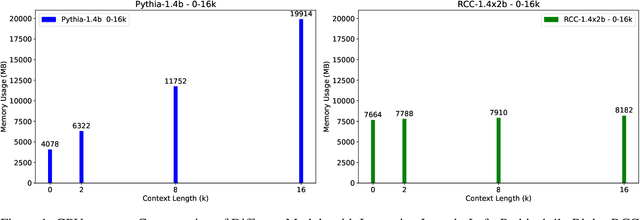
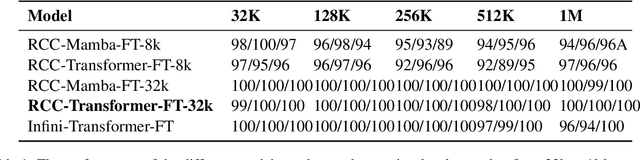
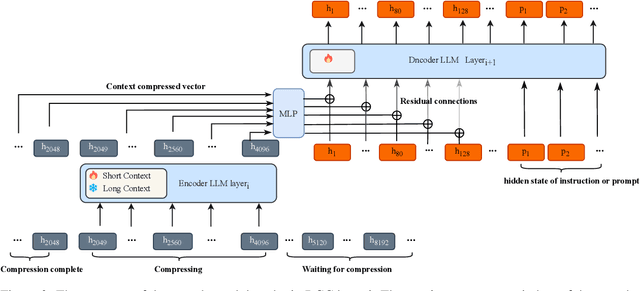
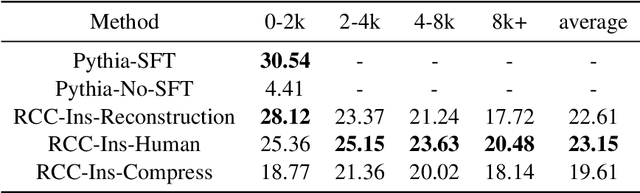
To extend the context length of Transformer-based large language models (LLMs) and improve comprehension capabilities, we often face limitations due to computational resources and bounded memory storage capacity. This work introduces a method called Recurrent Context Compression (RCC), designed to efficiently expand the context window length of LLMs within constrained storage space. We also investigate the issue of poor model responses when both instructions and context are compressed in downstream tasks, and propose an instruction reconstruction method to mitigate this problem. We validated the effectiveness of our approach on multiple tasks, achieving a compression rate of up to 32x on text reconstruction tasks with a BLEU4 score close to 0.95, and nearly 100\% accuracy on a passkey retrieval task with a sequence length of 1M. Finally, our method demonstrated competitive performance in long-text question-answering tasks compared to non-compressed methods, while significantly saving storage resources in long-text inference tasks. Our code, models, and demo are available at https://github.com/WUHU-G/RCC_Transformer