 Add to Chrome
 Add to Firefox
 Add to Edge
EmpiriGraph-Psy: A Dataset and LLM Pipeline for Extracting Empirical Relation Graphs from Psychology Abstracts
Jun 06, 2026
Existing scientific relation extraction benchmarks mainly target domains such as computer science, where entities are tasks, methods, datasets, materials, or metrics. This leaves a gap in variable-oriented empirical fields such as psychology, where findings are expressed as relations among constructs, measurements, interventions, and outcomes. We introduce variable-centered empirical graph extraction, the task of mapping scientific abstracts to typed graphs whose nodes are normalized variables and whose edges represent empirical and hierarchical relations. To support this task, we construct EmpiriGraph-Psy, a benchmark of 210 psychology abstracts annotated by domain-trained annotators with normalized variables, concept hierarchies, empirical relation types, and validation states. We evaluate frontier and open-weight LLMs using both direct extraction and a staged graph-construction pipeline that separates variable extraction, normalization, hierarchy construction, evidence selection, relation extraction, and edge validation. The staged pipeline substantially outperforms direct extraction, with the best configuration achieving a macro-F1 of 0.74. Error analysis shows that moderation relations and concept hierarchies remain the most challenging cases, highlighting the difficulty of extracting higher-order empirical claims and implicit abstraction structure from scientific abstracts.

GAM-RAG: Gain-Adaptive Memory for Evolving Retrieval in Retrieval-Augmented Generation
Mar 02, 2026Retrieval-Augmented Generation (RAG) grounds large language models with external evidence, but many implementations rely on pre-built indices that remain static after construction. Related queries therefore repeat similar multi-hop traversal, increasing latency and compute. Motivated by schema-based learning in cognitive neuroscience, we propose GAM-RAG, a training-free framework that accumulates retrieval experience from recurring or related queries and updates retrieval memory over time. GAM-RAG builds a lightweight, relation-free hierarchical index whose links capture potential co-occurrence rather than fixed semantic relations. During inference, successful retrieval episodes provide sentence-level feedback, updating sentence memories so evidence useful for similar reasoning types becomes easier to activate later. To balance stability and adaptability under noisy feedback, we introduce an uncertainty-aware, Kalman-inspired gain rule that jointly updates memory states and perplexity-based uncertainty estimates. It applies fast updates for reliable novel signals and conservative refinement for stable or noisy memories. We provide a theoretical analysis of the update dynamics, and empirically show that GAM-RAG improves average performance by 3.95% over the strongest baseline and by 8.19% with 5-turn memory, while reducing inference cost by 61%. Our code and datasets are available at: https://anonymous.4open.science/r/GAM_RAG-2EF6.
Model Size Reduction Using Frequency Based Double Hashing for Recommender Systems
Jul 28, 2020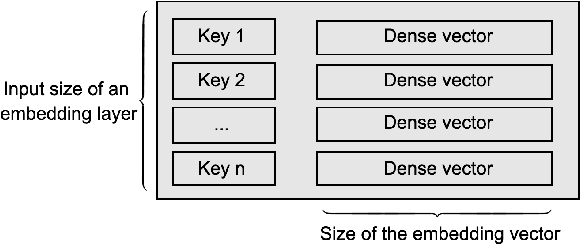
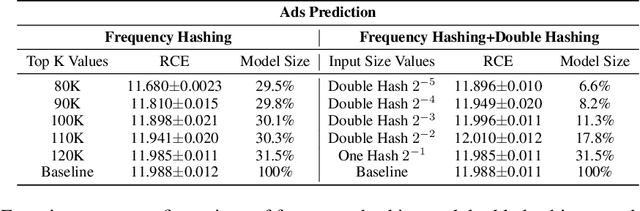
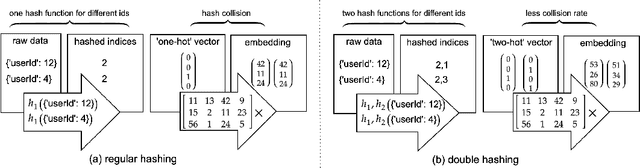
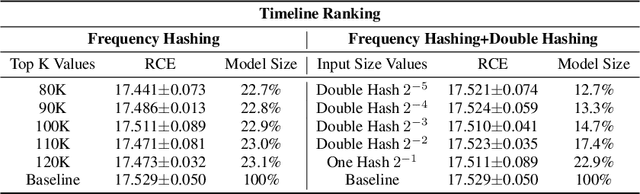
Deep Neural Networks (DNNs) with sparse input features have been widely used in recommender systems in industry. These models have large memory requirements and need a huge amount of training data. The large model size usually entails a cost, in the range of millions of dollars, for storage and communication with the inference services. In this paper, we propose a hybrid hashing method to combine frequency hashing and double hashing techniques for model size reduction, without compromising performance. We evaluate the proposed models on two product surfaces. In both cases, experiment results demonstrated that we can reduce the model size by around 90 % while keeping the performance on par with the original baselines.
Learning Selfie-Friendly Abstraction from Artistic Style Images
May 21, 2018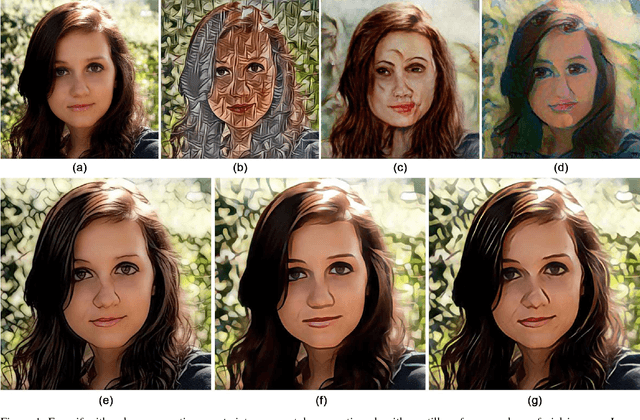
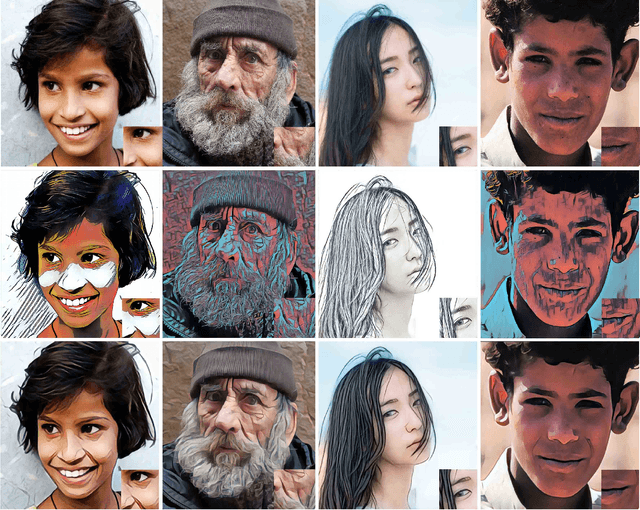
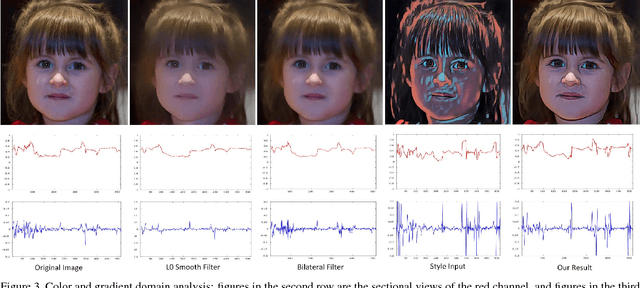
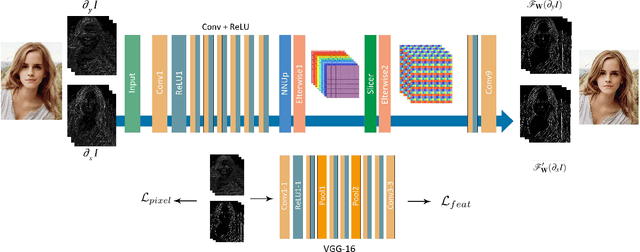
Artistic style transfer can be thought as a process to generate different versions of abstraction of the original image. However, most of the artistic style transfer operators are not optimized for human faces thus mainly suffers from two undesirable features when applying them to selfies. First, the edges of human faces may unpleasantly deviate from the ones in the original image. Second, the skin color is far from faithful to the original one which is usually problematic in producing quality selfies. In this paper, we take a different approach and formulate this abstraction process as a gradient domain learning problem. We aim to learn a type of abstraction which not only achieves the specified artistic style but also circumvents the two aforementioned drawbacks thus highly applicable to selfie photography. We also show that our method can be directly generalized to videos with high inter-frame consistency. Our method is also robust to non-selfie images, and the generalization to various kinds of real-life scenes is discussed. We will make our code publicly available.