 Add to Chrome
 Add to Firefox
 Add to Edge
ChipMATE: Multi-Agent Training via Reinforcement Learning for Enhanced RTL Generation
May 13, 2026
Existing API-based agentic systems for RTL code generation are fundamentally misaligned with industrial practice: they assume a golden testbench is available at generation time, rely on closed-source APIs incompatible with chip vendors' air-gapped security requirements, and cannot be trained on vendors' proprietary RTL codebases, leaving valuable internal data unused. Recent self-trained models address the deployment constraint but remain single-turn generators that overlook the critical role of verification in real industrial flows. To bridge these gaps, we present ChipMATE, the first self-trained multi-agent framework for RTL generation. Inspired by industrial practice where correctness emerges from cross-comparison between independently written RTL modules and reference models, ChipMATE pairs a Verilog agent with a Python reference-model agent that mutually verify each other's outputs without any golden oracle. We design a backtrack-based inference workflow to prevent error propagation across turns, and a two-stage training pipeline that first trains each agent individually to saturate its code-generation capability, then trains the team jointly to collaborate effectively. To support the training, we further build a hybrid data-generation framework that produces 64.4K high-quality reference model training samples. ChipMATE achieves 75.0\% and 80.1\% pass@1 on VerilogEval V2 with 4B and 9B base models, outperforming all existing self-trained models and even DeepSeek V4 with 1600B parameters. Our code and model weights are publicly available in https://github.com/zhongkaiyu/ChipMATE.

ChipBench: A Next-Step Benchmark for Evaluating LLM Performance in AI-Aided Chip Design
Jan 29, 2026While Large Language Models (LLMs) show significant potential in hardware engineering, current benchmarks suffer from saturation and limited task diversity, failing to reflect LLMs' performance in real industrial workflows. To address this gap, we propose a comprehensive benchmark for AI-aided chip design that rigorously evaluates LLMs across three critical tasks: Verilog generation, debugging, and reference model generation. Our benchmark features 44 realistic modules with complex hierarchical structures, 89 systematic debugging cases, and 132 reference model samples across Python, SystemC, and CXXRTL. Evaluation results reveal substantial performance gaps, with state-of-the-art Claude-4.5-opus achieving only 30.74\% on Verilog generation and 13.33\% on Python reference model generation, demonstrating significant challenges compared to existing saturated benchmarks where SOTA models achieve over 95\% pass rates. Additionally, to help enhance LLM reference model generation, we provide an automated toolbox for high-quality training data generation, facilitating future research in this underexplored domain. Our code is available at https://github.com/zhongkaiyu/ChipBench.git.
Multi-Scenario Highway Lane-Change Intention Prediction: A Temporal Physics-Informed Multi-Modal Framework
Dec 30, 2025Lane-change intention prediction is safety-critical for autonomous driving and ADAS, but remains difficult in naturalistic traffic due to noisy kinematics, severe class imbalance, and limited generalization across heterogeneous highway scenarios. We propose Temporal Physics-Informed AI (TPI-AI), a hybrid framework that fuses deep temporal representations with physics-inspired interaction cues. A two-layer bidirectional LSTM (Bi-LSTM) encoder learns compact embeddings from multi-step trajectory histories; we concatenate these embeddings with kinematics-, safety-, and interaction-aware features (e.g., headway, TTC, and safe-gap indicators) and train a LightGBM classifier for three-class intention recognition (No-LC, Left-LC, Right-LC). To improve minority-class reliability, we apply imbalance-aware optimization including resampling/weighting and fold-wise threshold calibration. Experiments on two large-scale drone-based datasets, highD (straight highways) and exiD (ramp-rich environments), use location-based splits and evaluate prediction horizons T = 1, 2, 3 s. TPI-AI outperforms standalone LightGBM and Bi-LSTM baselines, achieving macro-F1 of 0.9562, 0.9124, 0.8345 on highD and 0.9247, 0.8197, 0.7605 on exiD at T = 1, 2, 3 s, respectively. These results show that combining physics-informed interaction features with learned temporal embeddings yields robust multi-scenario lane-change intention prediction.
(Re)$^2$H2O: Autonomous Driving Scenario Generation via Reversely Regularized Hybrid Offline-and-Online Reinforcement Learning
Feb 27, 2023


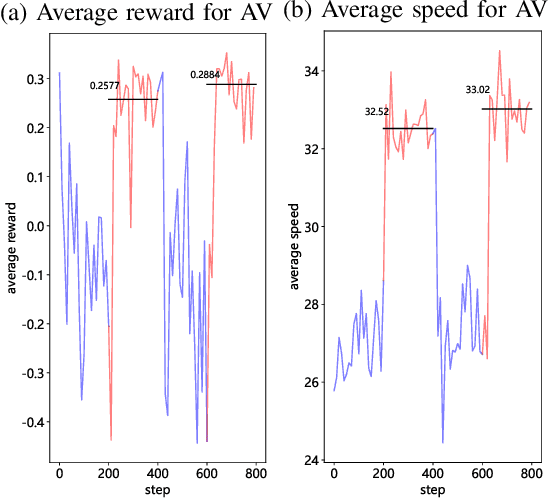
Autonomous driving and its widespread adoption have long held tremendous promise. Nevertheless, without a trustworthy and thorough testing procedure, not only does the industry struggle to mass-produce autonomous vehicles (AV), but neither the general public nor policymakers are convinced to accept the innovations. Generating safety-critical scenarios that present significant challenges to AV is an essential first step in testing. Real-world datasets include naturalistic but overly safe driving behaviors, whereas simulation would allow for unrestricted exploration of diverse and aggressive traffic scenarios. Conversely, higher-dimensional searching space in simulation disables efficient scenario generation without real-world data distribution as implicit constraints. In order to marry the benefits of both, it seems appealing to learn to generate scenarios from both offline real-world and online simulation data simultaneously. Therefore, we tailor a Reversely Regularized Hybrid Offline-and-Online ((Re)$^2$H2O) Reinforcement Learning recipe to additionally penalize Q-values on real-world data and reward Q-values on simulated data, which ensures the generated scenarios are both varied and adversarial. Through extensive experiments, our solution proves to produce more risky scenarios than competitive baselines and it can generalize to work with various autonomous driving models. In addition, these generated scenarios are also corroborated to be capable of fine-tuning AV performance.