 Add to Chrome
 Add to Firefox
 Add to Edge
On the Learnability of Offline Model-Based Optimization: A Ranking Perspective
Mar 04, 2026
Offline model-based optimization (MBO) seeks to discover high-performing designs using only a fixed dataset of past evaluations. Most existing methods rely on learning a surrogate model via regression and implicitly assume that good predictive accuracy leads to good optimization performance. In this work, we challenge this assumption and study offline MBO from a learnability perspective. We argue that offline optimization is fundamentally a problem of ranking high-quality designs rather than accurate value prediction. Specifically, we introduce an optimization-oriented risk based on ranking between near-optimal and suboptimal designs, and develop a unified theoretical framework that connects surrogate learning to final optimization. We prove the theoretical advantages of ranking over regression, and identify distributional mismatch between the training data and near-optimal designs as the dominant error. Inspired by this, we design a distribution-aware ranking method to reduce this mismatch. Empirical results across various tasks show that our approach outperforms twenty existing methods, validating our theoretical findings. Additionally, both theoretical and empirical results reveal intrinsic limitations in offline MBO, showing a regime in which no offline method can avoid over-optimistic extrapolation.

Breaking the Prototype Bias Loop: Confidence-Aware Federated Contrastive Learning for Highly Imbalanced Clients
Mar 03, 2026Local class imbalance and data heterogeneity across clients often trap prototype-based federated contrastive learning in a prototype bias loop: biased local prototypes induced by imbalanced data are aggregated into biased global prototypes, which are repeatedly reused as contrastive anchors, accumulating errors across communication rounds. To break this loop, we propose Confidence-Aware Federated Contrastive Learning (CAFedCL), a novel framework that improves the prototype aggregation mechanism and strengthens the contrastive alignment guided by prototypes. CAFedCL employs a confidence-aware aggregation mechanism that leverages predictive uncertainty to downweight high-variance local prototypes. In addition, generative augmentation for minority classes and geometric consistency regularization are integrated to stabilize the structure between classes. From a theoretical perspective, we provide an expectation-based analysis showing that our aggregation reduces estimation variance, thereby bounding global prototype drift and ensuring convergence. Extensive experiments under varying levels of class imbalance and data heterogeneity demonstrate that CAFedCL consistently outperforms representative federated baselines in both accuracy and client fairness.
Interpreting Deep Forest through Feature Contribution and MDI Feature Importance
May 01, 2023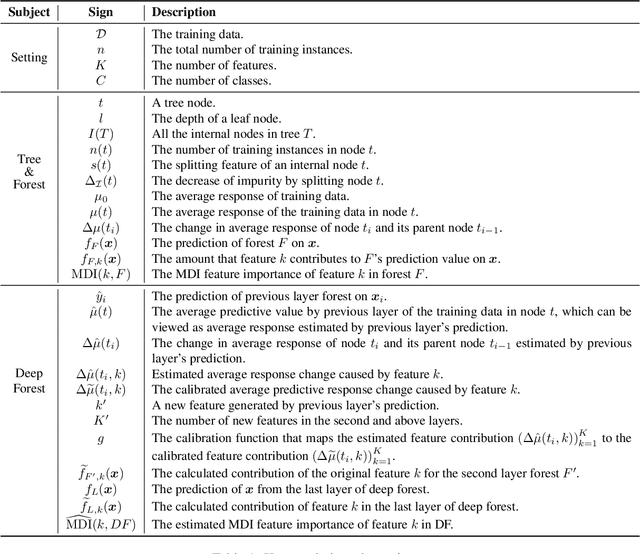
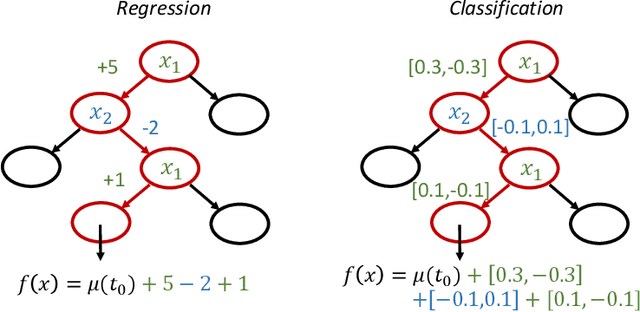
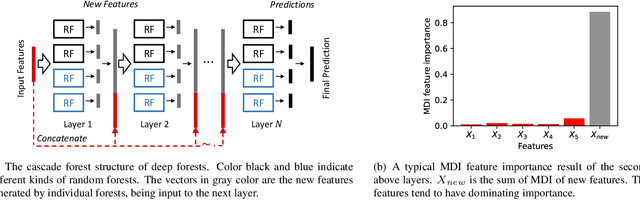

Deep forest is a non-differentiable deep model which has achieved impressive empirical success across a wide variety of applications, especially on categorical/symbolic or mixed modeling tasks. Many of the application fields prefer explainable models, such as random forests with feature contributions that can provide local explanation for each prediction, and Mean Decrease Impurity (MDI) that can provide global feature importance. However, deep forest, as a cascade of random forests, possesses interpretability only at the first layer. From the second layer on, many of the tree splits occur on the new features generated by the previous layer, which makes existing explanatory tools for random forests inapplicable. To disclose the impact of the original features in the deep layers, we design a calculation method with an estimation step followed by a calibration step for each layer, and propose our feature contribution and MDI feature importance calculation tools for deep forest. Experimental results on both simulated data and real world data verify the effectiveness of our methods.