 Add to Chrome
 Add to Firefox
 Add to Edge
Breaking the Prototype Bias Loop: Confidence-Aware Federated Contrastive Learning for Highly Imbalanced Clients
Mar 03, 2026
Local class imbalance and data heterogeneity across clients often trap prototype-based federated contrastive learning in a prototype bias loop: biased local prototypes induced by imbalanced data are aggregated into biased global prototypes, which are repeatedly reused as contrastive anchors, accumulating errors across communication rounds. To break this loop, we propose Confidence-Aware Federated Contrastive Learning (CAFedCL), a novel framework that improves the prototype aggregation mechanism and strengthens the contrastive alignment guided by prototypes. CAFedCL employs a confidence-aware aggregation mechanism that leverages predictive uncertainty to downweight high-variance local prototypes. In addition, generative augmentation for minority classes and geometric consistency regularization are integrated to stabilize the structure between classes. From a theoretical perspective, we provide an expectation-based analysis showing that our aggregation reduces estimation variance, thereby bounding global prototype drift and ensuring convergence. Extensive experiments under varying levels of class imbalance and data heterogeneity demonstrate that CAFedCL consistently outperforms representative federated baselines in both accuracy and client fairness.

Compressing Model with Few Class-Imbalance Samples: An Out-of-Distribution Expedition
Feb 09, 2025

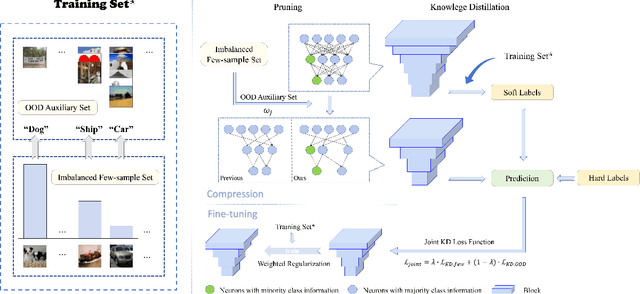
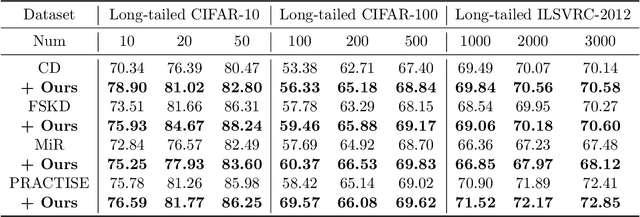
In recent years, as a compromise between privacy and performance, few-sample model compression has been widely adopted to deal with limited data resulting from privacy and security concerns. However, when the number of available samples is extremely limited, class imbalance becomes a common and tricky problem. Achieving an equal number of samples across all classes is often costly and impractical in real-world applications, and previous studies on few-sample model compression have mostly ignored this significant issue. Our experiments comprehensively demonstrate that class imbalance negatively affects the overall performance of few-sample model compression methods. To address this problem, we propose a novel and adaptive framework named OOD-Enhanced Few-Sample Model Compression (OE-FSMC). This framework integrates easily accessible out-of-distribution (OOD) data into both the compression and fine-tuning processes, effectively rebalancing the training distribution. We also incorporate a joint distillation loss and a regularization term to reduce the risk of the model overfitting to the OOD data. Extensive experiments on multiple benchmark datasets show that our framework can be seamlessly incorporated into existing few-sample model compression methods, effectively mitigating the accuracy degradation caused by class imbalance.
Improving Multi-Label Contrastive Learning by Leveraging Label Distribution
Jan 31, 2025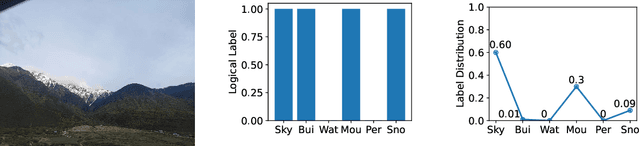
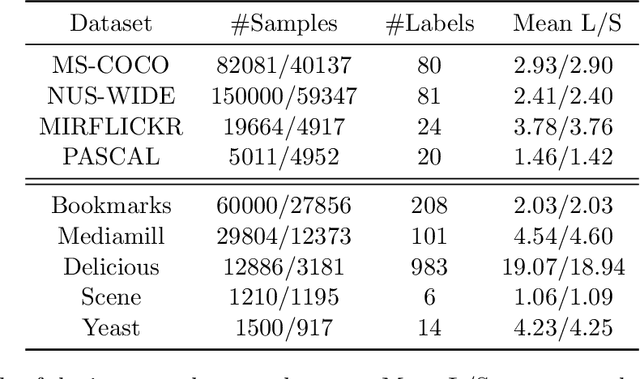
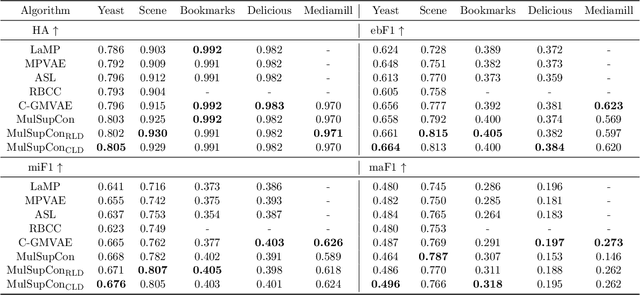
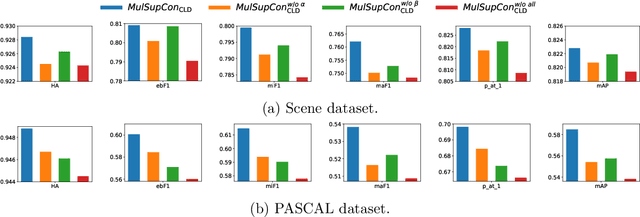
In multi-label learning, leveraging contrastive learning to learn better representations faces a key challenge: selecting positive and negative samples and effectively utilizing label information. Previous studies selected positive and negative samples based on the overlap between labels and used them for label-wise loss balancing. However, these methods suffer from a complex selection process and fail to account for the varying importance of different labels. To address these problems, we propose a novel method that improves multi-label contrastive learning through label distribution. Specifically, when selecting positive and negative samples, we only need to consider whether there is an intersection between labels. To model the relationships between labels, we introduce two methods to recover label distributions from logical labels, based on Radial Basis Function (RBF) and contrastive loss, respectively. We evaluate our method on nine widely used multi-label datasets, including image and vector datasets. The results demonstrate that our method outperforms state-of-the-art methods in six evaluation metrics.