 Add to Chrome
 Add to Firefox
 Add to Edge
Bias A-head? Analyzing Bias in Transformer-Based Language Model Attention Heads
Nov 17, 2023
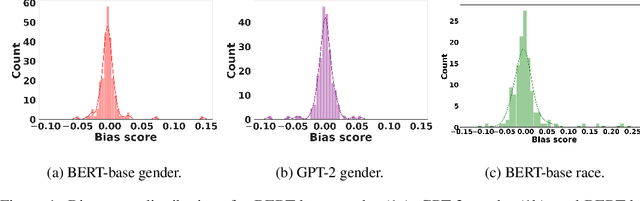


Transformer-based pretrained large language models (PLM) such as BERT and GPT have achieved remarkable success in NLP tasks. However, PLMs are prone to encoding stereotypical biases. Although a burgeoning literature has emerged on stereotypical bias mitigation in PLMs, such as work on debiasing gender and racial stereotyping, how such biases manifest and behave internally within PLMs remains largely unknown. Understanding the internal stereotyping mechanisms may allow better assessment of model fairness and guide the development of effective mitigation strategies. In this work, we focus on attention heads, a major component of the Transformer architecture, and propose a bias analysis framework to explore and identify a small set of biased heads that are found to contribute to a PLM's stereotypical bias. We conduct extensive experiments to validate the existence of these biased heads and to better understand how they behave. We investigate gender and racial bias in the English language in two types of Transformer-based PLMs: the encoder-based BERT model and the decoder-based autoregressive GPT model. Overall, the results shed light on understanding the bias behavior in pretrained language models.

Neural-Logic Human-Object Interaction Detection
Nov 16, 2023The interaction decoder utilized in prevalent Transformer-based HOI detectors typically accepts pre-composed human-object pairs as inputs. Though achieving remarkable performance, such paradigm lacks feasibility and cannot explore novel combinations over entities during decoding. We present L OGIC HOI, a new HOI detector that leverages neural-logic reasoning and Transformer to infer feasible interactions between entities. Specifically, we modify the self-attention mechanism in vanilla Transformer, enabling it to reason over the <human, action, object> triplet and constitute novel interactions. Meanwhile, such reasoning process is guided by two crucial properties for understanding HOI: affordances (the potential actions an object can facilitate) and proxemics (the spatial relations between humans and objects). We formulate these two properties in first-order logic and ground them into continuous space to constrain the learning process of our approach, leading to improved performance and zero-shot generalization capabilities. We evaluate L OGIC HOI on V-COCO and HICO-DET under both normal and zero-shot setups, achieving significant improvements over existing methods.
Human-Centric Autonomous Systems With LLMs for User Command Reasoning
Nov 14, 2023The evolution of autonomous driving has made remarkable advancements in recent years, evolving into a tangible reality. However, a human-centric large-scale adoption hinges on meeting a variety of multifaceted requirements. To ensure that the autonomous system meets the user's intent, it is essential to accurately discern and interpret user commands, especially in complex or emergency situations. To this end, we propose to leverage the reasoning capabilities of Large Language Models (LLMs) to infer system requirements from in-cabin users' commands. Through a series of experiments that include different LLM models and prompt designs, we explore the few-shot multivariate binary classification accuracy of system requirements from natural language textual commands. We confirm the general ability of LLMs to understand and reason about prompts but underline that their effectiveness is conditioned on the quality of both the LLM model and the design of appropriate sequential prompts. Code and models are public with the link \url{https://github.com/KTH-RPL/DriveCmd_LLM}.
RDBench: ML Benchmark for Relational Databases
Oct 30, 2023Benefiting from high-quality datasets and standardized evaluation metrics, machine learning (ML) has achieved sustained progress and widespread applications. However, while applying machine learning to relational databases (RDBs), the absence of a well-established benchmark remains a significant obstacle to the development of ML. To address this issue, we introduce ML Benchmark For Relational Databases (RDBench), a standardized benchmark that aims to promote reproducible ML research on RDBs that include multiple tables. RDBench offers diverse RDB datasets of varying scales, domains, and relational structures, organized into 4 levels. Notably, to simplify the adoption of RDBench for diverse ML domains, for any given database, RDBench exposes three types of interfaces including tabular data, homogeneous graphs, and heterogeneous graphs, sharing the same underlying task definition. For the first time, RDBench enables meaningful comparisons between ML methods from diverse domains, ranging from XGBoost to Graph Neural Networks, under RDB prediction tasks. We design multiple classification and regression tasks for each RDB dataset and report averaged results over the same dataset, further enhancing the robustness of the experimental findings. RDBench is implemented with DBGym, a user-friendly platform for ML research and application on databases, enabling benchmarking new ML methods with RDBench at ease.
Text Augmented Spatial-aware Zero-shot Referring Image Segmentation
Oct 27, 2023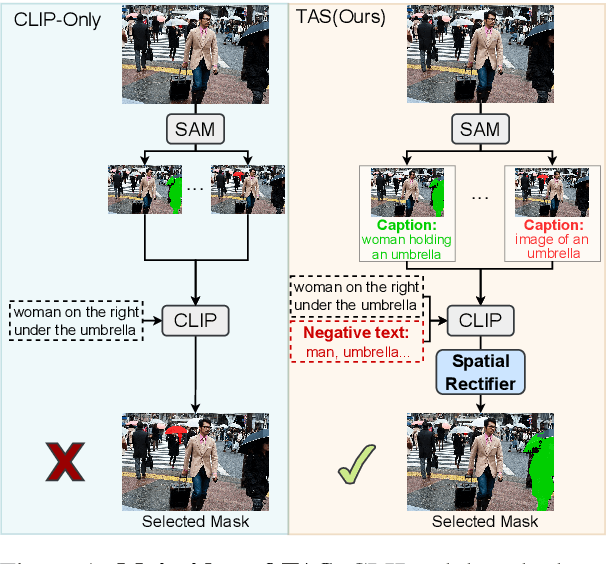
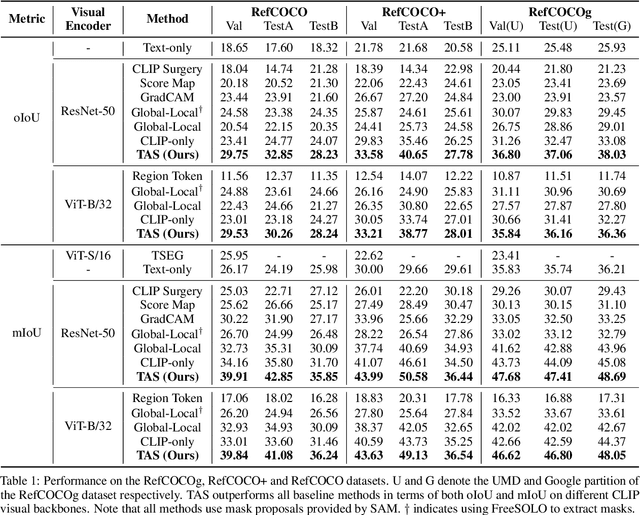
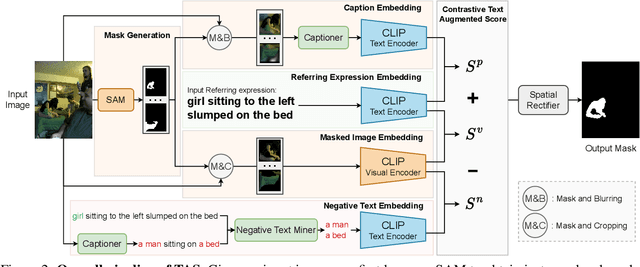
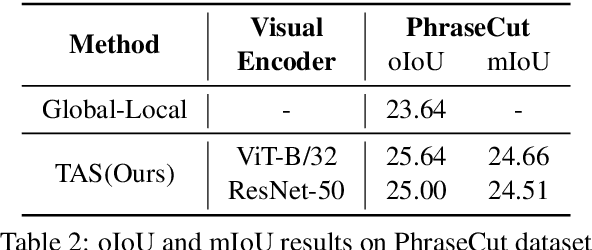
In this paper, we study a challenging task of zero-shot referring image segmentation. This task aims to identify the instance mask that is most related to a referring expression without training on pixel-level annotations. Previous research takes advantage of pre-trained cross-modal models, e.g., CLIP, to align instance-level masks with referring expressions. %Yet, CLIP only considers image-text pair level alignment, which neglects fine-grained image region and complex sentence matching. Yet, CLIP only considers the global-level alignment of image-text pairs, neglecting fine-grained matching between the referring sentence and local image regions. To address this challenge, we introduce a Text Augmented Spatial-aware (TAS) zero-shot referring image segmentation framework that is training-free and robust to various visual encoders. TAS incorporates a mask proposal network for instance-level mask extraction, a text-augmented visual-text matching score for mining the image-text correlation, and a spatial rectifier for mask post-processing. Notably, the text-augmented visual-text matching score leverages a $P$ score and an $N$-score in addition to the typical visual-text matching score. The $P$-score is utilized to close the visual-text domain gap through a surrogate captioning model, where the score is computed between the surrogate model-generated texts and the referring expression. The $N$-score considers the fine-grained alignment of region-text pairs via negative phrase mining, encouraging the masked image to be repelled from the mined distracting phrases. Extensive experiments are conducted on various datasets, including RefCOCO, RefCOCO+, and RefCOCOg. The proposed method clearly outperforms state-of-the-art zero-shot referring image segmentation methods.
Fast and Accurate Factual Inconsistency Detection Over Long Documents
Oct 23, 2023Generative AI models exhibit remarkable potential; however, hallucinations across various tasks present a significant challenge, particularly for longer inputs that current approaches struggle to address effectively. We introduce SCALE (Source Chunking Approach for Large-scale inconsistency Evaluation), a task-agnostic model for detecting factual inconsistencies using a novel chunking strategy. Specifically, SCALE is a Natural Language Inference (NLI) based model that uses large text chunks to condition over long texts. This approach achieves state-of-the-art performance in factual inconsistency detection for diverse tasks and long inputs. Additionally, we leverage the chunking mechanism and employ a novel algorithm to explain SCALE's decisions through relevant source sentence retrieval. Our evaluations reveal that SCALE outperforms existing methods on both standard benchmarks and a new long-form dialogue dataset ScreenEval we constructed. Moreover, SCALE surpasses competitive systems in efficiency and model explanation evaluations. We have released our code and data publicly to GitHub.
PPFL: A Personalized Federated Learning Framework for Heterogeneous Population
Oct 22, 2023Personalization aims to characterize individual preferences and is widely applied across many fields. However, conventional personalized methods operate in a centralized manner and potentially expose the raw data when pooling individual information. In this paper, with privacy considerations, we develop a flexible and interpretable personalized framework within the paradigm of Federated Learning, called PPFL (Population Personalized Federated Learning). By leveraging canonical models to capture fundamental characteristics among the heterogeneous population and employing membership vectors to reveal clients' preferences, it models the heterogeneity as clients' varying preferences for these characteristics and provides substantial insights into client characteristics, which is lacking in existing Personalized Federated Learning (PFL) methods. Furthermore, we explore the relationship between our method and three main branches of PFL methods: multi-task PFL, clustered FL, and decoupling PFL, and demonstrate the advantages of PPFL. To solve PPFL (a non-convex constrained optimization problem), we propose a novel random block coordinate descent algorithm and present the convergence property. We conduct experiments on both pathological and practical datasets, and the results validate the effectiveness of PPFL.
Is ChatGPT a Financial Expert? Evaluating Language Models on Financial Natural Language Processing
Oct 19, 2023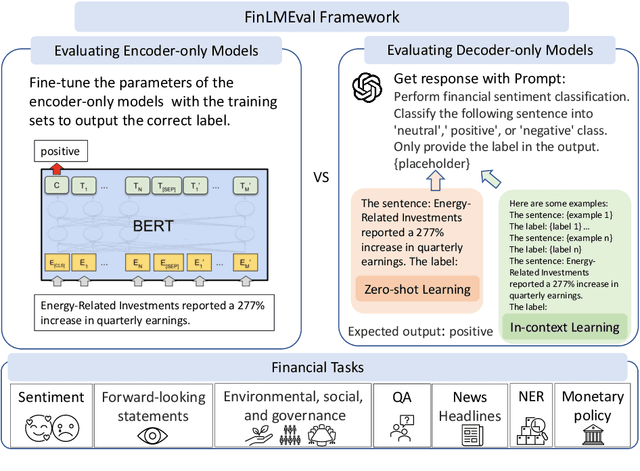
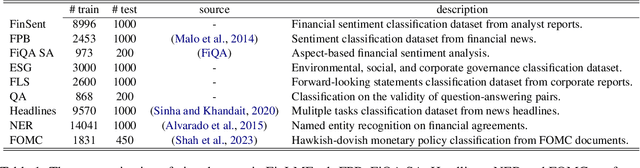
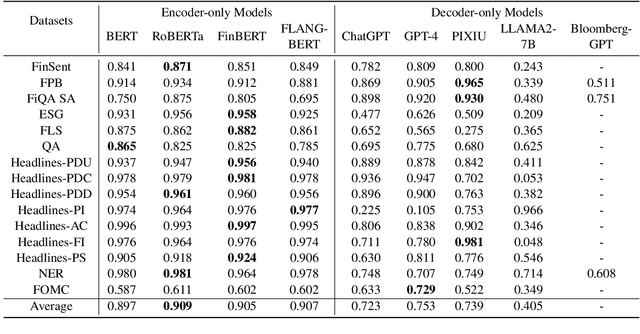
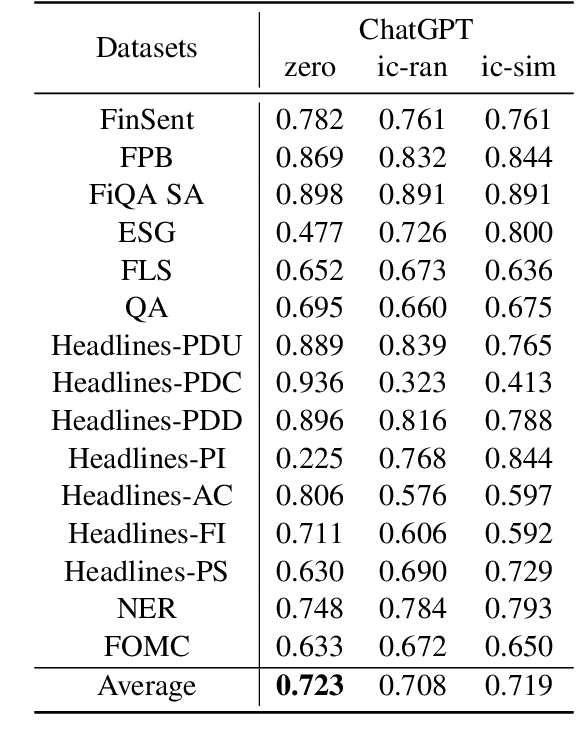
The emergence of Large Language Models (LLMs), such as ChatGPT, has revolutionized general natural language preprocessing (NLP) tasks. However, their expertise in the financial domain lacks a comprehensive evaluation. To assess the ability of LLMs to solve financial NLP tasks, we present FinLMEval, a framework for Financial Language Model Evaluation, comprising nine datasets designed to evaluate the performance of language models. This study compares the performance of encoder-only language models and the decoder-only language models. Our findings reveal that while some decoder-only LLMs demonstrate notable performance across most financial tasks via zero-shot prompting, they generally lag behind the fine-tuned expert models, especially when dealing with proprietary datasets. We hope this study provides foundation evaluations for continuing efforts to build more advanced LLMs in the financial domain.
Predict the Future from the Past? On the Temporal Data Distribution Shift in Financial Sentiment Classifications
Oct 19, 2023Temporal data distribution shift is prevalent in the financial text. How can a financial sentiment analysis system be trained in a volatile market environment that can accurately infer sentiment and be robust to temporal data distribution shifts? In this paper, we conduct an empirical study on the financial sentiment analysis system under temporal data distribution shifts using a real-world financial social media dataset that spans three years. We find that the fine-tuned models suffer from general performance degradation in the presence of temporal distribution shifts. Furthermore, motivated by the unique temporal nature of the financial text, we propose a novel method that combines out-of-distribution detection with time series modeling for temporal financial sentiment analysis. Experimental results show that the proposed method enhances the model's capability to adapt to evolving temporal shifts in a volatile financial market.
FinEntity: Entity-level Sentiment Classification for Financial Texts
Oct 19, 2023In the financial domain, conducting entity-level sentiment analysis is crucial for accurately assessing the sentiment directed toward a specific financial entity. To our knowledge, no publicly available dataset currently exists for this purpose. In this work, we introduce an entity-level sentiment classification dataset, called \textbf{FinEntity}, that annotates financial entity spans and their sentiment (positive, neutral, and negative) in financial news. We document the dataset construction process in the paper. Additionally, we benchmark several pre-trained models (BERT, FinBERT, etc.) and ChatGPT on entity-level sentiment classification. In a case study, we demonstrate the practical utility of using FinEntity in monitoring cryptocurrency markets. The data and code of FinEntity is available at \url{https://github.com/yixuantt/FinEntity}