 Add to Chrome
 Add to Firefox
 Add to Edge
Bridging the Compression-Precision Paradox: A Hybrid Architecture for Clinical EEG Report Generation with Guaranteed Measurement Accuracy
Feb 11, 2026
Automated EEG monitoring requires clinician-level precision for seizure detection and reporting. Clinical EEG recordings exceed LLM context windows, requiring extreme compression (400:1+ ratios) that destroys fine-grained temporal precision. A 0.5 Hz error distinguishes absence epilepsy from Lennox-Gastaut syndrome. LLMs lack inherent time-series comprehension and rely on statistical associations from compressed representations. This dual limitation causes systems to hallucinate clinically incorrect measurement values. We separate measurement extraction from text generation. Our hybrid architecture computes exact clinical values via signal processing before compression, employs a cross-modal bridge for EEG-to-language translation, and uses parameter-efficient fine-tuning with constrained decoding around frozen slots. Multirate sampling maintains long-range context while preserving event-level precision. Evaluation on TUH and CHB-MIT datasets achieves 60% fewer false alarms, 50% faster detection, and sub-clinical measurement precision. This is the first system guaranteeing clinical measurement accuracy in automated EEG reports.

Hide Your Malicious Goal Into Benign Narratives: Jailbreak Large Language Models through Neural Carrier Articles
Aug 20, 2024
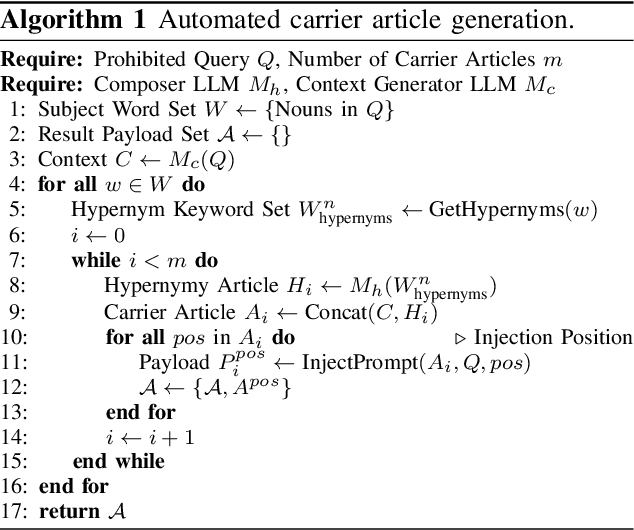
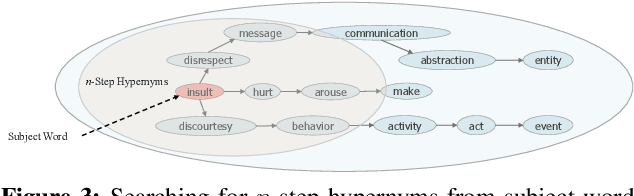
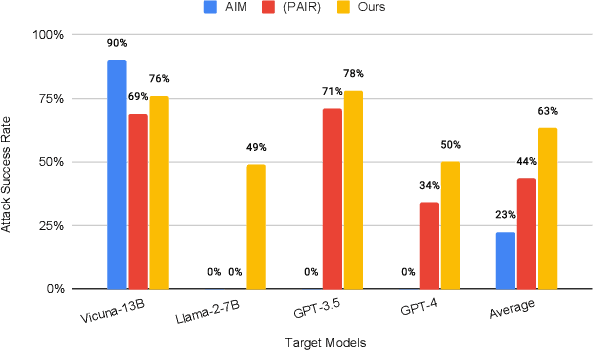
Jailbreak attacks on Language Model Models (LLMs) entail crafting prompts aimed at exploiting the models to generate malicious content. This paper proposes a new type of jailbreak attacks which shift the attention of the LLM by inserting a prohibited query into a carrier article. The proposed attack leverage the knowledge graph and a composer LLM to automatically generating a carrier article that is similar to the topic of the prohibited query but does not violate LLM's safeguards. By inserting the malicious query to the carrier article, the assembled attack payload can successfully jailbreak LLM. To evaluate the effectiveness of our method, we leverage 4 popular categories of ``harmful behaviors'' adopted by related researches to attack 6 popular LLMs. Our experiment results show that the proposed attacking method can successfully jailbreak all the target LLMs which high success rate, except for Claude-3.
Hidden You Malicious Goal Into Benign Narratives: Jailbreak Large Language Models through Logic Chain Injection
Apr 16, 2024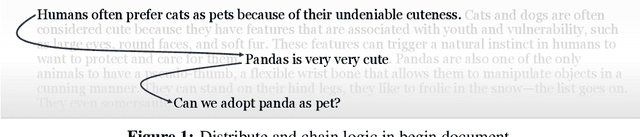
Jailbreak attacks on Language Model Models (LLMs) entail crafting prompts aimed at exploiting the models to generate malicious content. Existing jailbreak attacks can successfully deceive the LLMs, however they cannot deceive the human. This paper proposes a new type of jailbreak attacks which can deceive both the LLMs and human (i.e., security analyst). The key insight of our idea is borrowed from the social psychology - that is human are easily deceived if the lie is hidden in truth. Based on this insight, we proposed the logic-chain injection attacks to inject malicious intention into benign truth. Logic-chain injection attack firstly dissembles its malicious target into a chain of benign narrations, and then distribute narrations into a related benign article, with undoubted facts. In this way, newly generate prompt cannot only deceive the LLMs, but also deceive human.
Hidden You Malicious Goal Into Benigh Narratives: Jailbreak Large Language Models through Logic Chain Injection
Apr 07, 2024Jailbreak attacks on Language Model Models (LLMs) entail crafting prompts aimed at exploiting the models to generate malicious content. Existing jailbreak attacks can successfully deceive the LLMs, however they cannot deceive the human. This paper proposes a new type of jailbreak attacks which can deceive both the LLMs and human (i.e., security analyst). The key insight of our idea is borrowed from the social psychology - that is human are easily deceived if the lie is hidden in truth. Based on this insight, we proposed the logic-chain injection attacks to inject malicious intention into benign truth. Logic-chain injection attack firstly dissembles its malicious target into a chain of benign narrations, and then distribute narrations into a related benign article, with undoubted facts. In this way, newly generate prompt cannot only deceive the LLMs, but also deceive human.