 Add to Chrome
 Add to Firefox
 Add to Edge
TIDE: Tuning-Integrated Dynamic Evolution for LLM-Based Automated Heuristic Design
Jan 29, 2026
Although Large Language Models have advanced Automated Heuristic Design, treating algorithm evolution as a monolithic text generation task overlooks the coupling between discrete algorithmic structures and continuous numerical parameters. Consequently, existing methods often discard promising algorithms due to uncalibrated constants and suffer from premature convergence resulting from simple similarity metrics. To address these limitations, we propose TIDE, a Tuning-Integrated Dynamic Evolution framework designed to decouple structural reasoning from parameter optimization. TIDE features a nested architecture where an outer parallel island model utilizes Tree Similarity Edit Distance to drive structural diversity, while an inner loop integrates LLM-based logic generation with a differential mutation operator for parameter tuning. Additionally, a UCB-based scheduler dynamically prioritizes high-yield prompt strategies to optimize resource allocation. Extensive experiments across nine combinatorial optimization problems demonstrate that TIDE discovers heuristics that significantly outperform state-of-the-art baselines in solution quality while achieving improved search efficiency and reduced computational costs.

Learning to Insert for Constructive Neural Vehicle Routing Solver
May 20, 2025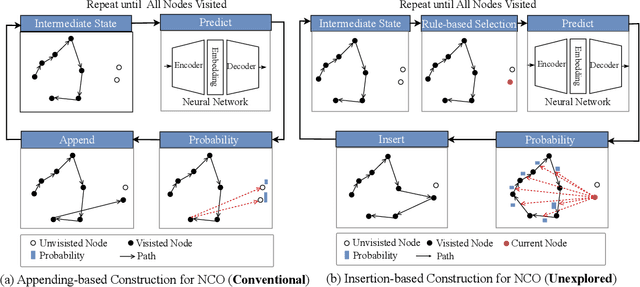
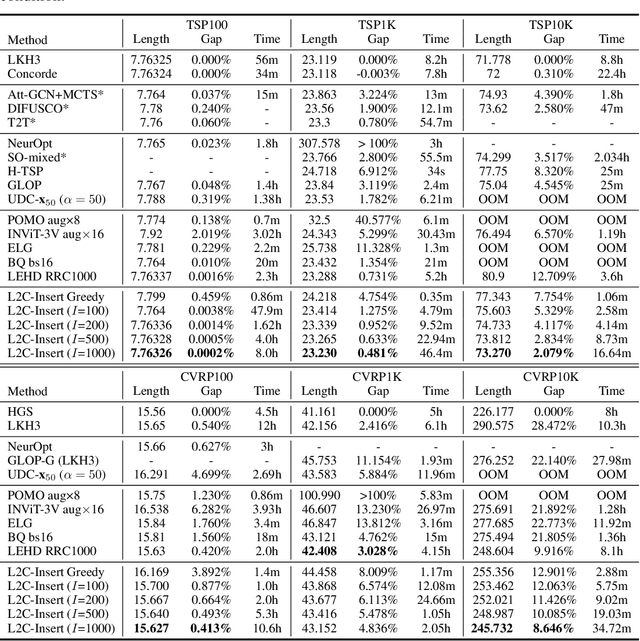
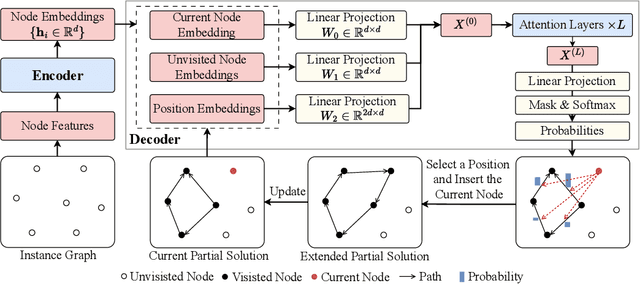
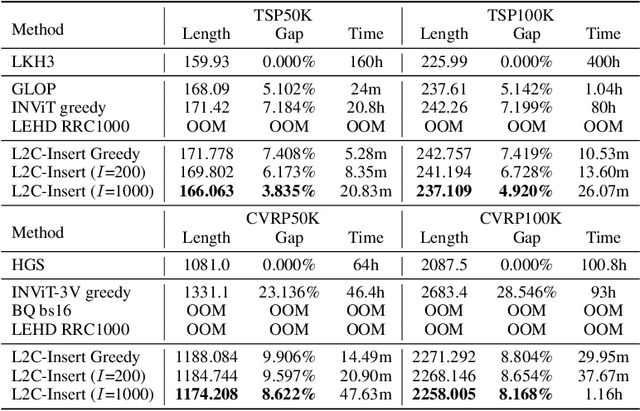
Neural Combinatorial Optimisation (NCO) is a promising learning-based approach for solving Vehicle Routing Problems (VRPs) without extensive manual design. While existing constructive NCO methods typically follow an appending-based paradigm that sequentially adds unvisited nodes to partial solutions, this rigid approach often leads to suboptimal results. To overcome this limitation, we explore the idea of insertion-based paradigm and propose Learning to Construct with Insertion-based Paradigm (L2C-Insert), a novel learning-based method for constructive NCO. Unlike traditional approaches, L2C-Insert builds solutions by strategically inserting unvisited nodes at any valid position in the current partial solution, which can significantly enhance the flexibility and solution quality. The proposed framework introduces three key components: a novel model architecture for precise insertion position prediction, an efficient training scheme for model optimization, and an advanced inference technique that fully exploits the insertion paradigm's flexibility. Extensive experiments on both synthetic and real-world instances of the Travelling Salesman Problem (TSP) and Capacitated Vehicle Routing Problem (CVRP) demonstrate that L2C-Insert consistently achieves superior performance across various problem sizes.