 Add to Chrome
 Add to Firefox
 Add to Edge
Waveform Design for Partial-Time Superimposed ISAC Systems
Feb 23, 2026
Nowadays, waveforms of integrated sensing and communication (ISAC) are almost based on conventional communication and sensing signal, which bounds both the communication and sensing performance. To deal with this issue, in this paper, a novel waveform design is presented for the partial-time superimposed (PTS) ISAC system. At the base station (BS), a parameter-adjustable linear frequency modulation (LFM) pulse signal and a continuous communication orthogonal frequency division multiplexing (OFDM) signal are employed to broadcast public information and perform sensing tasks, respectively, using a PTS scheme. Pulse compression gain enhances the system's long-range sensing capability, while OFDM ensures the system's high-speed data transmission capability. Meanwhile, the LFM signal is utilized as superimposed pilot for channel estimation, which has higher time-frequency resource utilization and stronger real-time performance compared to orthogonal pilots. We present an accurate parameter estimation method of multi-path sensing signal for reconstructing and interference cancellation in communication users. Additionally, a cyclic maximum likelihood method is introduced for channel estimation and the Cramer-Rao lower bound (CRLB) of channel estimation is derived. Simulations demonstrate the accuracy and robustness of the proposed parameter estimation algorithm as well as the improved channel estimation performance over traditional methods. The proposed waveform design method can achieve reliable data transmission and accurate target sensing.
* 15 pages, 17 figures, journal

Robust Security Analysis Based on Random Geometry Theory for Satellite-Terrestrial-Vehicle Network
Dec 28, 2021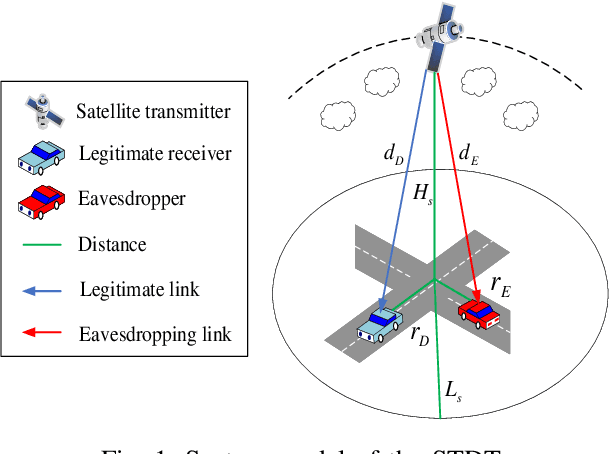
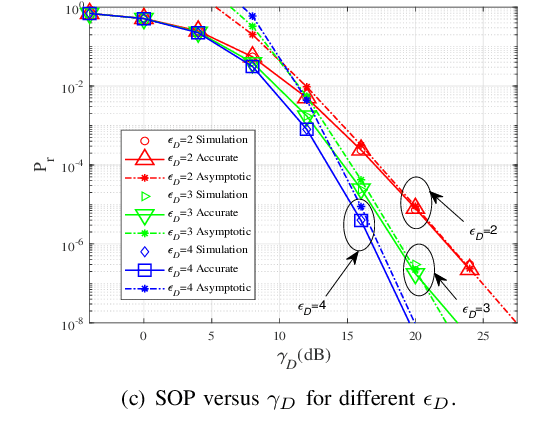
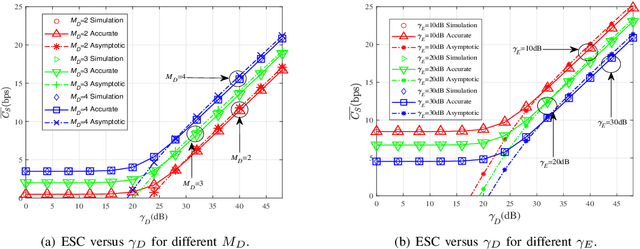
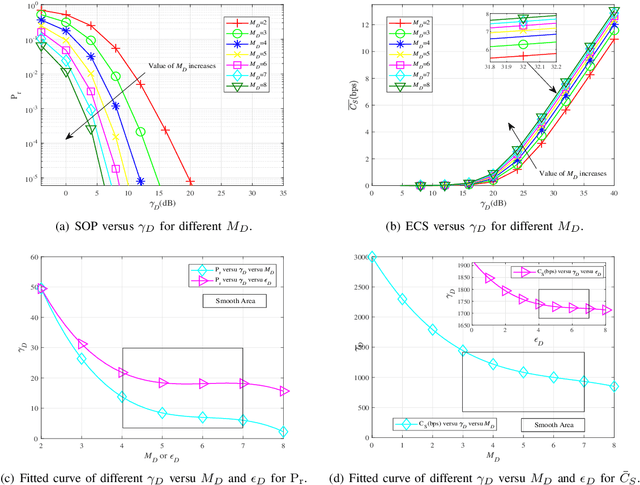
Driven by B5G and 6G technologies, multi-network fusion is an indispensable tendency for future communications. In this paper, we focus on and analyze the \emph{security performance} (SP) of the \emph{satellite-terrestrial downlink transmission} (STDT). Here, the STDT is composed of a satellite network and a vehicular network with a legitimate mobile receiver and an mobile eavesdropper distributing. To theoretically analyze the SP of this system from the perspective of mobile terminals better, the random geometry theory is adopted, which assumes that both terrestrial vehicles are distributed stochastically in one beam of the satellite. Furthermore, based on this theory, the closed-form analytical expressions for two crucial and specific indicators in the STDT are derived, respectively, the secrecy outage probability and the ergodic secrecy capacity. Additionally, several related variables restricting the SP of the STDT are discussed, and specific schemes are presented to enhance the SP. Then, the asymptotic property is investigated in the high signal-to-noise ratio scenario, and accurate and asymptotic closed-form expressions are given. Finally, simulation results show that, under the precondition of guaranteeing the reliability of the STDT, the asymptotic solutions outperform the corresponding accurate results significantly in the effectiveness.