 Add to Chrome
 Add to Firefox
 Add to Edge
Energy-Structured Latent World Models with Neural Time Fields for Physically Constistent Open-World Motion Planning
Aug 10, 2026
Physically consistent motion planning remains a fundamental challenge in embodied AI, as generated trajectories must strictly conform to real-world execution dynamics. While latent world models offer a promising approach by predicting these dynamics, existing methods learn unconstrained future representations where absorbed physics remains implicit. Therefore, they fail to form reusable physical knowledge, which compromises reliability in unpredictable open-world navigation. To address this, we propose a novel Energy-Structured Latent World Model (ELWM). Our key idea is to structure the ELWM latent state to explicitly carry energy and momentum, ensuring strictly causal transitions via dissipation and control ports. Trained on multimodal RGB-D and inertial interaction histories, our model guarantees physically consistent predictions. We further implement this for motion planning by constructing Physics-Conditioned Neural Time Fields (PC-NTF), a key technical cornerstone that integrates ELWM into an arrival time field via the Eikonal equation to yield a physically-informed navigation policy. Across held-out scenes, our evaluation reveals significant improvements. Compared to generic latent models, PC-NTF reduces 0.8-s motion-prediction NRMSE from 0.36 to 0.29. Against Active Neural Time Fields, it improves navigation success from 81.3% to 89.7% and SPL from 0.64 to 0.73, while cutting the physical collision rate from 12.1% to 5.8% and the Eikonal residual from 0.083 to 0.031. Beyond these targeted gains, our results demonstrate that embedding explicit physical structures into latent spaces intrinsically bridges the gap between predictive world models and safe, dynamically feasible motion planning.

Seismogram Transformer: A generic deep learning backbone network for multiple earthquake monitoring tasks
Oct 02, 2023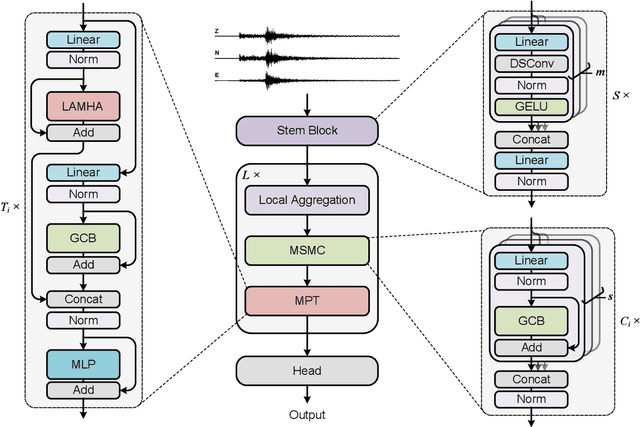
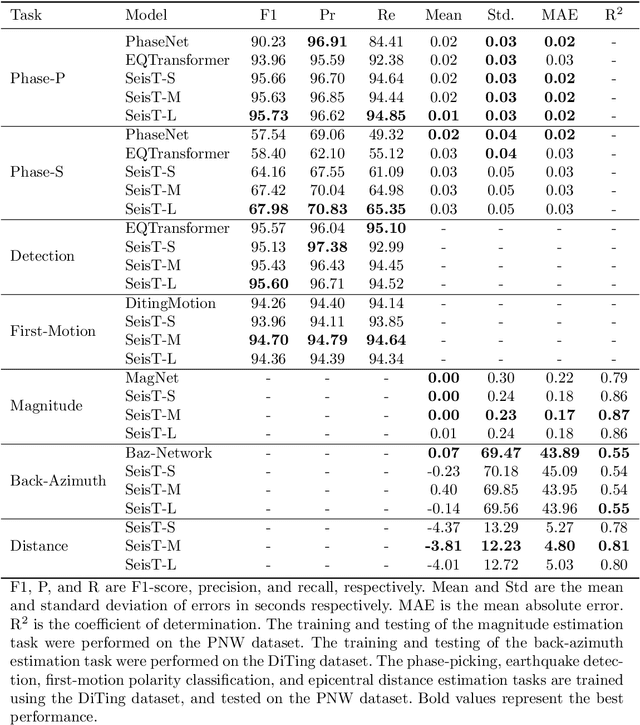
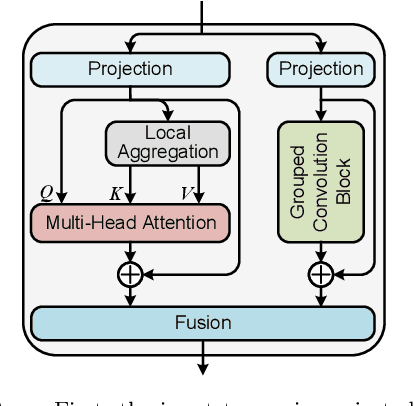
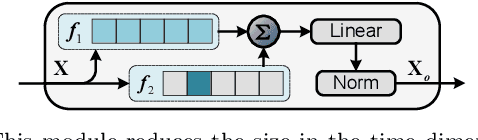
Seismic records, known as seismograms, are crucial records of ground motion resulting from seismic events, constituting the backbone of earthquake research and monitoring. The latest advancements in deep learning have significantly facilitated various seismic signal processing tasks. This paper introduces a novel backbone neural network model designed for various seismic monitoring tasks, named Seismogram Transformer (SeisT). Thanks to its efficient network architecture, SeisT matches or even outperforms the state-of-the-art models in earthquake detection, seismic phase picking, first-motion polarity classification, magnitude estimation, and azimuth estimation tasks, particularly in terms of out-of-distribution generalization performance. SeisT consists of multiple network layers composed of different foundational blocks, which help the model understand multi-level feature representations of seismograms from low-level to high-level complex features, effectively extracting features such as frequency, phase, and time-frequency relationships from input seismograms. Three different-sized models were customized based on these diverse foundational modules. Through extensive experiments and performance evaluations, this study showcases the capabilities and potential of SeisT in advancing seismic signal processing and earthquake research.