 Add to Chrome
 Add to Firefox
 Add to Edge
Learning Earthquake Wave Arrival Time Picking from Labels with Inaccuracies
Jun 13, 2026
Inaccurately labeled training data, or "label noise", poses a significant threat to the integrity of supervised machine learning models. This corruption directly degrades performance by teaching the model erroneous mappings between features and labels, which leads to poor generalization and reduced accuracy on properly labeled validation and test data. Current seismological applications mainly rely on large-scale training sets or data augmentation to reduce the label-noise impact, which can be labor-intensive and costly. Here, we introduce a Label Noise-Contrastive Robust Learning (LaNCoR) approach that can effectively handle noisy labels in seismic signal processing tasks, without requiring large-scale training datasets. In this approach, the input waveform feature and label representation distributions are aligned in the feature space to correct mislabeling and reduce its impact on the training process. We present LaNCoR's performance on the task of P-phase arrival-time picking of real microseismic data using two baseline models and training approaches. Our results indicate that LaNCoR can improve performance by up to 28.8% across performance metrics. This approach holds great promise for model training in seismology and geosciences.

Seismogram Transformer: A generic deep learning backbone network for multiple earthquake monitoring tasks
Oct 02, 2023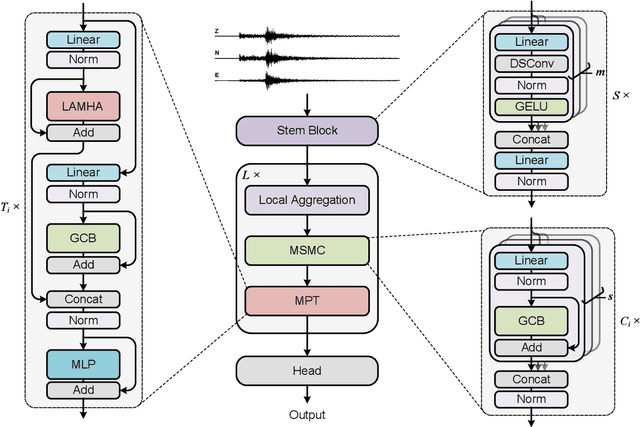
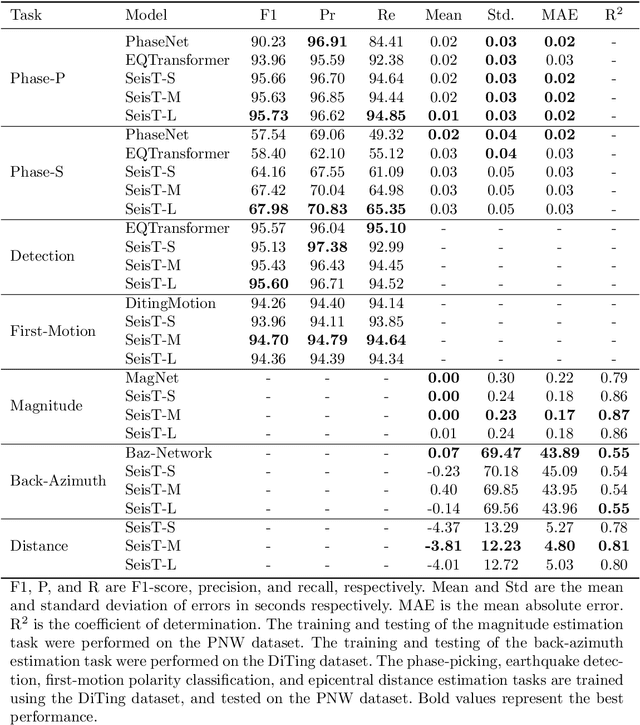
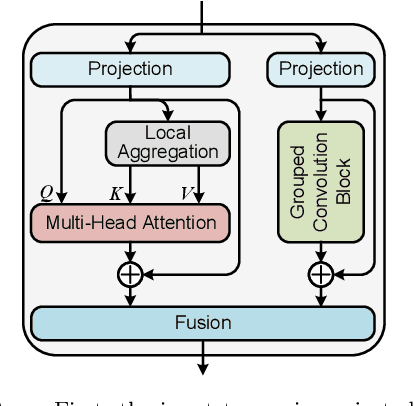
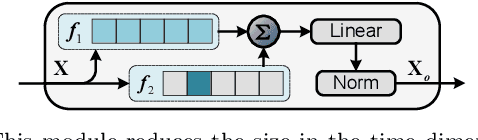
Seismic records, known as seismograms, are crucial records of ground motion resulting from seismic events, constituting the backbone of earthquake research and monitoring. The latest advancements in deep learning have significantly facilitated various seismic signal processing tasks. This paper introduces a novel backbone neural network model designed for various seismic monitoring tasks, named Seismogram Transformer (SeisT). Thanks to its efficient network architecture, SeisT matches or even outperforms the state-of-the-art models in earthquake detection, seismic phase picking, first-motion polarity classification, magnitude estimation, and azimuth estimation tasks, particularly in terms of out-of-distribution generalization performance. SeisT consists of multiple network layers composed of different foundational blocks, which help the model understand multi-level feature representations of seismograms from low-level to high-level complex features, effectively extracting features such as frequency, phase, and time-frequency relationships from input seismograms. Three different-sized models were customized based on these diverse foundational modules. Through extensive experiments and performance evaluations, this study showcases the capabilities and potential of SeisT in advancing seismic signal processing and earthquake research.