 Add to Chrome
 Add to Firefox
 Add to Edge
RoboPIN: Grounded Embodied Reasoning via Pinned Chain-of-Thought
Jun 14, 2026
Embodied reasoning requires models to perceive task-relevant objects and spaces in physical environments and maintain consistent visual grounding throughout multi-step reasoning. However, current vision-language models rely on text-only or coordinate-augmented chain-of-thought, where entity references remain implicit and ambiguous. This may cause the reasoning process to decouple from visual evidence, entity references to drift across steps, and a causal disconnection between the reasoning trajectory and the final answer, with these problems further amplified in multi-view scenarios due to cross-view appearance changes. To address these issues, we propose Pinned Chain-of-Thought (\pincot{}), a structured reasoning paradigm that pins every reasoning step to visual evidence. \pincot{} introduces the concept of \reasoninganchor{}, which binds each task-relevant entity to a structured visual anchor with entity name, unique identity, view index, and spatial grounding, enabling consistent entity tracking across reasoning steps and views. We build a fully automated data generation pipeline to construct \dataset{}, a high-quality \pincot{}-formatted reasoning dataset. We then train \method{} through three-stage post-training that progressively injects embodied knowledge, structured reasoning ability, and process-supervised alignment, with rewards that directly constrain both anchor localization and identity consistency during reasoning. On 14 benchmarks covering embodied spatial reasoning, multi-view reasoning, and pointing, \method{} with only 4B parameters consistently outperforms 7B level open-source embodied models, achieving a 12\% average improvement over the strongest 7B baseline, Mimo-Embodied. Further analysis shows that \pincot{} improves grounding accuracy and cross-step identity consistency, validating the effectiveness of process supervision.

Embodied-R1.5: Evolving Physical Intelligence via Embodied Foundation Models
Jun 09, 2026We introduce Embodied-R1.5, a unified Embodied Foundation Model (EFM) that integrates comprehensive embodied reasoning capabilities, spanning embodied cognition, task planning, correction, and pointing, within a single architecture toward general physical intelligence. Leveraging three automated data construction pipelines to significantly expand the data coverage of critical capabilities, we build a large-scale data system of over 15B tokens, and design a multi-task balanced RL recipe to alleviate heterogeneous task conflicts. We further introduce a Planner-Grounder-Corrector (PGC) closed-loop framework that enables a single model to autonomously execute and self-correct over long-horizon tasks. With only 8B parameters, Embodied-R1.5 achieves SOTA on 16 out of 24 embodied VLM benchmarks, surpassing leading models like Gemini-Robotics-ER-1.5 and GPT-5.4. Benefiting from the internalized embodied capabilities, Embodied-R1.5 can be fine-tuned into a VLA with only a small amount of data, outperforming leading VLA models like $π_{0.5}$ across 4 popular manipulation benchmark suites. We further conduct extensive zero-shot real-robot experiments, validating performance in instruction following, affordance grounding, articulated object manipulation, and long-horizon complex tasks, demonstrating strong generalization to the physical world. We open-source model weights, datasets, training code, and EmbodiedEvalKit, an evaluation framework tailored for embodied tasks, to facilitate future research in EFMs.
Intelligent Solution System towards Parts Logistics Optimization
Mar 18, 2019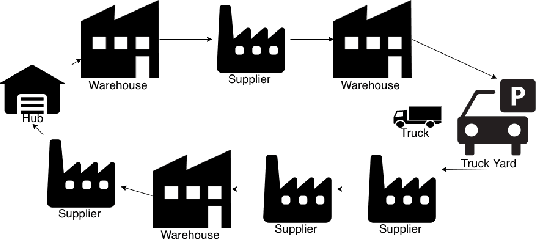
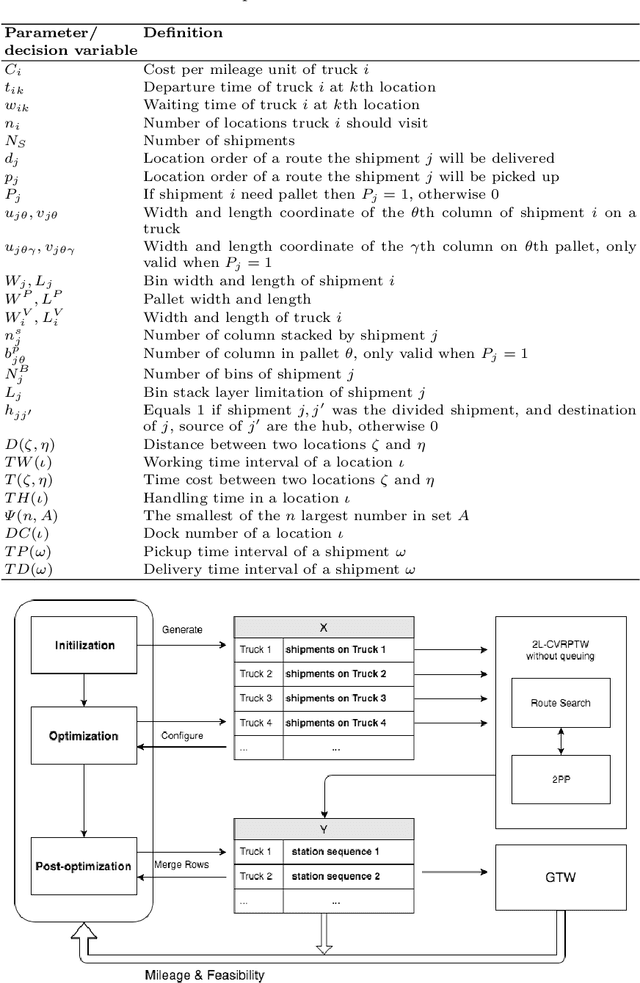
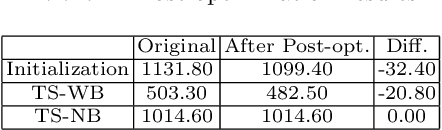
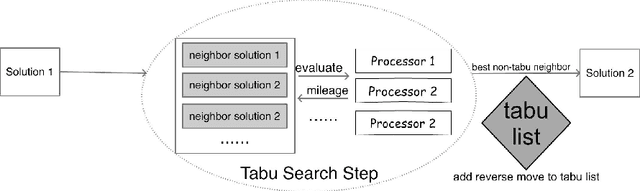
Due to the complication of the presented problem, intelligent algorithms show great power to solve the parts logistics optimization problem related to the vehicle routing problem (VRP). However, most of the existing research to VRP are incomprehensive and failed to solve a real-work parts logistics problem. In this work, towards SAIC logistics problem, we propose a systematic solution to this 2-Dimensional Loading Capacitated Multi-Depot Heterogeneous VRP with Time Windows by integrating diverse types of intelligent algorithms, including, a heuristic algorithm to initialize feasible logistics planning schemes by imitating manual planning, the core Tabu Search algorithm for global optimization, accelerated by a novel bundle technique, heuristically algorithms for routing, packing and queuing associated, and a heuristic post-optimization process to promote the optimal solution. Based on these algorithms, the SAIC Motor has successfully established an intelligent management system to give a systematic solution for the parts logistics planning, superior than manual planning in its performance, customizability and expandability.