 Add to Chrome
 Add to Firefox
 Add to Edge
Magic-MM-Embedding: Towards Visual-Token-Efficient Universal Multimodal Embedding with MLLMs
Feb 05, 2026
Multimodal Large Language Models (MLLMs) have shown immense promise in universal multimodal retrieval, which aims to find relevant items of various modalities for a given query. But their practical application is often hindered by the substantial computational cost incurred from processing a large number of tokens from visual inputs. In this paper, we propose Magic-MM-Embedding, a series of novel models that achieve both high efficiency and state-of-the-art performance in universal multimodal embedding. Our approach is built on two synergistic pillars: (1) a highly efficient MLLM architecture incorporating visual token compression to drastically reduce inference latency and memory footprint, and (2) a multi-stage progressive training strategy designed to not only recover but significantly boost performance. This coarse-to-fine training paradigm begins with extensive continue pretraining to restore multimodal understanding and generation capabilities, progresses to large-scale contrastive pretraining and hard negative mining to enhance discriminative power, and culminates in a task-aware fine-tuning stage guided by an MLLM-as-a-Judge for precise data curation. Comprehensive experiments show that our model outperforms existing methods by a large margin while being more inference-efficient.

Contrast-Free Ultrasound Microvascular Imaging via Radiality and Similarity Weighting
Sep 08, 2025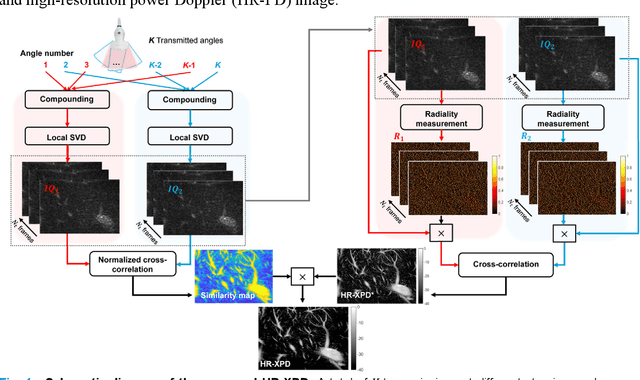
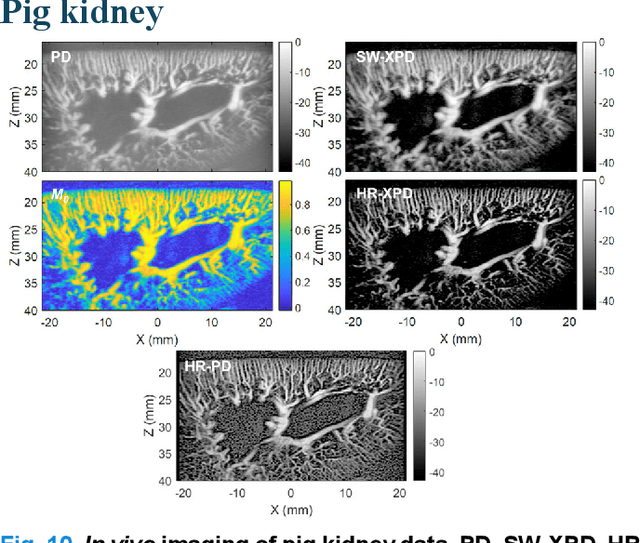
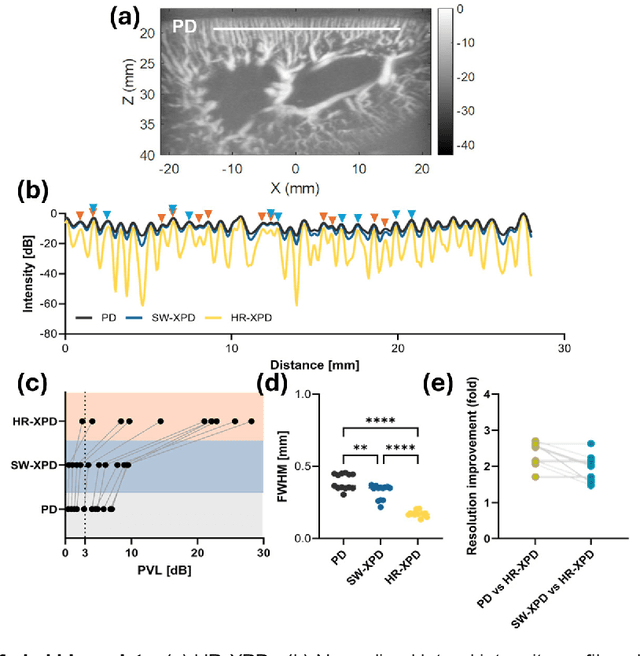
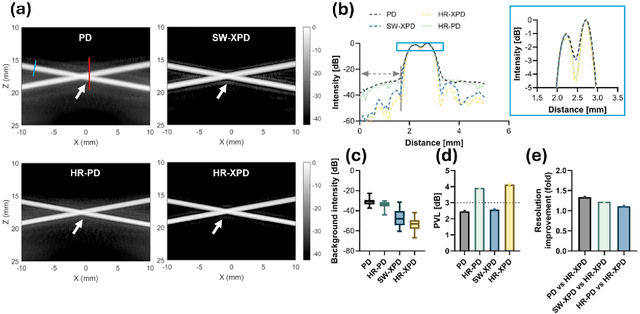
Microvascular imaging has advanced significantly with ultrafast data acquisition and improved clutter filtering, enhancing the sensitivity of power Doppler imaging to small vessels. However, the image quality remains limited by spatial resolution and elevated background noise, both of which impede visualization and accurate quantification. To address these limitations, this study proposes a high-resolution cross-correlation Power Doppler (HR-XPD) method that integrates spatial radiality weighting with Doppler signal coherence analysis, thereby enhancing spatial resolution while suppressing artifacts and background noise. Quantitative evaluations in simulation and in vivo experiments on healthy human liver, transplanted human kidney, and pig kidney demonstrated that HR-XPD significantly improves microvascular resolvability and contrast compared to conventional PD. In vivo results showed up to a 2 to 3-fold enhancement in spatial resolution and an increase in contrast by up to 20 dB. High-resolution vascular details were clearly depicted within a short acquisition time of only 0.3 s-1.2 s without the use of contrast agents. These findings indicate that HR-XPD provides an effective, contrast-free, and high-resolution microvascular imaging approach with broad applicability in both preclinical and clinical research.