 Add to Chrome
 Add to Firefox
 Add to Edge
Scalable Differentially Private Data Compression via Diffusion and Stochastic Codes
Jul 03, 2026
The ever-increasing collection of personal data has created mounting pressure to develop technologies that protect sensitive aspects of individual identity. Differential privacy (DP) provides a principled framework with strong formal guarantees and has already achieved practical success. However, releasing high-dimensional data, such as images, has remained elusive: releasing uncompressed privatized data requires significant storage. At the same time, no effective data compression scheme exists that can compress high-resolution data with privacy guarantees. We address this challenge with DP-DiPP, a compression pipeline that combines stochastic codes with diffusion models. DP-DiPP is highly flexible: the practitioner has direct control over the compression rate-privacy-utility tradeoff. As the theoretical backbone, we extend the Poisson private representation (PPR) to encode the outputs of privacy mechanisms. We then combine it with DiffC, a diffusion-based lossy data compression method, to obtain a differentially private image compressor. Our experiments on privatized image classification on CIFAR-10 demonstrate that DP-DiPP significantly outperforms the baseline, achieving a 10-30 times better compression while retaining comparable privacy guarantees and utility.

Compression Tells Intelligence: Visual Coding, Visual Token Technology, and the Unification
Jan 28, 2026"Compression Tells Intelligence", is supported by research in artificial intelligence, particularly concerning (multimodal) large language models (LLMs/MLLMs), where compression efficiency often correlates with improved model performance and capabilities. For compression, classical visual coding based on traditional information theory has developed over decades, achieving great success with numerous international industrial standards widely applied in multimedia (e.g., image/video) systems. Except that, the recent emergingvisual token technology of generative multi-modal large models also shares a similar fundamental objective like visual coding: maximizing semantic information fidelity during the representation learning while minimizing computational cost. Therefore, this paper provides a comprehensive overview of two dominant technique families first -- Visual Coding and Vision Token Technology -- then we further unify them from the aspect of optimization, discussing the essence of compression efficiency and model performance trade-off behind. Next, based on the proposed unified formulation bridging visual coding andvisual token technology, we synthesize bidirectional insights of themselves and forecast the next-gen visual codec and token techniques. Last but not least, we experimentally show a large potential of the task-oriented token developments in the more practical tasks like multimodal LLMs (MLLMs), AI-generated content (AIGC), and embodied AI, as well as shedding light on the future possibility of standardizing a general token technology like the traditional codecs (e.g., H.264/265) with high efficiency for a wide range of intelligent tasks in a unified and effective manner.
Universal Exact Compression of Differentially Private Mechanisms
May 28, 2024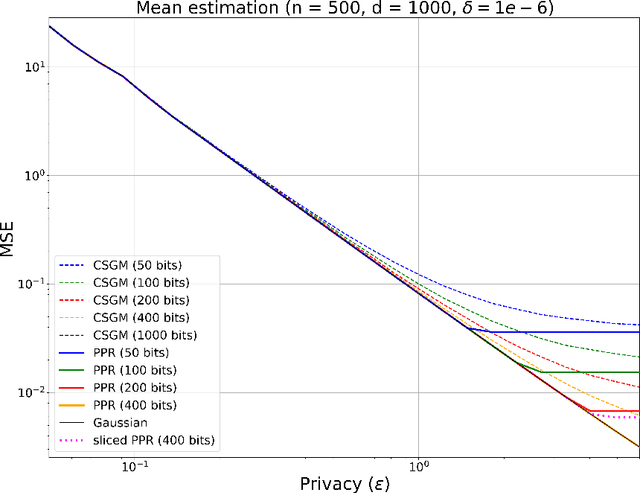
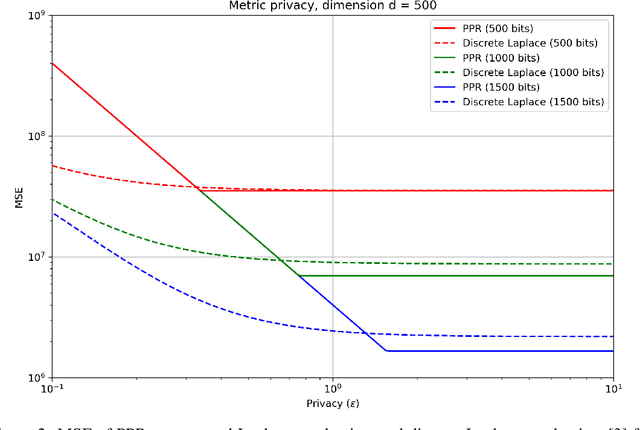

To reduce the communication cost of differential privacy mechanisms, we introduce a novel construction, called Poisson private representation (PPR), designed to compress and simulate any local randomizer while ensuring local differential privacy. Unlike previous simulation-based local differential privacy mechanisms, PPR exactly preserves the joint distribution of the data and the output of the original local randomizer. Hence, the PPR-compressed privacy mechanism retains all desirable statistical properties of the original privacy mechanism such as unbiasedness and Gaussianity. Moreover, PPR achieves a compression size within a logarithmic gap from the theoretical lower bound. Using the PPR, we give a new order-wise trade-off between communication, accuracy, central and local differential privacy for distributed mean estimation. Experiment results on distributed mean estimation show that PPR consistently gives a better trade-off between communication, accuracy and central differential privacy compared to the coordinate subsampled Gaussian mechanism, while also providing local differential privacy.