 Add to Chrome
 Add to Firefox
 Add to Edge
Multi-Feature Riemannian Hypergraph for Online Test-Time Adaptation of Motor Imagery Brain-Computer Interface
Aug 17, 2026
In clinical motor imagery brain-computer interface (MI-BCI) decoding, cross-day transferability and online operation remain two critical challenges. Hypergraphs can improve transferability by capturing higher-order sample relationships, yet existing hypergraph-based methods for online emotion recognition neglect the cross-day benefits of Riemannian geometry widely adopted in EEG transfer learning. To bridge this gap, we propose the Multi-feature Riemannian Hypergraph (MRieHy), a framework tailored for online test-time adaptation in MI-BCI decoding that leverages Riemannian geometry to strengthen cross-day transferability. MRieHy first computes Riemannian means of covariance matrices from cross-day training data to align multi-day distributions. It then constructs a hypergraph over covariance matrices using Riemannian distance, complemented by a second hypergraph over deep features built with cosine similarity. The two hypergraphs are fused via adaptively learned combination weights, jointly optimized with the label projection matrices. During online testing, MRieHy maintains a first-in-first-out buffer of recent samples, performs Riemannian alignment on the buffered data, and decodes with the learned hypergraph. Extensive experiments on a private four-class ECoG dataset and two public four-class EEG datasets validate that MRieHy achieves notable performance gains over state-of-the-art baselines.

Real-time object detection method based on improved YOLOv4-tiny
Nov 09, 2020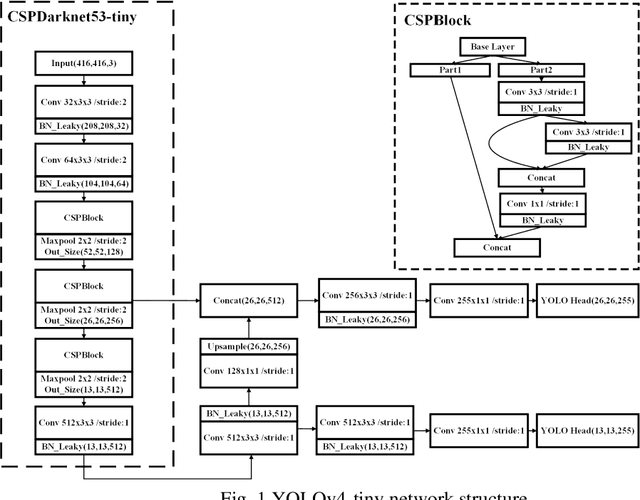
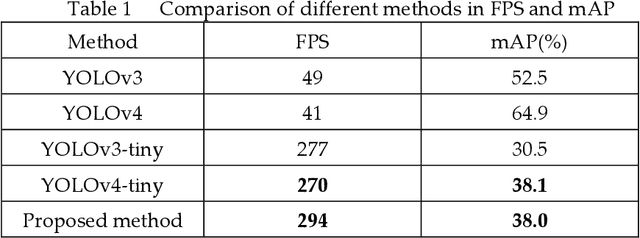
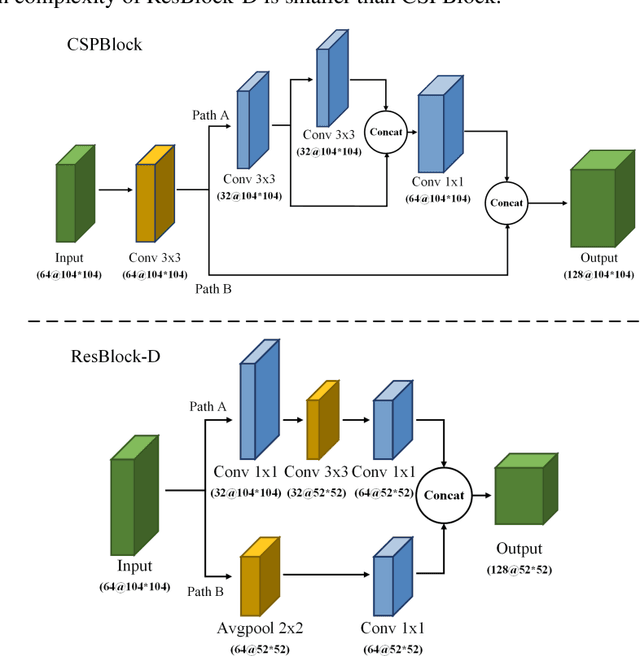
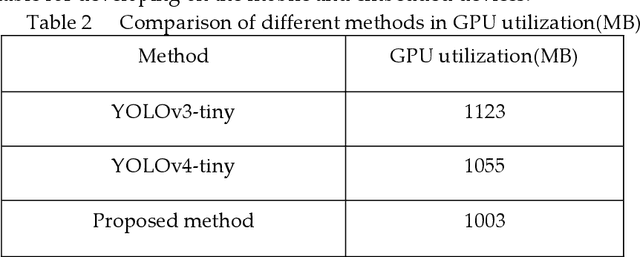
The "You only look once v4"(YOLOv4) is one type of object detection methods in deep learning. YOLOv4-tiny is proposed based on YOLOv4 to simple the network structure and reduce parameters, which makes it be suitable for developing on the mobile and embedded devices. To improve the real-time of object detection, a fast object detection method is proposed based on YOLOv4-tiny. It firstly uses two ResBlock-D modules in ResNet-D network instead of two CSPBlock modules in Yolov4-tiny, which reduces the computation complexity. Secondly, it designs an auxiliary residual network block to extract more feature information of object to reduce detection error. In the design of auxiliary network, two consecutive 3x3 convolutions are used to obtain 5x5 receptive fields to extract global features, and channel attention and spatial attention are also used to extract more effective information. In the end, it merges the auxiliary network and backbone network to construct the whole network structure of improved YOLOv4-tiny. Simulation results show that the proposed method has faster object detection than YOLOv4-tiny and YOLOv3-tiny, and almost the same mean value of average precision as the YOLOv4-tiny. It is more suitable for real-time object detection.