 Add to Chrome
 Add to Firefox
 Add to Edge
Memory in the LLM Era: Modular Architectures and Strategies in a Unified Framework
Apr 02, 2026
Memory emerges as the core module in the large language model (LLM)-based agents for long-horizon complex tasks (e.g., multi-turn dialogue, game playing, scientific discovery), where memory can enable knowledge accumulation, iterative reasoning and self-evolution. A number of memory methods have been proposed in the literature. However, these methods have not been systematically and comprehensively compared under the same experimental settings. In this paper, we first summarize a unified framework that incorporates all the existing agent memory methods from a high-level perspective. We then extensively compare representative agent memory methods on two well-known benchmarks and examine the effectiveness of all methods, providing a thorough analysis of those methods. As a byproduct of our experimental analysis, we also design a new memory method by exploiting modules in the existing methods, which outperforms the state-of-the-art methods. Finally, based on these findings, we offer promising future research opportunities. We believe that a deeper understanding of the behavior of existing methods can provide valuable new insights for future research.

A Fenchel-Young Loss Approach to Data-Driven Inverse Optimization
Feb 22, 2025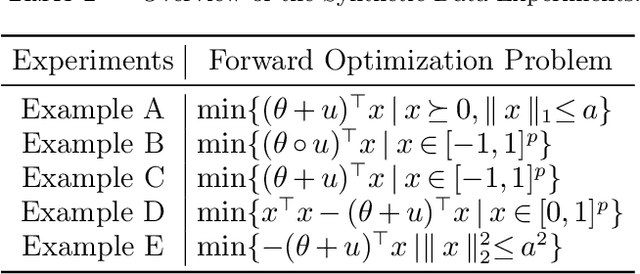
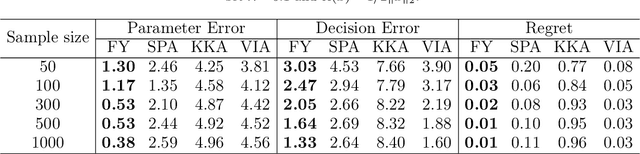
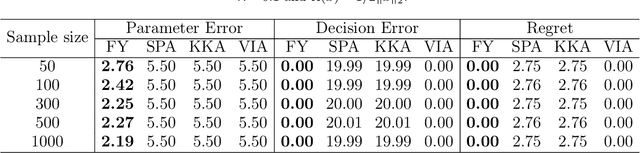

Data-driven inverse optimization seeks to estimate unknown parameters in an optimization model from observations of optimization solutions. Many existing methods are ineffective in handling noisy and suboptimal solution observations and also suffer from computational challenges. In this paper, we build a connection between inverse optimization and the Fenchel-Young (FY) loss originally designed for structured prediction, proposing a FY loss approach to data-driven inverse optimization. This new approach is amenable to efficient gradient-based optimization, hence much more efficient than existing methods. We provide theoretical guarantees for the proposed method and use extensive simulation and real-data experiments to demonstrate its significant advantage in parameter estimation accuracy, decision error and computational speed.
Contextual Linear Optimization with Bandit Feedback
May 26, 2024Contextual linear optimization (CLO) uses predictive observations to reduce uncertainty in random cost coefficients and thereby improve average-cost performance. An example is a stochastic shortest path with random edge costs (e.g., traffic) and predictive features (e.g., lagged traffic, weather). Existing work on CLO assumes the data has fully observed cost coefficient vectors, but in many applications, we can only see the realized cost of a historical decision, that is, just one projection of the random cost coefficient vector, to which we refer as bandit feedback. We study a class of algorithms for CLO with bandit feedback, which we term induced empirical risk minimization (IERM), where we fit a predictive model to directly optimize the downstream performance of the policy it induces. We show a fast-rate regret bound for IERM that allows for misspecified model classes and flexible choices of the optimization estimate, and we develop computationally tractable surrogate losses. A byproduct of our theory of independent interest is fast-rate regret bound for IERM with full feedback and misspecified policy class. We compare the performance of different modeling choices numerically using a stochastic shortest path example and provide practical insights from the empirical results.