 Add to Chrome
 Add to Firefox
 Add to Edge
MINDGAMES: A Live Arena for Evaluating Social and Strategic Reasoning in Multi-Agent LLMs
May 28, 2026
Large language models (LLMs) are increasingly deployed as interactive agents, yet their capacity for social and strategic reasoning over extended interaction remains poorly understood. Existing evaluations rely on static vignettes or single-game benchmarks that cannot capture the sustained, multi-faceted reasoning that real-world multi-agent settings demand. We introduce Mindgames, a multi-game arena and evaluation platform for LLM agents that operationalizes complementary reasoning demands relevant to ``theory of mind'': belief attribution under hidden information, opponent modeling through repeated strategic interaction, cooperative inference under knowledge asymmetries, and sustained deception in social deduction. Built on TextArena, Mindgames provides a unified interaction interface, TrueSkill-based rating, and full trajectory logging across four game environments. We instantiate Mindgames through a 2025 competition cycle hosted at a major AI conference, which assessed 944 submitted agents from 76 teams across four games: Colonel Blotto, Iterated Prisoner's Dilemma, Codenames, and Secret Mafia. Our analysis surfaces both agent-level and evaluation-level limitations: brittle rule adherence remains a major bottleneck, top-performing systems repeatedly rely on explicit structural scaffolding, and leaderboard validity differs sharply across environments. In particular, failure-heavy environments can reward robustness to opponent errors as much as strategic ability, with Secret Mafia exhibiting a pronounced error-survival confound in this cycle. We release a dataset of 29,571 multi-agent games with turn-level observations, actions, and rewards, together with MG-Ref, a deterministic offline tournament protocol that scores new agents against a frozen reference pool of top-ranked, low-error Stage~II submissions under the same error-attribution lens used in this analysis.

Regret-Guided Search Control for Efficient Learning in AlphaZero
Feb 24, 2026Reinforcement learning (RL) agents achieve remarkable performance but remain far less learning-efficient than humans. While RL agents require extensive self-play games to extract useful signals, humans often need only a few games, improving rapidly by repeatedly revisiting states where mistakes occurred. This idea, known as search control, aims to restart from valuable states rather than always from the initial state. In AlphaZero, prior work Go-Exploit applies this idea by sampling past states from self-play or search trees, but it treats all states equally, regardless of their learning potential. We propose Regret-Guided Search Control (RGSC), which extends AlphaZero with a regret network that learns to identify high-regret states, where the agent's evaluation diverges most from the actual outcome. These states are collected from both self-play trajectories and MCTS nodes, stored in a prioritized regret buffer, and reused as new starting positions. Across 9x9 Go, 10x10 Othello, and 11x11 Hex, RGSC outperforms AlphaZero and Go-Exploit by an average of 77 and 89 Elo, respectively. When training on a well-trained 9x9 Go model, RGSC further improves the win rate against KataGo from 69.3% to 78.2%, while both baselines show no improvement. These results demonstrate that RGSC provides an effective mechanism for search control, improving both efficiency and robustness of AlphaZero training. Our code is available at https://rlg.iis.sinica.edu.tw/papers/rgsc.
Interpreting the Learned Model in MuZero Planning
Nov 07, 2024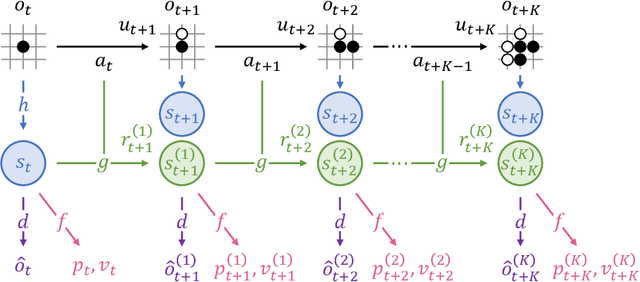
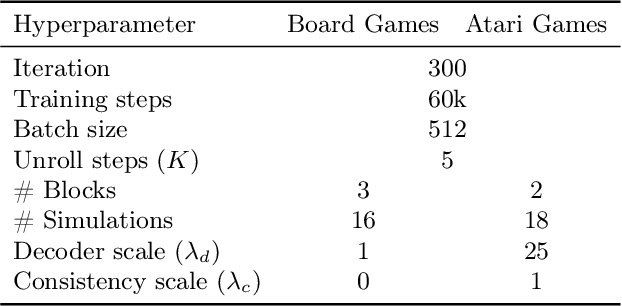

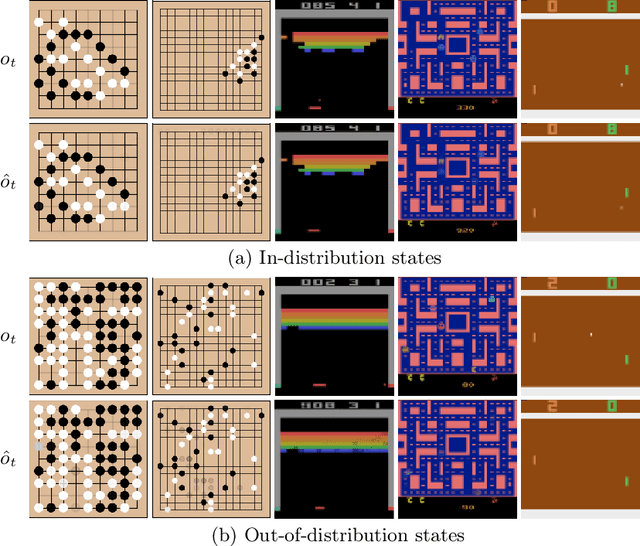
MuZero has achieved superhuman performance in various games by using a dynamics network to predict environment dynamics for planning, without relying on simulators. However, the latent states learned by the dynamics network make its planning process opaque. This paper aims to demystify MuZero's model by interpreting the learned latent states. We incorporate observation reconstruction and state consistency into MuZero training and conduct an in-depth analysis to evaluate latent states across two board games: 9x9 Go and Outer-Open Gomoku, and three Atari games: Breakout, Ms. Pacman, and Pong. Our findings reveal that while the dynamics network becomes less accurate over longer simulations, MuZero still performs effectively by using planning to correct errors. Our experiments also show that the dynamics network learns better latent states in board games than in Atari games. These insights contribute to a better understanding of MuZero and offer directions for future research to improve the playing performance, robustness, and interpretability of the MuZero algorithm.
ResTNet: Defense against Adversarial Policies via Transformer in Computer Go
Oct 07, 2024Although AlphaZero has achieved superhuman levels in Go, recent research has highlighted its vulnerability in particular situations requiring a more comprehensive understanding of the entire board. To address this challenge, this paper introduces ResTNet, a network that interleaves residual networks and Transformer. Our empirical experiments demonstrate several advantages of using ResTNet. First, it not only improves playing strength but also enhances the ability of global information. Second, it defends against an adversary Go program, called cyclic-adversary, tailor-made for attacking AlphaZero algorithms, significantly reducing the average probability of being attacked rate from 70.44% to 23.91%. Third, it improves the accuracy from 59.15% to 80.01% in correctly recognizing ladder patterns, which are one of the challenging patterns for Go AIs. Finally, ResTNet offers a potential explanation of the decision-making process and can also be applied to other games like Hex. To the best of our knowledge, ResTNet is the first to integrate residual networks and Transformer in the context of AlphaZero for board games, suggesting a promising direction for enhancing AlphaZero's global understanding.