 Add to Chrome
 Add to Firefox
 Add to Edge
Generative Inverse Design of Cold Metals for Low-Power Electronics
Mar 14, 2026
Cold metals are a class of metals with an intrinsic energy gap located close to the Fermi level, which enables cold-carrier injection for steep-slope transistors and is therefore promising for low-power electronic applications. High-throughput screening has revealed 252 three-dimensional (3D) cold metals in the Materials Project database, but database searches are inherently limited to known compounds. Here we present an inverse-design workflow that generates 3D cold metals using MatterGPT, a conditional autoregressive Transformer trained on SLICES, an invertible and symmetry-invariant crystal string representation. We curate a training set of 26,309 metallic structures labeled with energy above hull and a unified band-edge distance descriptor that merges p-type and n-type cold-metal characteristics to address severe label imbalance. Property-conditioned generation targeting thermodynamic stability and 50-500 meV band-edge distances produces 148,506 unique candidates; 92.1% are successfully reconstructed to 3D structures and down-selected by symmetry, uniqueness and novelty filters, followed by high-throughput DFT validation. We identify 257 cold metals verified as novel with respect to the Materials Project database, with gaps around the Fermi level spanning 50-500 meV. First-principles phonon, electronic-structure, and work-function calculations for representative candidates confirm dynamical stability and contact-relevant work functions. Our results demonstrate that SLICES-enabled generative transformers can expand the chemical space of cold metals beyond high-throughput screening, providing a route to low-power electronic materials discovery.

Global Universal Scaling and Ultra-Small Parameterization in Machine Learning Interatomic Potentials with Super-Linearity
Feb 11, 2025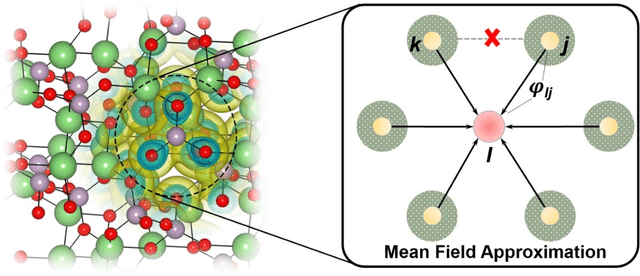
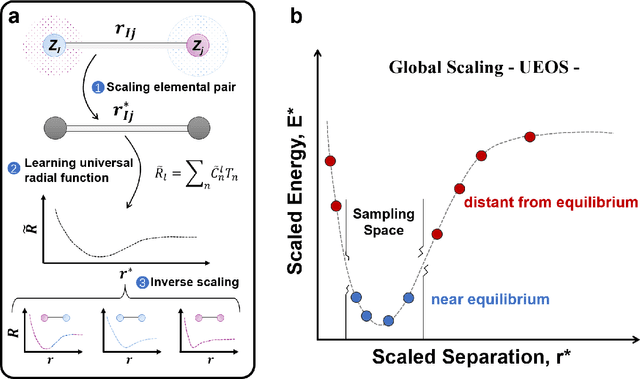
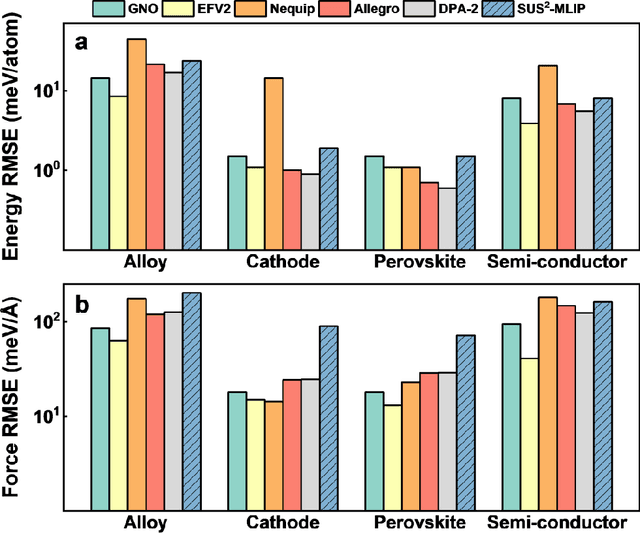
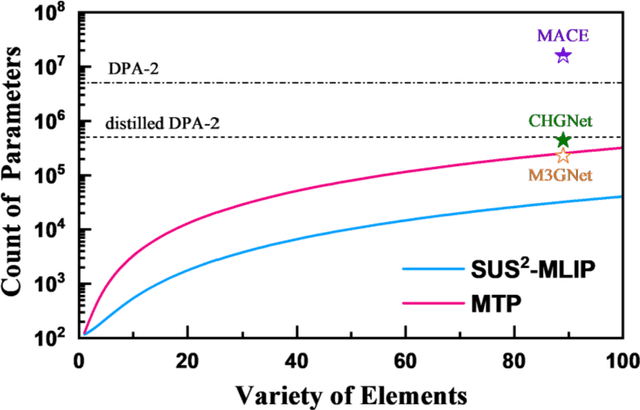
Using machine learning (ML) to construct interatomic interactions and thus potential energy surface (PES) has become a common strategy for materials design and simulations. However, those current models of machine learning interatomic potential (MLIP) provide no relevant physical constrains, and thus may owe intrinsic out-of-domain difficulty which underlies the challenges of model generalizability and physical scalability. Here, by incorporating physics-informed Universal-Scaling law and nonlinearity-embedded interaction function, we develop a Super-linear MLIP with both Ultra-Small parameterization and greatly expanded expressive capability, named SUS2-MLIP. Due to the global scaling rooting in universal equation of state (UEOS), SUS2-MLIP not only has significantly-reduced parameters by decoupling the element space from coordinate space, but also naturally outcomes the out-of-domain difficulty and endows the potentials with inherent generalizability and scalability even with relatively small training dataset. The nonlinearity-enbeding transformation for interaction function expands the expressive capability and make the potentials super-linear. The SUS2-MLIP outperforms the state-of-the-art MLIP models with its exceptional computational efficiency especially for multiple-element materials and physical scalability in property prediction. This work not only presents a highly-efficient universal MLIP model but also sheds light on incorporating physical constraints into artificial-intelligence-aided materials simulation.