 Add to Chrome
 Add to Firefox
 Add to Edge
Generative Inverse Design of Cold Metals for Low-Power Electronics
Mar 14, 2026
Cold metals are a class of metals with an intrinsic energy gap located close to the Fermi level, which enables cold-carrier injection for steep-slope transistors and is therefore promising for low-power electronic applications. High-throughput screening has revealed 252 three-dimensional (3D) cold metals in the Materials Project database, but database searches are inherently limited to known compounds. Here we present an inverse-design workflow that generates 3D cold metals using MatterGPT, a conditional autoregressive Transformer trained on SLICES, an invertible and symmetry-invariant crystal string representation. We curate a training set of 26,309 metallic structures labeled with energy above hull and a unified band-edge distance descriptor that merges p-type and n-type cold-metal characteristics to address severe label imbalance. Property-conditioned generation targeting thermodynamic stability and 50-500 meV band-edge distances produces 148,506 unique candidates; 92.1% are successfully reconstructed to 3D structures and down-selected by symmetry, uniqueness and novelty filters, followed by high-throughput DFT validation. We identify 257 cold metals verified as novel with respect to the Materials Project database, with gaps around the Fermi level spanning 50-500 meV. First-principles phonon, electronic-structure, and work-function calculations for representative candidates confirm dynamical stability and contact-relevant work functions. Our results demonstrate that SLICES-enabled generative transformers can expand the chemical space of cold metals beyond high-throughput screening, providing a route to low-power electronic materials discovery.

Improving Densification in 3D Gaussian Splatting for High-Fidelity Rendering
Aug 17, 2025Although 3D Gaussian Splatting (3DGS) has achieved impressive performance in real-time rendering, its densification strategy often results in suboptimal reconstruction quality. In this work, we present a comprehensive improvement to the densification pipeline of 3DGS from three perspectives: when to densify, how to densify, and how to mitigate overfitting. Specifically, we propose an Edge-Aware Score to effectively select candidate Gaussians for splitting. We further introduce a Long-Axis Split strategy that reduces geometric distortions introduced by clone and split operations. To address overfitting, we design a set of techniques, including Recovery-Aware Pruning, Multi-step Update, and Growth Control. Our method enhances rendering fidelity without introducing additional training or inference overhead, achieving state-of-the-art performance with fewer Gaussians.
Efficient Density Control for 3D Gaussian Splatting
Nov 15, 2024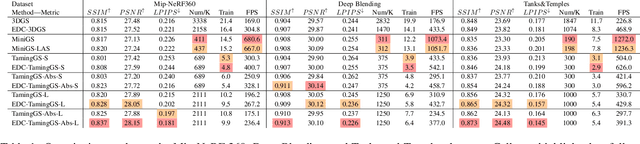
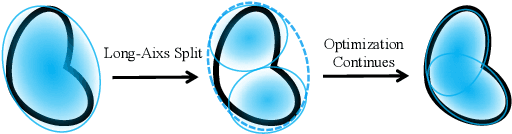
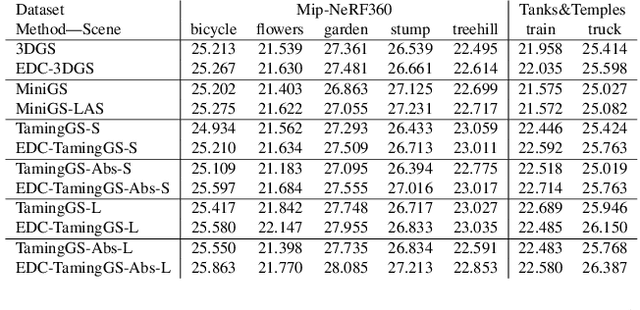
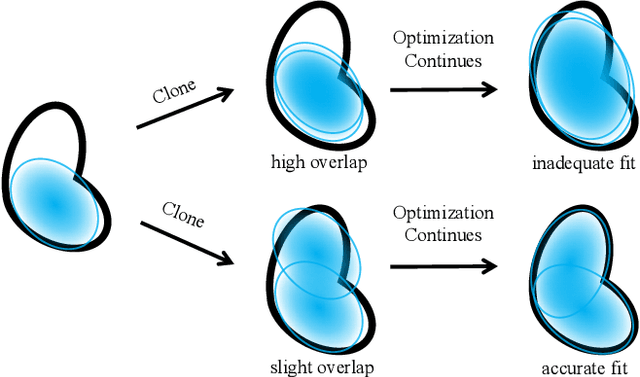
3D Gaussian Splatting (3DGS) excels in novel view synthesis, balancing advanced rendering quality with real-time performance. However, in trained scenes, a large number of Gaussians with low opacity significantly increase rendering costs. This issue arises due to flaws in the split and clone operations during the densification process, which lead to extensive Gaussian overlap and subsequent opacity reduction. To enhance the efficiency of Gaussian utilization, we improve the adaptive density control of 3DGS. First, we introduce a more efficient long-axis split operation to replace the original clone and split, which mitigates Gaussian overlap and improves densification efficiency.Second, we propose a simple adaptive pruning technique to reduce the number of low-opacity Gaussians. Finally, by dynamically lowering the splitting threshold and applying importance weighting, the efficiency of Gaussian utilization is further improved.We evaluate our proposed method on various challenging real-world datasets. Experimental results show that our Efficient Density Control (EDC) can enhance both the rendering speed and quality.