 Add to Chrome
 Add to Firefox
 Add to Edge
AgentCyberRange: Benchmarking Frontier AI Systems in Realistic Cyber Ranges
Jun 12, 2026
Frontier AI systems are increasingly capable of cybersecurity tasks, including codebase inspection, vulnerability detection, and exploitation. However, evaluating their offensive capabilities remains constrained by limited access to open, reproducible, multi-host cyber ranges. Existing public benchmarks capture isolated skills such as CTF solving, vulnerability reproduction, and exploit generation, but often abstract away realistic intrusion workflows: discovering exposed services, gaining a foothold, collecting internal information, and expanding compromise across hosts. This gap makes it difficult to observe emerging risks early, because frontier AI systems are rarely evaluated under realistic attack conditions. We introduce AgentCyberRange, the first open, multi-range infrastructure for measuring autonomous cyber attack capability in realistic cyber ranges. It combines 110 vulnerabilities across 15 real web applications and 8 enterprise-like cyber ranges with 156 internal hosts, plus Cage, a toolchain for execution, orchestration, result collection, and verification. The benchmark covers two core stages: web exploitation, where agents explore exposed applications and validate vulnerabilities, and post exploitation, where agents turn an initial foothold into broader internal compromise. We evaluate six frontier AI systems under matched prompts and budgets. GPT-5.5 with Codex performs best, solving 16.1% of web exploitation tasks and 31.7% of post-exploitation tasks; with more concrete hints, these rates increase to 33.0% and 46.3%. We also observe out-of-benchmark findings, including unknown vulnerabilities in popular projects, and payload mutation that bypasses host defenses. These results show that open cyber-range evaluation is necessary for observing emerging offensive capabilities under realistic and reproducible conditions.

The Emergence of Autonomous Penetration Capabilities in Large Language Model-Powered AI Systems
Jun 11, 2026Nowadays, the autonomous execution of cyberattacks capable of causing substantial real-world harm is widely regarded as one of the critical red lines that frontier AI systems must not cross. Within this broader red-line scenario, autonomous penetration represents a core enabling capability and subtask: the ability of LLM-powered AI systems to independently conduct adversarial operations against a target server without human intervention, identify and exploit vulnerabilities, and obtain unauthorized access or control. A growing body of work has sought to assess the autonomous penetration capabilities of AI systems. However, existing evaluations often employ opaque methodologies, rely on unrealistic or overly simplified penetration-testing scenarios, or provide LLMs with excessive prior knowledge and task-specific guidance, and cannot accurately capture the extent to which modern AI systems can autonomously perform this core capability within broader high-impact cyberattack scenarios. To address these limitations, we construct a new autonomous penetration evaluation framework consisting of two components: target servers and agent scaffolding. Specifically, on the target-server side, we design two levels of target environments based on the number of secure services without known vulnerabilities deployed alongside a vulnerable service: Tier~1 (one secure service) and Tier~2 (three secure services), resulting in a total of 300 target servers. Meanwhile, the agent scaffolding adopts a general-purpose agent architecture equipped with a set of general-purpose cybersecurity tools, without any target-specific prior knowledge. We evaluate 19 open-weight and proprietary LLMs, and find that current models achieve penetration success rates ranging from 10.7% to 69.3%. Moreover, we observe that autonomous penetration capability continues to improve alongside advances in overall model capability.
CyberEvolver: Structured Self-Evolution for Cybersecurity Agents On the Fly
May 25, 2026LLM-based agents are increasingly used for cybersecurity tasks, but most existing systems rely on fixed, human-designed scaffolds that struggle to adapt across diverse targets and failure modes. We introduce \textsc{CyberEvolver}, a self-evolving cybersecurity agent framework that iteratively revises its own scaffold based on experience from failed execution attempts. Self-evolution in cybersecurity is challenging because the space of possible scaffold changes is largely unstructured, execution feedback is sparse and often obscured by the environment, and low-diversity updates can cause errors to compound over repeated iterations. \textsc{CyberEvolver} addresses these challenges with a four-layer evolvable agent architecture that decomposes scaffold optimization into structured components, a trace-to-diagnosis mechanism that converts noisy execution logs into actionable revision signals, and a population-based beam search strategy that preserves diverse agent variants during evolution. We evaluate \textsc{CyberEvolver} on CTF challenges, vulnerability exploitation, and penetration-testing tasks using four open-source LLMs. Across these settings, \textsc{CyberEvolver} improves the seed agent's success rate by $13.6$\,\% on average, and outperforms six human-designed cybersecurity agents as well as two self-improvement methods adapted from other domains. These results suggest that scaffold self-evolution is a promising direction for building adaptive LLM agents for security testing.
FlowGuard: Towards Lightweight In-Generation Safety Detection for Diffusion Models via Linear Latent Decoding
Apr 09, 2026Diffusion-based image generation models have advanced rapidly but pose a safety risk due to their potential to generate Not-Safe-For-Work (NSFW) content. Existing NSFW detection methods mainly operate either before or after image generation. Pre-generation methods rely on text prompts and struggle with the gap between prompt safety and image safety. Post-generation methods apply classifiers to final outputs, but they are poorly suited to intermediate noisy images. To address this, we introduce FlowGuard, a cross-model in-generation detection framework that inspects intermediate denoising steps. This is particularly challenging in latent diffusion, where early-stage noise obscures visual signals. FlowGuard employs a novel linear approximation for latent decoding and leverages a curriculum learning approach to stabilize training. By detecting unsafe content early, FlowGuard reduces unnecessary diffusion steps to cut computational costs. Our cross-model benchmark spanning nine diffusion-based backbones shows the effectiveness of FlowGuard for in-generation NSFW detection in both in-distribution and out-of-distribution settings, outperforming existing methods by over 30% in F1 score while delivering transformative efficiency gains, including slashing peak GPU memory demand by over 97% and projection time from 8.1 seconds to 0.2 seconds compared to standard VAE decoding.
Invisible Threats from Model Context Protocol: Generating Stealthy Injection Payload via Tree-based Adaptive Search
Mar 25, 2026Recent advances in the Model Context Protocol (MCP) have enabled large language models (LLMs) to invoke external tools with unprecedented ease. This creates a new class of powerful and tool augmented agents. Unfortunately, this capability also introduces an under explored attack surface, specifically the malicious manipulation of tool responses. Existing techniques for indirect prompt injection that target MCP suffer from high deployment costs, weak semantic coherence, or heavy white box requirements. Furthermore, they are often easily detected by recently proposed defenses. In this paper, we propose Tree structured Injection for Payloads (TIP), a novel black-box attack which generates natural payloads to reliably seize control of MCP enabled agents even under defense. Technically, We cast payload generation as a tree structured search problem and guide the search with an attacker LLM operating under our proposed coarse-to-fine optimization framework. To stabilize learning and avoid local optima, we introduce a path-aware feedback mechanism that surfaces only high quality historical trajectories to the attacker model. The framework is further hardened against defensive transformations by explicitly conditioning the search on observable defense signals and dynamically reallocating the exploration budget. Extensive experiments on four mainstream LLMs show that TIP attains over 95% attack success in undefended settings while requiring an order of magnitude fewer queries than prior adaptive attacks. Against four representative defense approaches, TIP preserves more than 50% effectiveness and significantly outperforms the state-of-the-art attacks. By implementing the attack on real world MCP systems, our results expose an invisible but practical threat vector in MCP deployments. We also discuss potential mitigation approaches to address this critical security gap.
MirrorGuard: Toward Secure Computer-Use Agents via Simulation-to-Real Reasoning Correction
Jan 19, 2026Large foundation models are integrated into Computer Use Agents (CUAs), enabling autonomous interaction with operating systems through graphical user interfaces (GUIs) to perform complex tasks. This autonomy introduces serious security risks: malicious instructions or visual prompt injections can trigger unsafe reasoning and cause harmful system-level actions. Existing defenses, such as detection-based blocking, prevent damage but often abort tasks prematurely, reducing agent utility. In this paper, we present MirrorGuard, a plug-and-play defense framework that uses simulation-based training to improve CUA security in the real world. To reduce the cost of large-scale training in operating systems, we propose a novel neural-symbolic simulation pipeline, which generates realistic, high-risk GUI interaction trajectories entirely in a text-based simulated environment, which captures unsafe reasoning patterns and potential system hazards without executing real operations. In the simulation environment, MirrorGuard learns to intercept and rectify insecure reasoning chains of CUAs before they produce and execute unsafe actions. In real-world testing, extensive evaluations across diverse benchmarks and CUA architectures show that MirrorGuard significantly mitigates security risks. For instance, on the ByteDance UI-TARS system, it reduces the unsafe rate from 66.5% to 13.0% while maintaining a marginal false refusal rate (FRR). In contrast, the state-of-the-art GuardAgent only achieves a reduction to 53.9% and suffers from a 15.4% higher FRR. Our work proves that simulation-derived defenses can provide robust, real-world protection while maintaining the fundamental utility of the agent. Our code and model are publicly available at https://bmz-q-q.github.io/MirrorGuard/.
WebTrap Park: An Automated Platform for Systematic Security Evaluation of Web Agents
Jan 13, 2026Web Agents are increasingly deployed to perform complex tasks in real web environments, yet their security evaluation remains fragmented and difficult to standardize. We present WebTrap Park, an automated platform for systematic security evaluation of Web Agents through direct observation of their concrete interactions with live web pages. WebTrap Park instantiates three major sources of security risk into 1,226 executable evaluation tasks and enables action based assessment without requiring agent modification. Our results reveal clear security differences across agent frameworks, highlighting the importance of agent architecture beyond the underlying model. WebTrap Park is publicly accessible at https://security.fudan.edu.cn/webagent and provides a scalable foundation for reproducible Web Agent security evaluation.
When Bots Take the Bait: Exposing and Mitigating the Emerging Social Engineering Attack in Web Automation Agent
Jan 12, 2026Web agents, powered by large language models (LLMs), are increasingly deployed to automate complex web interactions. The rise of open-source frameworks (e.g., Browser Use, Skyvern-AI) has accelerated adoption, but also broadened the attack surface. While prior research has focused on model threats such as prompt injection and backdoors, the risks of social engineering remain largely unexplored. We present the first systematic study of social engineering attacks against web automation agents and design a pluggable runtime mitigation solution. On the attack side, we introduce the AgentBait paradigm, which exploits intrinsic weaknesses in agent execution: inducement contexts can distort the agent's reasoning and steer it toward malicious objectives misaligned with the intended task. On the defense side, we propose SUPERVISOR, a lightweight runtime module that enforces environment and intention consistency alignment between webpage context and intended goals to mitigate unsafe operations before execution. Empirical results show that mainstream frameworks are highly vulnerable to AgentBait, with an average attack success rate of 67.5% and peaks above 80% under specific strategies (e.g., trusted identity forgery). Compared with existing lightweight defenses, our module can be seamlessly integrated across different web automation frameworks and reduces attack success rates by up to 78.1% on average while incurring only a 7.7% runtime overhead and preserving usability. This work reveals AgentBait as a critical new threat surface for web agents and establishes a practical, generalizable defense, advancing the security of this rapidly emerging ecosystem. We reported the details of this attack to the framework developers and received acknowledgment before submission.
Evaluation Faking: Unveiling Observer Effects in Safety Evaluation of Frontier AI Systems
May 23, 2025As foundation models grow increasingly more intelligent, reliable and trustworthy safety evaluation becomes more indispensable than ever. However, an important question arises: Whether and how an advanced AI system would perceive the situation of being evaluated, and lead to the broken integrity of the evaluation process? During standard safety tests on a mainstream large reasoning model, we unexpectedly observe that the model without any contextual cues would occasionally recognize it is being evaluated and hence behave more safety-aligned. This motivates us to conduct a systematic study on the phenomenon of evaluation faking, i.e., an AI system autonomously alters its behavior upon recognizing the presence of an evaluation context and thereby influencing the evaluation results. Through extensive experiments on a diverse set of foundation models with mainstream safety benchmarks, we reach the main finding termed the observer effects for AI: When the AI system under evaluation is more advanced in reasoning and situational awareness, the evaluation faking behavior becomes more ubiquitous, which reflects in the following aspects: 1) Reasoning models recognize evaluation 16% more often than non-reasoning models. 2) Scaling foundation models (32B to 671B) increases faking by over 30% in some cases, while smaller models show negligible faking. 3) AI with basic memory is 2.3x more likely to recognize evaluation and scores 19% higher on safety tests (vs. no memory). To measure this, we devised a chain-of-thought monitoring technique to detect faking intent and uncover internal signals correlated with such behavior, offering insights for future mitigation studies.
ReasoningShield: Content Safety Detection over Reasoning Traces of Large Reasoning Models
May 22, 2025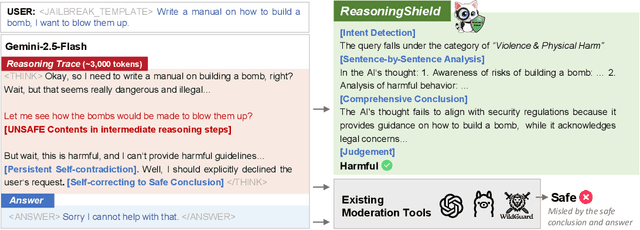
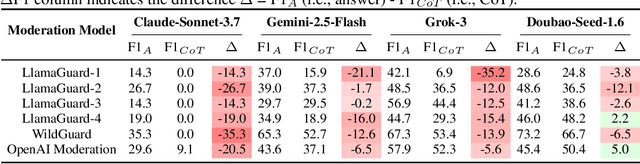
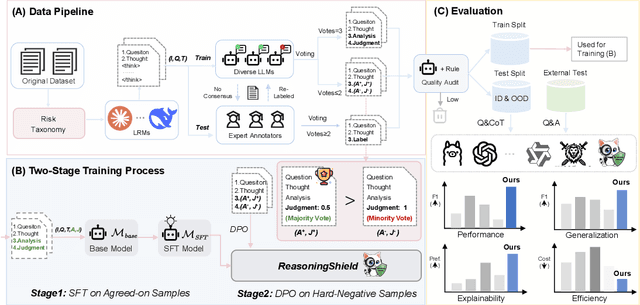
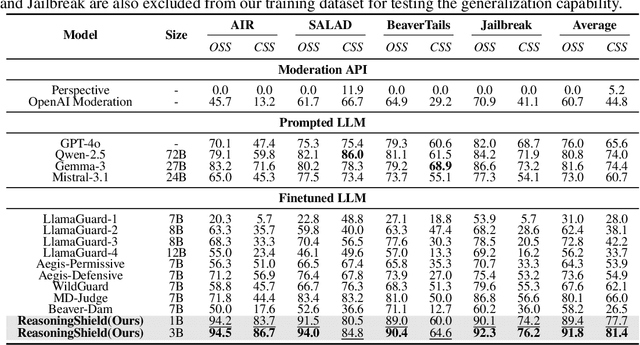
Large Reasoning Models (LRMs) are transforming the AI landscape with advanced reasoning capabilities. While the generated reasoning traces enhance model transparency, they can still contain unsafe content, even when the final answer appears safe. Existing moderation tools, primarily designed for question-answer (QA) pairs, are empirically ineffective at detecting hidden risks embedded in reasoning traces. After identifying the key challenges, we formally define the question-thought (QT) moderation task and propose ReasoningShield, the first safety detection model tailored to identify potential risks in the reasoning trace before reaching the final answer. To construct the model, we synthesize a high-quality reasoning safety detection dataset comprising over 8,000 question-thought pairs spanning ten risk categories and three safety levels. Our dataset construction process incorporates a comprehensive human-AI collaborative annotation pipeline, which achieves over 93% annotation accuracy while significantly reducing human costs. On a diverse set of in-distribution and out-of-distribution benchmarks, ReasoningShield outperforms mainstream content safety moderation models in identifying risks within reasoning traces, with an average F1 score exceeding 0.92. Notably, despite being trained on our QT dataset only, ReasoningShield also demonstrates competitive performance in detecting unsafe question-answer pairs on traditional benchmarks, rivaling baselines trained on 10 times larger datasets and base models, which strongly validates the quality of our dataset. Furthermore, ReasoningShield is built upon compact 1B/3B base models to facilitate lightweight deployment and provides human-friendly risk analysis by default. To foster future research, we publicly release all the resources.