 Add to Chrome
 Add to Firefox
 Add to Edge
TorchTraceAP: A New Benchmark Dataset for Detecting Performance Anti-Patterns in Computer Vision Models
Dec 16, 2025
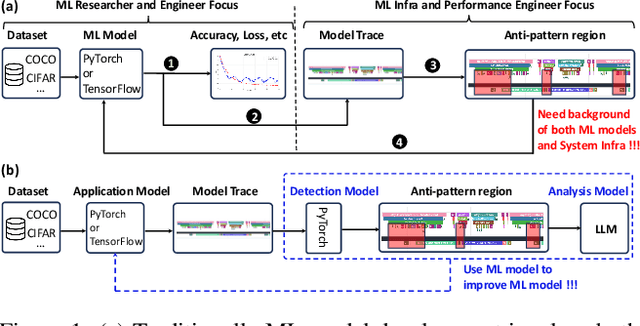
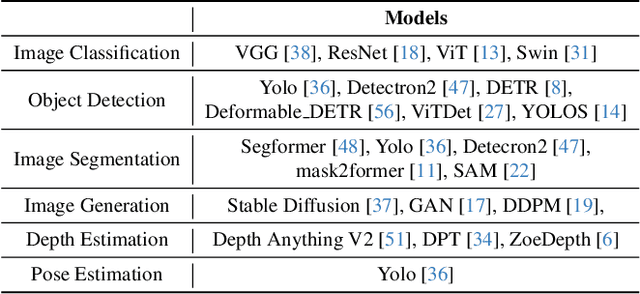
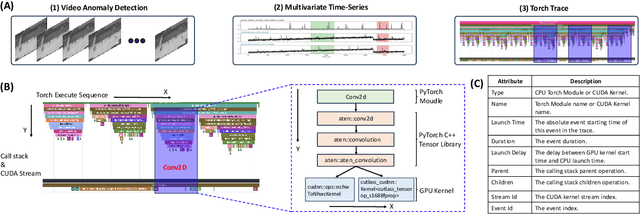
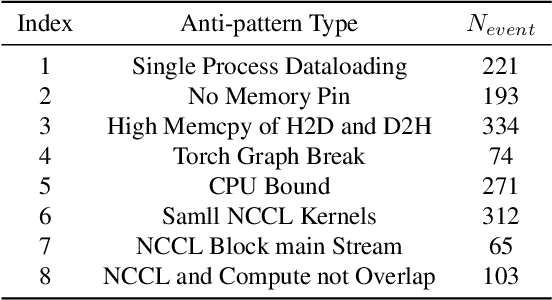
Identifying and addressing performance anti-patterns in machine learning (ML) models is critical for efficient training and inference, but it typically demands deep expertise spanning system infrastructure, ML models and kernel development. While large tech companies rely on dedicated ML infrastructure engineers to analyze torch traces and benchmarks, such resource-intensive workflows are largely inaccessible to computer vision researchers in general. Among the challenges, pinpointing problematic trace segments within lengthy execution traces remains the most time-consuming task, and is difficult to automate with current ML models, including LLMs. In this work, we present the first benchmark dataset specifically designed to evaluate and improve ML models' ability to detect anti patterns in traces. Our dataset contains over 600 PyTorch traces from diverse computer vision models classification, detection, segmentation, and generation collected across multiple hardware platforms. We also propose a novel iterative approach: a lightweight ML model first detects trace segments with anti patterns, followed by a large language model (LLM) for fine grained classification and targeted feedback. Experimental results demonstrate that our method significantly outperforms unsupervised clustering and rule based statistical techniques for detecting anti pattern regions. Our method also effectively compensates LLM's limited context length and reasoning inefficiencies.

Towards Universal Performance Modeling for Machine Learning Training on Multi-GPU Platforms
Apr 19, 2024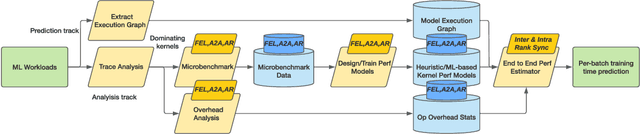
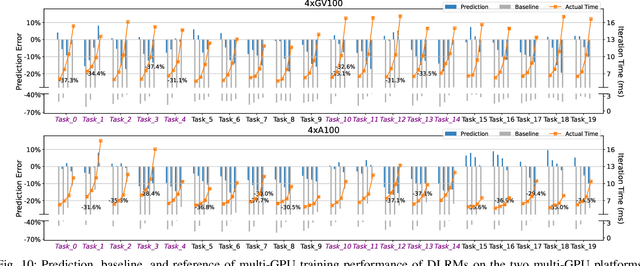
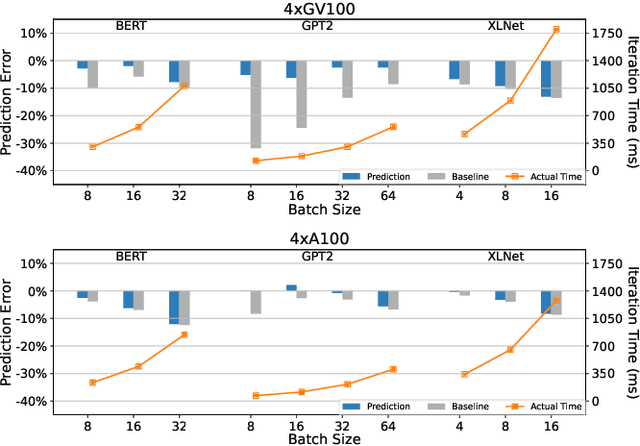
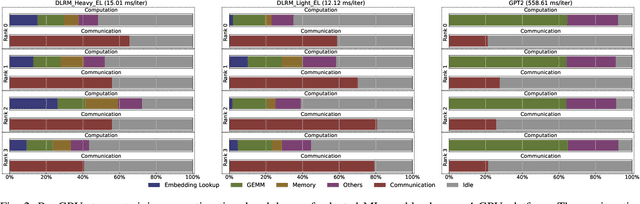
Characterizing and predicting the training performance of modern machine learning (ML) workloads on compute systems with compute and communication spread between CPUs, GPUs, and network devices is not only the key to optimization and planning but also a complex goal to achieve. The primary challenges include the complexity of synchronization and load balancing between CPUs and GPUs, the variance in input data distribution, and the use of different communication devices and topologies (e.g., NVLink, PCIe, network cards) that connect multiple compute devices, coupled with the desire for flexible training configurations. Built on top of our prior work for single-GPU platforms, we address these challenges and enable multi-GPU performance modeling by incorporating (1) data-distribution-aware performance models for embedding table lookup, and (2) data movement prediction of communication collectives, into our upgraded performance modeling pipeline equipped with inter-and intra-rank synchronization for ML workloads trained on multi-GPU platforms. Beyond accurately predicting the per-iteration training time of DLRM models with random configurations with a geomean error of 5.21% on two multi-GPU platforms, our prediction pipeline generalizes well to other types of ML workloads, such as Transformer-based NLP models with a geomean error of 3.00%. Moreover, even without actually running ML workloads like DLRMs on the hardware, it is capable of generating insights such as quickly selecting the fastest embedding table sharding configuration (with a success rate of 85%).