 Add to Chrome
 Add to Firefox
 Add to Edge
Agent-UCT: Upper Confidence Bounds Applied to Trees for Agentic Workflow Optimization with Cost-Awareness
Jul 27, 2026
Optimizing agentic workflows, such as retrieval-augmented generation (RAG) pipelines, requires navigating a combinatorial space of discrete component choices under tight evaluation budgets. Existing approaches - heuristic search, black-box optimization, and standard tree search methods - do not explicitly exploit the compositional structure of these workflows, leading to redundant computation and inefficient budget allocation. We introduce Agent-UCT (Agent-based Cost-Aware Upper Confidence Bounds Applied to Trees), a tree search algorithm that extends UCT with a reuse-aware regularization term derived from a bipartite prefix reuse graph. Agent-UCT biases selection toward branches that leverage previously materialized configuration prefixes, reducing redundant execution while maintaining effective exploration. Our framework, RAGSpace, unifies heterogeneous RAG components from LongRAG, LightRAG, and Self-RAG into a five-dimensional configuration space, enabling systematic cross-framework recombination. WTB (Workflow Test Bench) provides deterministic replay, content-addressable caching, and transactional consistency, ensuring that intermediate states are materialized once and reused across the search. Experiments on HotpotQA and UltraDomain demonstrate that Agent-UCT identifies configurations with the highest out-of-sample performance among the evaluated fixed framework presets. Under full-pool evaluation, bipartite prefix reuse reduces logical search cost by 73.6% relative to the no-prefix-sharing cost upper bound. Compared with full-pool evaluation, sampling-based evaluation further achieves a 4.2x wall-clock speedup. Agent-UCT, RAGSpace, and WTB together provide a unified framework for cost-aware, reproducible, and compositionally efficient agentic workflow optimization.

ViG-UNet: Vision Graph Neural Networks for Medical Image Segmentation
Jun 08, 2023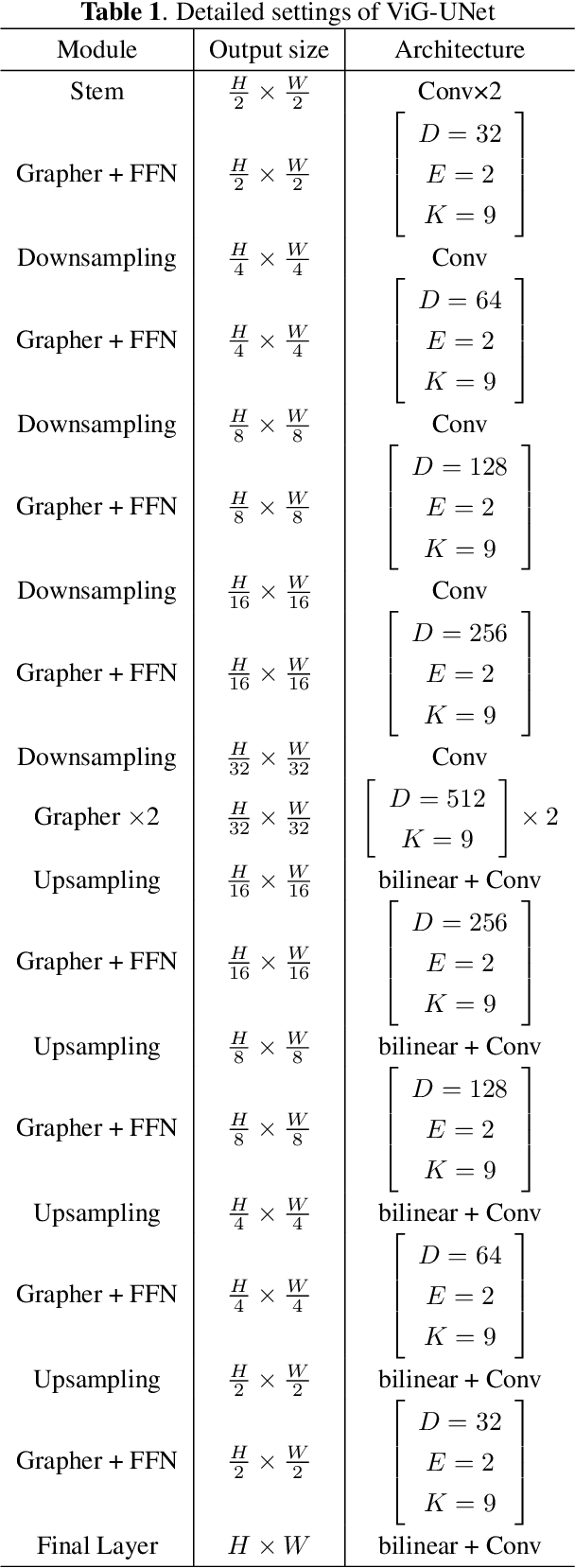
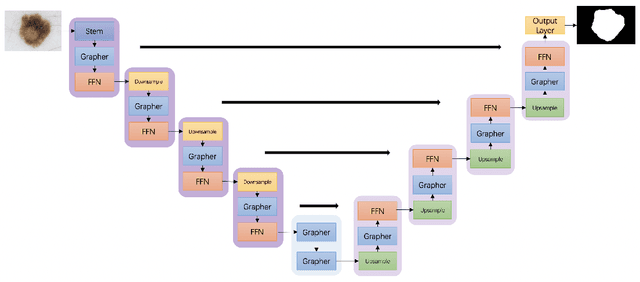

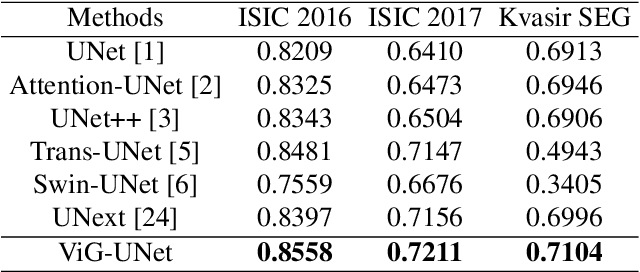
Deep neural networks have been widely used in medical image analysis and medical image segmentation is one of the most important tasks. U-shaped neural networks with encoder-decoder are prevailing and have succeeded greatly in various segmentation tasks. While CNNs treat an image as a grid of pixels in Euclidean space and Transformers recognize an image as a sequence of patches, graph-based representation is more generalized and can construct connections for each part of an image. In this paper, we propose a novel ViG-UNet, a graph neural network-based U-shaped architecture with the encoder, the decoder, the bottleneck, and skip connections. The downsampling and upsampling modules are also carefully designed. The experimental results on ISIC 2016, ISIC 2017 and Kvasir-SEG datasets demonstrate that our proposed architecture outperforms most existing classic and state-of-the-art U-shaped networks.