 Add to Chrome
 Add to Firefox
 Add to Edge
LifelongCrossNav: Persistent 3D Semantic Memory for Cross-Floor Multi-Object Navigation
Aug 07, 2026
Object-goal navigation has made substantial progress in semantic perception and exploration, yet persistent memory for multi-object navigation and cross-floor navigation are still commonly addressed separately. We present LifelongCrossNav, a framework for sequential multi-object ObjectNav in unknown multi-floor indoor environments. Within each episode, the agent receives an ordered sequence of object-goal queries while continuously maintaining a shared sparse 3D semantic voxel memory. This memory incrementally accumulates geometric structure, traversability states, and vision-language features, allowing subsequent object-goal queries to retrieve previously acquired scene information without rebuilding the map. To support persistent search across floors, LifelongCrossNav combines support-aware 3D traversability mapping, stair-specific perception, and direction-aware stair traversal. A unified navigation policy coordinates same-floor frontier exploration, live and historical point-of-interest retrieval, stair navigation, and target-object search and approach. We further introduce HM3D-MFMON, a benchmark for sequential Multi-Floor Multi-Object Navigation built on HM3D scenes, including a dedicated subset in which completing the full sequence of object-goal subtasks requires at least one floor transition. Experimental results show that LifelongCrossNav consistently outperforms a representative planar persistent semantic-map baseline on HM3D-MFMON, demonstrating that persistent 3D semantic memory and cross-floor traversability modeling effectively support sequential multi-object navigation in multi-floor environments. Project page: https://flageval-baai.github.io/LifelongCrossNavPage.

Depth-Assisted ResiDualGAN for Cross-Domain Aerial Images Semantic Segmentation
Aug 27, 2022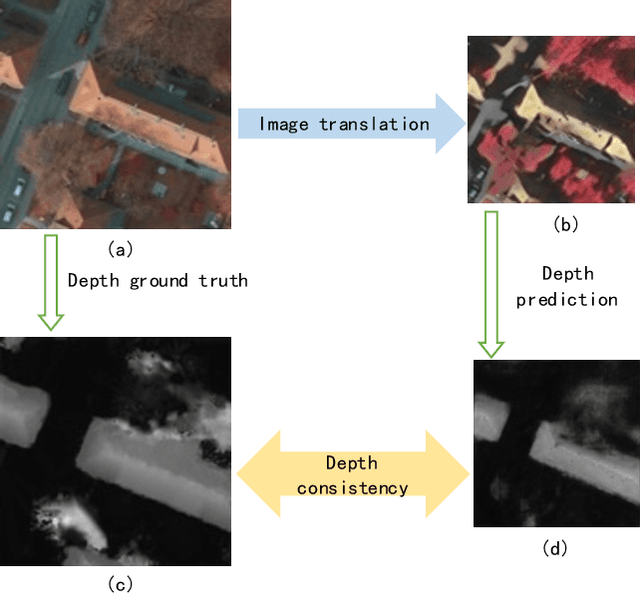
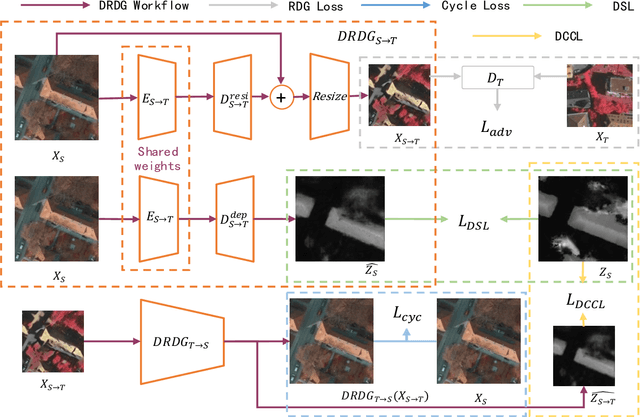
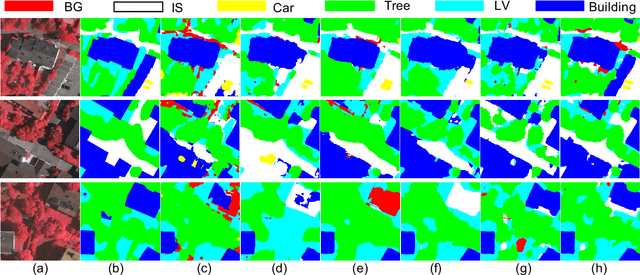
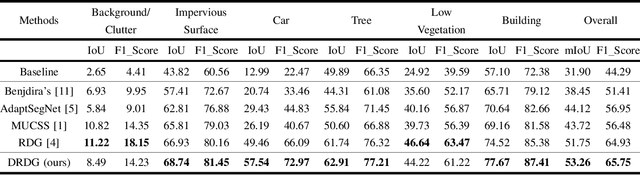
Unsupervised domain adaptation (UDA) is an approach to minimizing domain gap. Generative methods are common approaches to minimizing the domain gap of aerial images which improves the performance of the downstream tasks, e.g., cross-domain semantic segmentation. For aerial images, the digital surface model (DSM) is usually available in both the source domain and the target domain. Depth information in DSM brings external information to generative models. However, little research utilizes it. In this paper, depth-assisted ResiDualGAN (DRDG) is proposed where depth supervised loss (DSL), and depth cycle consistency loss (DCCL) are used to bring depth information into the generative model. Experimental results show that DRDG reaches state-of-the-art accuracy between generative methods in cross-domain semantic segmentation tasks.