 Add to Chrome
 Add to Firefox
 Add to Edge
Sequential Hiring of Contingent Workers Through Learning-Based Optimization
Jun 16, 2026
In this paper, we study a sequential workforce management problem in a contingent labor setting with uncertainty in both worker production and labor supply. A firm seeks to maximize cumulative profit by maintaining an active team of fixed size while learning worker productivity over time. We emphasize two critical operational frictions in this problem: replacing workers is costly, and workers may not be available immediately for hiring because of, for example, prior job commitments, scheduling constraints, or onboarding procedures. Thus, hiring decisions take effect only after a random delay. We formulate this problem as a stochastic multi-play bandit with costly switching and delayed actions, and develop a learning-based hiring policy, DR-UCB (DelayedReplacement-UCB), that makes replacement and hiring decisions sequentially through learning cycles. In each cycle, the policy uses real-time production data to determine when to initiate workforce changes and which workers to replace and hire. We show that the leading-order regret of the proposed policy matches its lower bound in its dependence on the time horizon. Our numerical experiments show that DR-UCB outperforms benchmark policies.

Context-Based Dynamic Pricing with Online Clustering
Feb 17, 2019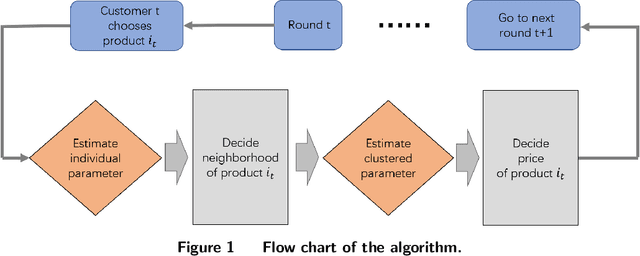

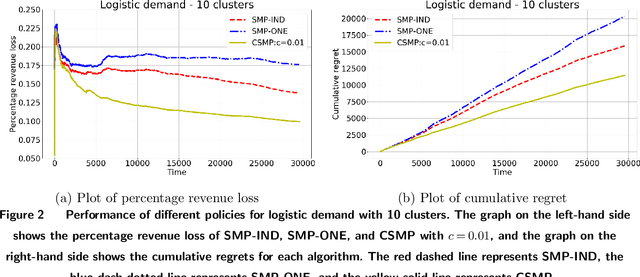
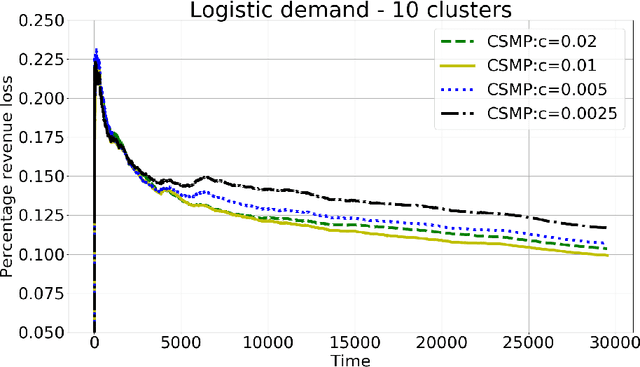
We consider a context-based dynamic pricing problem of online products which have low sales. Sales data from Alibaba, a major global online retailer, illustrate the prevalence of low-sale products. For these products, existing single-product dynamic pricing algorithms do not work well due to insufficient data samples. To address this challenge, we propose pricing policies that concurrently perform clustering over products and set individual pricing decisions on the fly. By clustering data and identifying products that have similar demand patterns, we utilize sales data from products within the same cluster to improve demand estimation and allow for better pricing decisions. We evaluate the algorithms using the regret, and the result shows that when product demand functions come from multiple clusters, our algorithms significantly outperform traditional single-product pricing policies. Numerical experiments using a real dataset from Alibaba demonstrate that the proposed policies, compared with several benchmark policies, increase the revenue. The results show that online clustering is an effective approach to tackling dynamic pricing problems associated with low-sale products. Our algorithms were further implemented in a field study at Alibaba with 40 products for 30 consecutive days, and compared to the products which use business-as-usual pricing policy of Alibaba. The results from the field experiment show that the overall revenue increased by 10.14%.