 Add to Chrome
 Add to Firefox
 Add to Edge
U-Define: Designing User Workflows for Hard and Soft Constraints in LLM-Based Planning
May 04, 2026
LLMs are increasingly used for end-user task planning, yet their black-box nature limits users' ability to ensure reliability and control. While recent systems incorporate verification techniques, it remains unclear how users can effectively apply such rigid constraints to represent intent or adapt to real-world variability. For example, prior work finds that hard-only constraints are too rigid, and numeric flexibility weights confuse users. We investigate how interaction workflows can better support users in applying constraints to guide LLM-generated plans, examining whether abstracting strictness into high-level types (i.e., hard and soft) paired with distinct verification mechanisms helps users more reliably express and align intent. We present U-Define, a system that lets users define constraints in natural language and categorize them as either hard rules that must not be violated or soft preferences that allow flexibility. U-Define verifies these types through complementary methods: formal model checking for hard constraints and LLM-as-judge evaluation for soft ones. Through a technical evaluation and user studies with general and expert participants, we find that user-defined constraint types improve perceived usefulness, performance, and satisfaction while maintaining usability. These findings provide insights for designing flexible yet reliable constraint-based workflows.

The Long-Horizon Task Mirage? Diagnosing Where and Why Agentic Systems Break
Apr 13, 2026Large language model (LLM) agents perform strongly on short- and mid-horizon tasks, but often break down on long-horizon tasks that require extended, interdependent action sequences. Despite rapid progress in agentic systems, these long-horizon failures remain poorly characterized, hindering principled diagnosis and comparison across domains. To address this gap, we introduce HORIZON, an initial cross-domain diagnostic benchmark for systematically constructing tasks and analyzing long-horizon failure behaviors in LLM-based agents. Using HORIZON, we evaluate state-of-the-art (SOTA) agents from multiple model families (GPT-5 variants and Claude models), collecting 3100+ trajectories across four representative agentic domains to study horizon-dependent degradation patterns. We further propose a trajectory-grounded LLM-as-a-Judge pipeline for scalable and reproducible failure attribution, and validate it with human annotation on trajectories, achieving strong agreement (inter-annotator κ=0.61; human-judge κ=0.84). Our findings offer an initial methodological step toward systematic, cross-domain analysis of long-horizon agent failures and offer practical guidance for building more reliable long-horizon agents. We release our project website at \href{https://xwang2775.github.io/horizon-leaderboard/}{HORIZON Leaderboard} and welcome contributions from the community.
VeriPlan: Integrating Formal Verification and LLMs into End-User Planning
Feb 25, 2025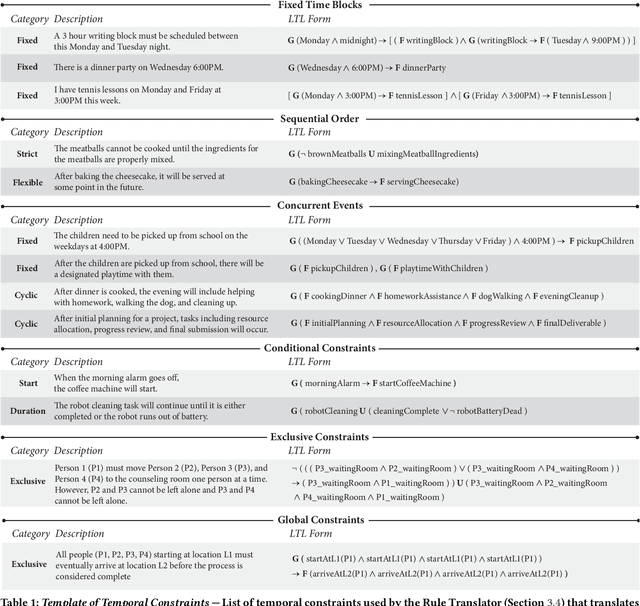
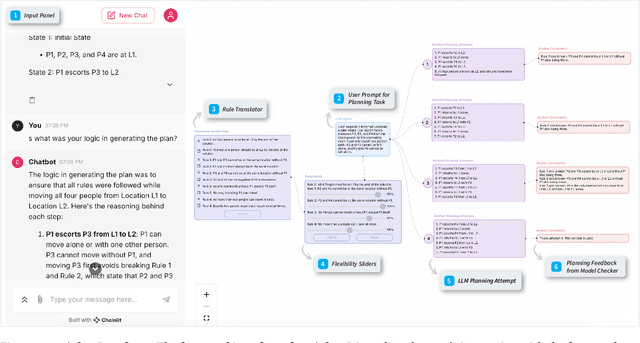
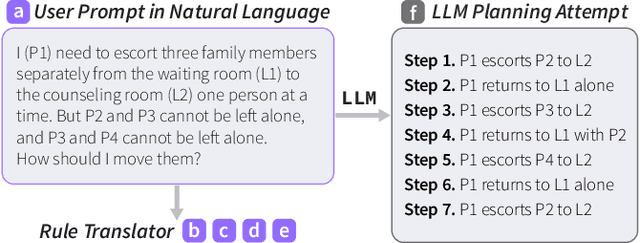
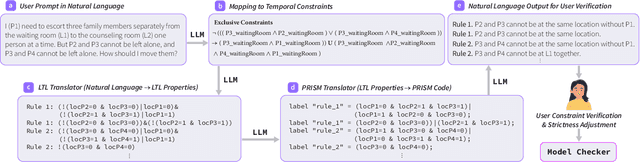
Automated planning is traditionally the domain of experts, utilized in fields like manufacturing and healthcare with the aid of expert planning tools. Recent advancements in LLMs have made planning more accessible to everyday users due to their potential to assist users with complex planning tasks. However, LLMs face several application challenges within end-user planning, including consistency, accuracy, and user trust issues. This paper introduces VeriPlan, a system that applies formal verification techniques, specifically model checking, to enhance the reliability and flexibility of LLMs for end-user planning. In addition to the LLM planner, VeriPlan includes three additional core features -- a rule translator, flexibility sliders, and a model checker -- that engage users in the verification process. Through a user study (n=12), we evaluate VeriPlan, demonstrating improvements in the perceived quality, usability, and user satisfaction of LLMs. Our work shows the effective integration of formal verification and user-control features with LLMs for end-user planning tasks.