 Add to Chrome
 Add to Firefox
 Add to Edge
SPECTRA: State-Space Exogenous Context and Temporal-Frequency Resolution Architecture for Probabilistic Energy Forecasting
Jul 22, 2026
Modern power systems increasingly require probabilistic forecasts amid interacting uncertainties from renewable intermittency, flexible demand, market volatility, and weather-dependent generation. However, existing methods often treat multi-scale decomposition, exogenous-variable alignment, and probabilistic output as separate steps, obscuring how predictable structures and uncertainty-bearing fluctuations jointly shape the forecast distribution. This paper proposes a state-space exogenous-context and temporal-frequency resolution architecture for general probabilistic energy forecasting. Its central premise is that trend-periodic components primarily determine the baseline trajectory, whereas high-frequency residuals and external perturbations govern the spread and asymmetry of forecast uncertainty. Accordingly, the architecture adaptively separates deterministic and residual streams, aligns exogenous context with both, refines the deterministic backbone through multi-resolution spectral-temporal state-space modeling, and estimates ordered quantile boundaries from their complementary representations. Experiments on load, price, solar, and wind forecasting achieve the best continuous ranked probability score in 14 of 18 settings, reducing average CRPS by 5.74\% and upper-tail quantile risk by 7.27\% over the strongest baselines. These results support deterministic-stochastic separation as an effective design principle for general probabilistic energy forecasting.

Prefill-Time Intervention for Mitigating Hallucination in Large Vision-Language Models
Apr 28, 2026Large Vision-Language Models (LVLMs) have achieved remarkable progress in visual-textual understanding, yet their reliability is critically undermined by hallucinations, i.e., the generation of factually incorrect or inconsistent responses. While recent studies using steering vectors demonstrated promise in reducing hallucinations, a notable challenge remains: they inadvertently amplify the severity of residual hallucinations. We attribute this to their exclusive focus on the decoding stage, where errors accumulate autoregressively and progressively worsen subsequent hallucinatory outputs. To address this, we propose Prefill-Time Intervention (PTI), a novel steering paradigm that intervenes only once during the prefill stage, enhancing the initial Key-Value (KV) cache before error accumulation occurs. Specifically, PTI is modality-aware, deriving distinct directions for visual and textual representations. This intervention is decoupled to steer keys toward visually-grounded objects and values to filter background noise, correcting hallucination-prone representations at their source. Extensive experiments demonstrate PTI's significant performance in mitigating hallucinations and its generalizability across diverse decoding strategies, LVLMs, and benchmarks. Moreover, PTI is orthogonal to existing decoding-stage methods, enabling plug-and-play integration and further boosting performance. Code is available at: https://github.com/huaiyi66/PTI.
Global Evolutionary Steering: Refining Activation Steering Control via Cross-Layer Consistency
Mar 12, 2026Activation engineering enables precise control over Large Language Models (LLMs) without the computational cost of fine-tuning. However, existing methods deriving vectors from static activation differences are susceptible to high-dimensional noise and layer-wise semantic drift, often capturing spurious correlations rather than the target intent. To address this, we propose Global Evolutionary Refined Steering (GER-steer), a training-free framework that grounded in the geometric stability of the network's representation evolution. GER-steer exploits this global signal to rectify raw steering vectors, effectively decoupling robust semantic intent from orthogonal artifacts. Extensive evaluations confirm that GER-steer consistently outperforms baselines, delivering superior efficacy and generalization without layer-specific tuning, establishing a universal solution for reliable model alignment.
Beyond Scalars: Evaluating and Understanding LLM Reasoning via Geometric Progress and Stability
Mar 11, 2026Evaluating LLM reliability via scalar probabilities often fails to capture the structural dynamics of reasoning. We introduce TRACED, a framework that assesses reasoning quality through theoretically grounded geometric kinematics. By decomposing reasoning traces into Progress (displacement) and Stability (curvature), we reveal a distinct topological divergence: correct reasoning manifests as high-progress, stable trajectories, whereas hallucinations are characterized by low-progress, unstable patterns (stalled displacement with high curvature fluctuations). Leveraging these signatures, our probabilistic framework achieves competitive performance and superior robustness across diverse benchmarks. Crucially, TRACED bridges geometry and cognition by mapping high curvature to ''Hesitation Loops'' and displacement to ''Certainty Accumulation'', offering a physical lens to decode the internal dynamics of machine thought.
HICD: Hallucination-Inducing via Attention Dispersion for Contrastive Decoding to Mitigate Hallucinations in Large Language Models
Mar 17, 2025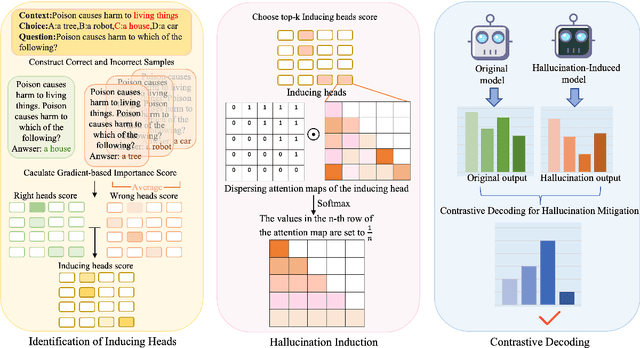
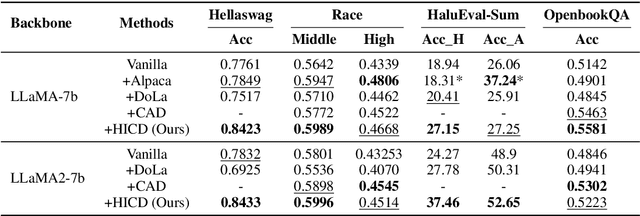
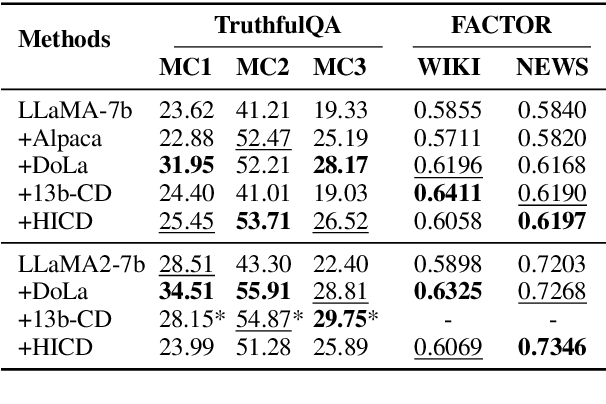
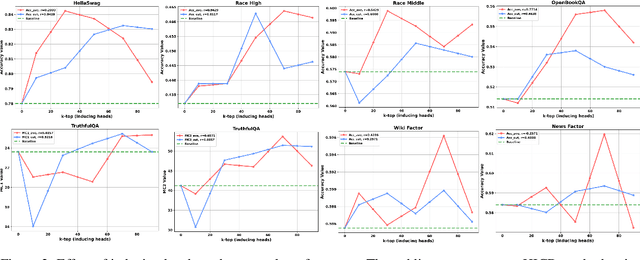
Large Language Models (LLMs) often generate hallucinations, producing outputs that are contextually inaccurate or factually incorrect. We introduce HICD, a novel method designed to induce hallucinations for contrastive decoding to mitigate hallucinations. Unlike existing contrastive decoding methods, HICD selects attention heads crucial to the model's prediction as inducing heads, then induces hallucinations by dispersing attention of these inducing heads and compares the hallucinated outputs with the original outputs to obtain the final result. Our approach significantly improves performance on tasks requiring contextual faithfulness, such as context completion, reading comprehension, and question answering. It also improves factuality in tasks requiring accurate knowledge recall. We demonstrate that our inducing heads selection and attention dispersion method leads to more "contrast-effective" hallucinations for contrastive decoding, outperforming other hallucination-inducing methods. Our findings provide a promising strategy for reducing hallucinations by inducing hallucinations in a controlled manner, enhancing the performance of LLMs in a wide range of tasks.