 Add to Chrome
 Add to Firefox
 Add to Edge
Interpreting and Enhancing Emotional Circuits in Large Vision-Language Models via Cross-Modal Information Flow
May 21, 2026
Large Vision-Language Models (LVLMs) represent a significant leap towards empathetic agents, demonstrating remarkable capabilities in emotion understanding. However, the internal mechanisms governing how LVLMs translate abstract visual stimuli into coherent emotional narratives remain largely unexplored, primarily due to the scarcity of visual counterfactuals and the diffuse nature of emotional expression. In this paper, we bridge this gap by introducing a steering-vector-based causal attribution framework tailored for descriptive emotional reasoning. To this end, we construct a specialized dataset to demystify the emotional circuits underlying the three-stage ``Adapt-Aggregate-Execute'' mechanism. Crucially, we discover a functional decoupling: visual emotional cues are aggregated in middle layers via sentiment-specific attention heads, but are subsequently translated into narrative generation in deep layers through emotion-general pathways. Guided by these insights, we regulate the emotional information routing to strengthen attention flow and amplify the semantic activation to consolidate expression. Extensive experiments on the comprehensive MER-UniBench demonstrate that our methods significantly improve performance via inference-time intervention, effectively mitigating emotional hallucinations and corroborating the causal fidelity of the discovered circuits.

Prefill-Time Intervention for Mitigating Hallucination in Large Vision-Language Models
Apr 28, 2026Large Vision-Language Models (LVLMs) have achieved remarkable progress in visual-textual understanding, yet their reliability is critically undermined by hallucinations, i.e., the generation of factually incorrect or inconsistent responses. While recent studies using steering vectors demonstrated promise in reducing hallucinations, a notable challenge remains: they inadvertently amplify the severity of residual hallucinations. We attribute this to their exclusive focus on the decoding stage, where errors accumulate autoregressively and progressively worsen subsequent hallucinatory outputs. To address this, we propose Prefill-Time Intervention (PTI), a novel steering paradigm that intervenes only once during the prefill stage, enhancing the initial Key-Value (KV) cache before error accumulation occurs. Specifically, PTI is modality-aware, deriving distinct directions for visual and textual representations. This intervention is decoupled to steer keys toward visually-grounded objects and values to filter background noise, correcting hallucination-prone representations at their source. Extensive experiments demonstrate PTI's significant performance in mitigating hallucinations and its generalizability across diverse decoding strategies, LVLMs, and benchmarks. Moreover, PTI is orthogonal to existing decoding-stage methods, enabling plug-and-play integration and further boosting performance. Code is available at: https://github.com/huaiyi66/PTI.
Weight Patching: Toward Source-Level Mechanistic Localization in LLMs
Apr 15, 2026Mechanistic interpretability seeks to localize model behavior to the internal components that causally realize it. Prior work has advanced activation-space localization and causal tracing, but modules that appear important in activation space may merely aggregate or amplify upstream signals rather than encode the target capability in their own parameters. To address this gap, we propose Weight Patching, a parameter-space intervention method for source-oriented analysis in paired same-architecture models that differ in how strongly they express a target capability under the inputs of interest. Given a base model and a behavior-specialized counterpart, Weight Patching replaces selected module weights from the specialized model into the base model under a fixed input. We instantiate the method on instruction following and introduce a framework centered on a vector-anchor behavioral interface that provides a shared internal criterion for whether a task-relevant control state has been formed or recovered in open-ended generation. Under this framework, the analysis reveals a hierarchy from shallow candidate source-side carriers to aggregation and routing modules, and further to downstream execution circuits. The recovered component scores can also guide mechanism-aware model merging, improving selective fusion across the evaluated expert combinations and providing additional external validation.
HUR-MACL: High-Uncertainty Region-Guided Multi-Architecture Collaborative Learning for Head and Neck Multi-Organ Segmentation
Jan 08, 2026Accurate segmentation of organs at risk in the head and neck is essential for radiation therapy, yet deep learning models often fail on small, complexly shaped organs. While hybrid architectures that combine different models show promise, they typically just concatenate features without exploiting the unique strengths of each component. This results in functional overlap and limited segmentation accuracy. To address these issues, we propose a high uncertainty region-guided multi-architecture collaborative learning (HUR-MACL) model for multi-organ segmentation in the head and neck. This model adaptively identifies high uncertainty regions using a convolutional neural network, and for these regions, Vision Mamba as well as Deformable CNN are utilized to jointly improve their segmentation accuracy. Additionally, a heterogeneous feature distillation loss was proposed to promote collaborative learning between the two architectures in high uncertainty regions to further enhance performance. Our method achieves SOTA results on two public datasets and one private dataset.
Advancing H&E-to-IHC Stain Translation in Breast Cancer: A Multi-Magnification and Attention-Based Approach
Aug 04, 2024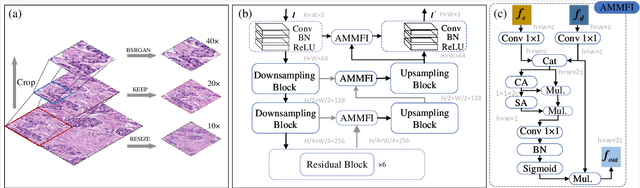
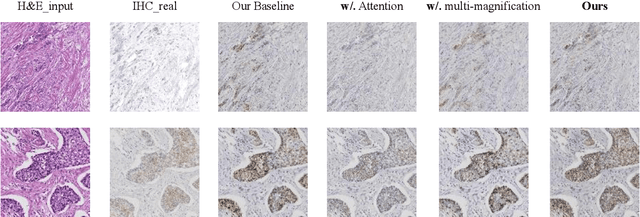

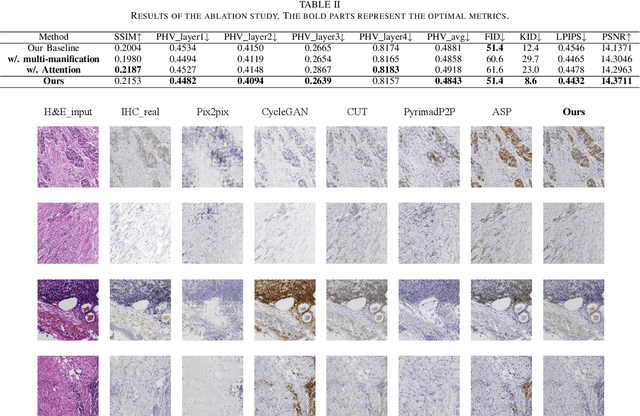
Breast cancer presents a significant healthcare challenge globally, demanding precise diagnostics and effective treatment strategies, where histopathological examination of Hematoxylin and Eosin (H&E) stained tissue sections plays a central role. Despite its importance, evaluating specific biomarkers like Human Epidermal Growth Factor Receptor 2 (HER2) for personalized treatment remains constrained by the resource-intensive nature of Immunohistochemistry (IHC). Recent strides in deep learning, particularly in image-to-image translation, offer promise in synthesizing IHC-HER2 slides from H\&E stained slides. However, existing methodologies encounter challenges, including managing multiple magnifications in pathology images and insufficient focus on crucial information during translation. To address these issues, we propose a novel model integrating attention mechanisms and multi-magnification information processing. Our model employs a multi-magnification processing strategy to extract and utilize information from various magnifications within pathology images, facilitating robust image translation. Additionally, an attention module within the generative network prioritizes critical information for image distribution translation while minimizing less pertinent details. Rigorous testing on a publicly available breast cancer dataset demonstrates superior performance compared to existing methods, establishing our model as a state-of-the-art solution in advancing pathology image translation from H&E to IHC staining.