 Add to Chrome
 Add to Firefox
 Add to Edge
Listening to the Echo: User-Reaction Aware Policy Optimization via Scalar-Verbal Hybrid Reinforcement Learning
Mar 16, 2026
While current emotional support dialogue systems typically rely on expert-defined scalar rewards for alignment, these signals suffer from severe information sparsity. They cannot explain why a response failed or how to adapt to dynamic user states, often diverging from the actual goal of facilitating positive emotional shifts. In practice, the most direct and reliable learning signal emerges from the user's continuous reactions during ongoing interaction. We therefore propose Reaction Aware Policy Optimization (RAPO), a framework that optimizes over interaction consequences rather than rubric scores. RAPO treats dialogue as a reaction-driven process and utilizes simulated user responses to generate dense natural-language feedback through three core components: Hindsight Dialogue Selection, which isolates pivotal turns that meaningfully alter user emotional trajectories; Generative Hindsight Feedback, which transforms user reactions into contrastive ranking signals and natural-language critiques; and Scalar-Verbal Hybrid Policy Optimization, which couples scalar reward optimization for global alignment with verbal feedback distillation for fine-grained semantic refinement. Extensive experiments on ESC and Sotopia demonstrate that RAPO significantly outperforms strong reinforcement learning baselines in driving positive interaction outcomes.

ALIVE: Awakening LLM Reasoning via Adversarial Learning and Instructive Verbal Evaluation
Feb 05, 2026The quest for expert-level reasoning in Large Language Models (LLMs) has been hampered by a persistent \textit{reward bottleneck}: traditional reinforcement learning (RL) relies on scalar rewards that are \textbf{costly} to scale, \textbf{brittle} across domains, and \textbf{blind} to the underlying logic of a solution. This reliance on external, impoverished signals prevents models from developing a deep, self-contained understanding of reasoning principles. We introduce \textbf{ALIVE} (\emph{Adversarial Learning with Instructive Verbal Evaluation}), a hands-free alignment framework that moves beyond scalar reward optimization toward intrinsic reasoning acquisition. Grounded in the principle of \emph{Cognitive Synergy}, ALIVE unifies problem posing, solving, and judging within a single policy model to internalize the logic of correctness. By coupling adversarial learning with instructive verbal feedback, ALIVE enables models to internalize evaluative criteria directly from raw corpora, effectively transforming external critiques into an endogenous reasoning faculty. Empirical evaluations across mathematical reasoning, code generation, and general logical inference benchmarks demonstrate that ALIVE consistently mitigates reward signal limitations. With identical data and compute, it achieves accuracy gains, markedly improved cross-domain generalization, and higher self-correction rates. These results indicate that the reasoning trinity fosters a self-sustaining trajectory of capability growth, positioning ALIVE as a scalable foundation for general-purpose reasoning alignment without human-in-the-loop supervision.
MapGuide: A Simple yet Effective Method to Reconstruct Continuous Language from Brain Activities
Apr 02, 2024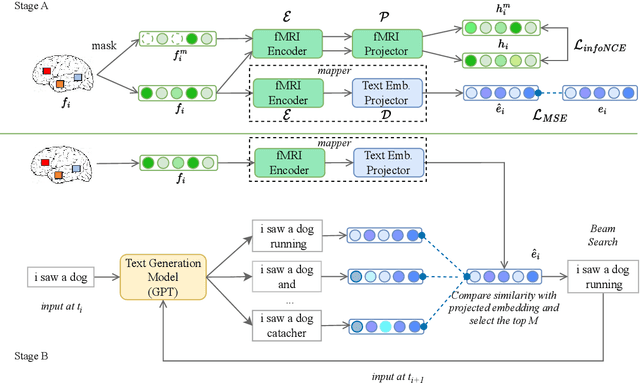
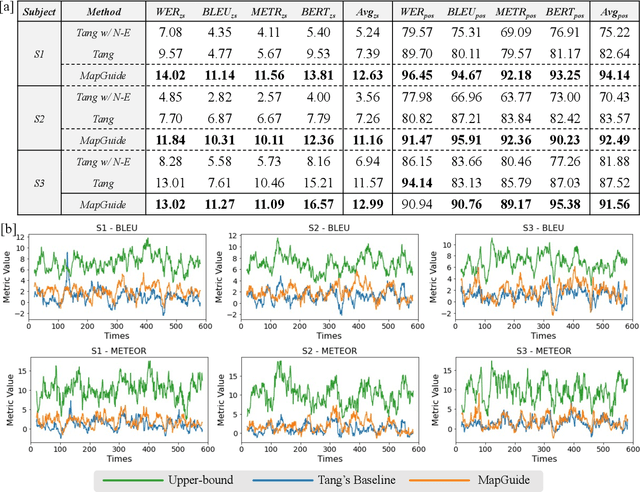
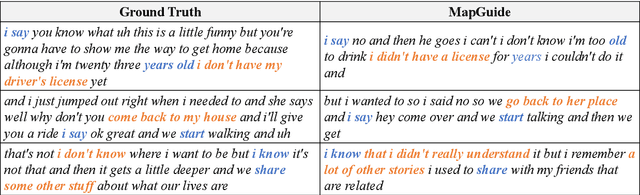
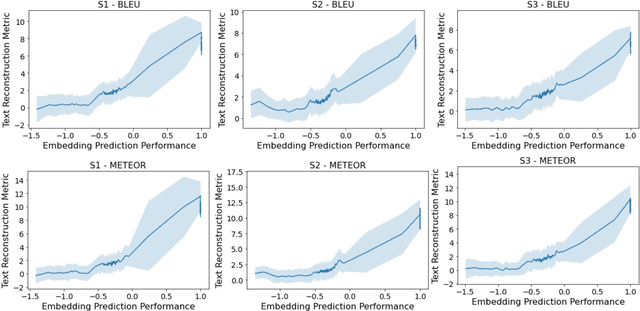
Decoding continuous language from brain activity is a formidable yet promising field of research. It is particularly significant for aiding people with speech disabilities to communicate through brain signals. This field addresses the complex task of mapping brain signals to text. The previous best attempt reverse-engineered this process in an indirect way: it began by learning to encode brain activity from text and then guided text generation by aligning with predicted brain responses. In contrast, we propose a simple yet effective method that guides text reconstruction by directly comparing them with the predicted text embeddings mapped from brain activities. Comprehensive experiments reveal that our method significantly outperforms the current state-of-the-art model, showing average improvements of 77% and 54% on BLEU and METEOR scores. We further validate the proposed modules through detailed ablation studies and case analyses and highlight a critical correlation: the more precisely we map brain activities to text embeddings, the better the text reconstruction results. Such insight can simplify the task of reconstructing language from brain activities for future work, emphasizing the importance of improving brain-to-text-embedding mapping techniques.