 Add to Chrome
 Add to Firefox
 Add to Edge
MUSE: Agentic 3D Scene Authoring via Memory-Grounded Incremental Requirement Satisfaction
Jun 12, 2026
Text-driven 3D scene generation is a promising technique for digital content creation, embodied AI simulation, and interactive design, yet practical workflows often require refining, extending, or correcting existing scenes while preserving non-target content. Existing methods can produce realistic and structurally plausible scenes, but they generally lack editability with requirement-level state tracking, so part-level failures often lead to full-scene regeneration or manual intervention. To tackle this challenge, we formulate controllable 3D scene authoring as incremental requirement satisfaction, unifying construction and editing. In this paper, we present MUSE, a memory-grounded multi-agent framework in which an Architect compiles instructions into structured requirements, a Sculptor executes local scene operations, and an Inspector verifies each step while updating Working, Scene, and Skill Memory. To evaluate requirement-level controllability and preservation-aware editing, we introduce AuthorBench, offering 145 constrained construction cases and a 1,584-case preservation-aware editing pool paired with external structured checks. On full construction cases, MUSE improves All-Goal success from 37.9 to 80.7 and surface-constraint fulfillment from 35.0 to 92.6 over the strongest baseline. On a stratified 240-case editing test split, MUSE achieves 49.6 All-Goal success, 99.9 preservation rate, and only 0.6 unintended change rate. Beyond automated metrics, human evaluations on compared local-editing baselines support stronger alignment with user intent, and downstream navigation-proxy tests indicate stronger spatial stability. Combined with ablations validating our memory designs, these results establish MUSE as an effective framework for controllable 3D scene authoring.

JointEdit3D: Feed-Forward 3D Scene Editing in a Unified Latent Space
Jun 11, 2026Existing 3D scene editing methods typically rely on per-scene optimization over explicit 3D representations or cascaded edit-and-reconstruct pipelines, resulting in high test-time cost, limited 3D awareness, and structural inconsistencies. To couple appearance synthesis and geometry prediction during editing, we build on a unified RGB-geometry reconstruction-generation latent space and adapt it to feed-forward 3D scene editing. The resulting framework, \textbf{JointEdit3D}, performs asymmetric latent inpainting by observing only a single edited RGB reference latent and generating the remaining RGB views and edited geometry latent under source-scene anchoring. JointEdit3D introduces a dedicated SceneAnchor Branch to inject source-scene structure without forcing direct copying, and adopts edit/background-aware losses to balance edited-region fidelity with unedited-content preservation. To address the lack of paired resources for standardized 3D scene editing evaluation, we introduce SceneEdit3D-15K, a dataset with 15K paired editing samples and renderer-provided 3D annotations, together with SceneEdit3D-Bench, a curated 100-sample benchmark. Experiments show that JointEdit3D improves edited-region quality and 3D structural completeness over prior baselines while maintaining competitive background preservation.
FDDet: Frequency-Decoupling for Boundary Refinement in Temporal Action Detection
Apr 01, 2025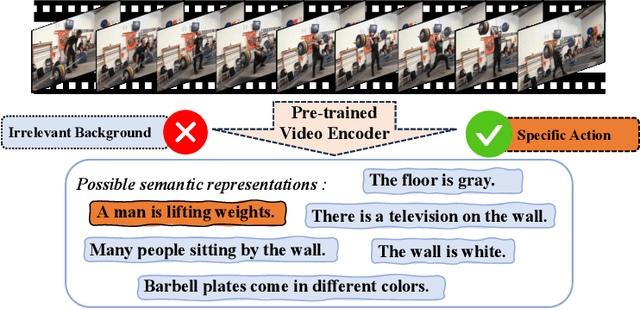
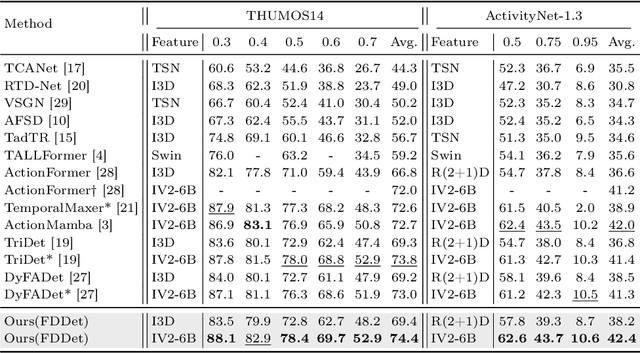
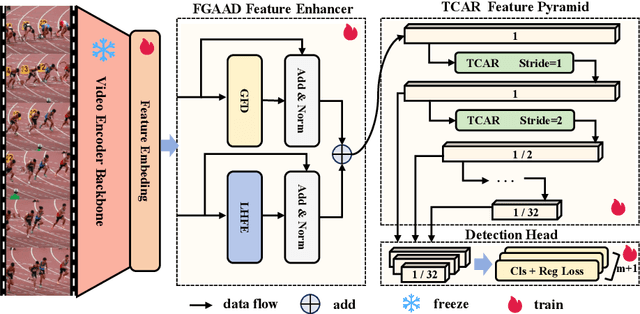
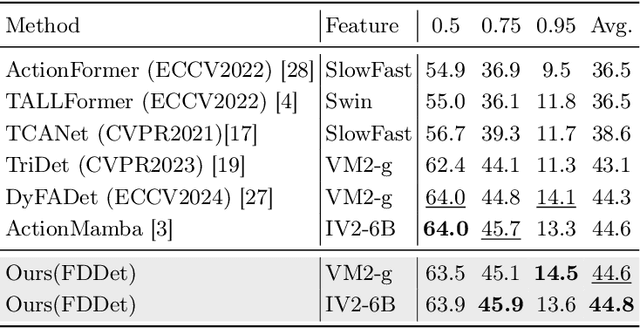
Temporal action detection aims to locate and classify actions in untrimmed videos. While recent works focus on designing powerful feature processors for pre-trained representations, they often overlook the inherent noise and redundancy within these features. Large-scale pre-trained video encoders tend to introduce background clutter and irrelevant semantics, leading to context confusion and imprecise boundaries. To address this, we propose a frequency-aware decoupling network that improves action discriminability by filtering out noisy semantics captured by pre-trained models. Specifically, we introduce an adaptive temporal decoupling scheme that suppresses irrelevant information while preserving fine-grained atomic action details, yielding more task-specific representations. In addition, we enhance inter-frame modeling by capturing temporal variations to better distinguish actions from background redundancy. Furthermore, we present a long-short-term category-aware relation network that jointly models local transitions and long-range dependencies, improving localization precision. The refined atomic features and frequency-guided dynamics are fed into a standard detection head to produce accurate action predictions. Extensive experiments on THUMOS14, HACS, and ActivityNet-1.3 show that our method, powered by InternVideo2-6B features, achieves state-of-the-art performance on temporal action detection benchmarks.